Before you approve remote-worker travel, check where the employee will work and review reimbursements separately from payroll taxes. We recommend confirming the destination, workdays, business purpose, and expected costs before booking. In some jurisdictions, one workday can trigger withholding, so a short trip can still create extra payroll costs.
For your finance, HR, and hiring teams, we suggest three checks:
- Classify the trip: Separate business travel from commuting, personal travel, and a permanent work-location change.
- Assign owners: Give expense approval, payroll review, and location records clear deadlines and named owners.
- Check what happened: Match actual workdays and expenses to approved records, then correct errors before they lead to more rework.
Tax-free reimbursement does not remove payroll duties. We also recommend <u>approving new work locations before making hiring or relocation commitments</u>, so your team can plan costs and avoid preventable start-date delays.
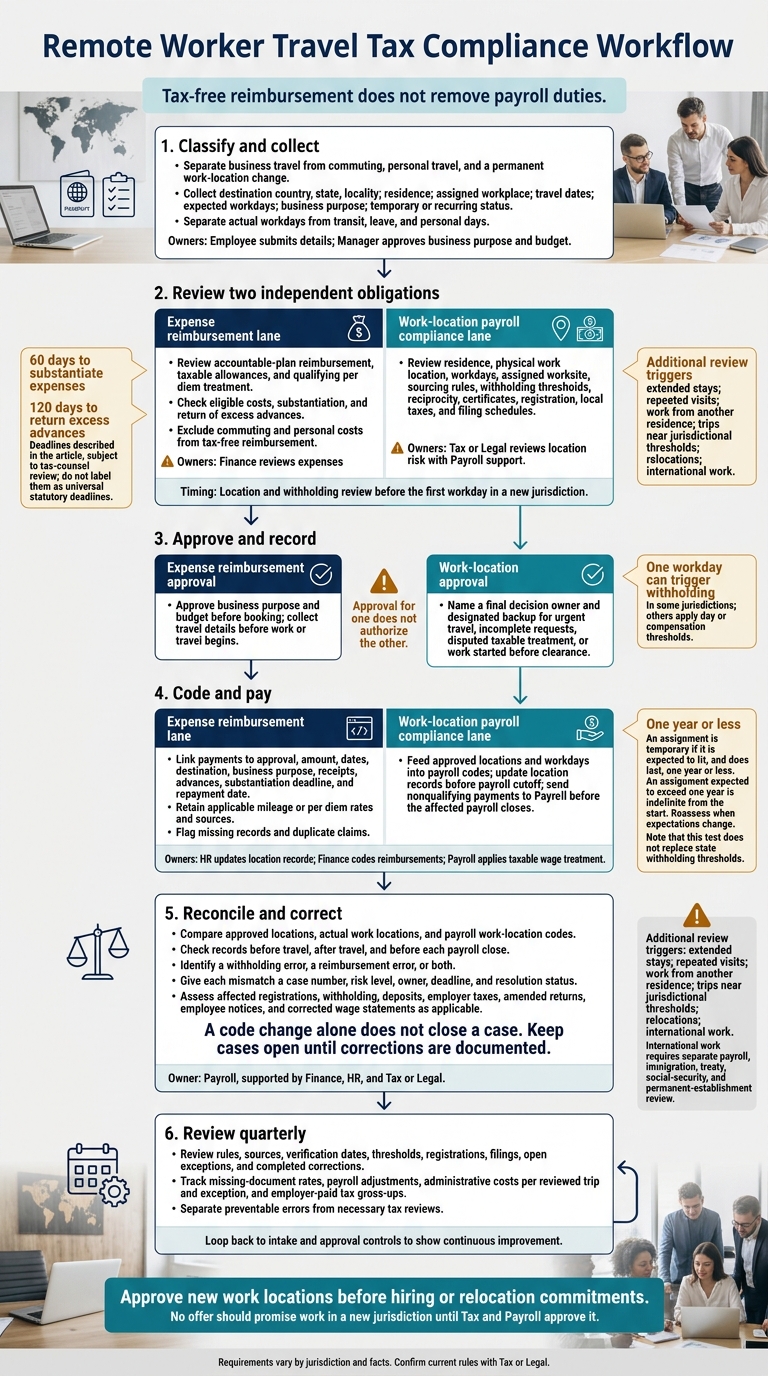
Remote Worker Travel Tax Compliance Workflow
Remote Work and State Taxes: What You Need to Know | The Deduction
sbb-itb-a23bd6a
Determine Reimbursement and Wage Tax Rules
Once you approve a trip, review reimbursement and payroll withholding separately. Each has its own rules and employer obligations.
Apply Accountable Plan and Travel Expense Rules
Set clear deadlines: 60 days to substantiate expenses and 120 days to return excess advances, subject to tax-counsel review. Keep receipts, dates, destinations, business purpose, and repayment records. Accountable-plan treatment depends on these facts, not what you call the payment.[1][2]
| Arrangement | Documentation required | Payroll treatment | Employer risk | Appropriate use |
|---|---|---|---|---|
| Accountable-plan reimbursement | Business purpose, dates, location, expense category, receipts or mileage records, and return of excess advances | Qualifying amounts generally excluded from federal wages and Form W-2; assess nonqualifying amounts for wage treatment | Missing records or repayment controls can make payments taxable | Business travel and qualifying employee expenses |
| Nonaccountable stipend or allowance | Little or no expense-level substantiation; fixed monthly or trip amount | Generally taxable wages reported through payroll and Form W-2; withholding and employment taxes usually apply | Misclassification or inconsistent treatment | Payments intentionally treated as taxable |
| Qualifying per diem arrangement | Trip dates, destination, business purpose, employee eligibility, and applicable federal rate or permitted substantiation procedure | May be excluded under accountable-plan rules; excess or unsupported amounts may be taxable | Incorrect rate, destination, duration, or proration | Routine domestic travel with predictable incidental costs |
| Unreimbursed employee expenses | Employee keeps receipts and other records but receives no reimbursement | Do not treat employee tax deductions as a substitute for a reimbursement policy | Employee disputes and state-law reimbursement exposure | Generally avoid as a default policy |
Exclude commuting and personal costs when providing tax-free reimbursement for airfare, lodging, mileage, ground transportation, and meals. Review internet and workspace payments separately for substantiation and state reimbursement duties. Home-based employees must meet the same substantiation rules.
For per diem payments, retain the rate and destination. Apply departure- and return-day proration when using a federal or high-low per diem.
Finance should also review meal-deduction limits separately. Tax-free reimbursement for an employee does not mean a fully deductible expense for your business. Nor does it remove state withholding or registration duties.
Check State Withholding and Payroll Registration Rules
Payroll must source wages using residence, physical work location, workdays, and assigned worksite. Use the workday and location records from the travel request to determine sourcing and withholding.
Some jurisdictions can require withholding after one workday. Others apply day or compensation thresholds. Reciprocity may require an exemption certificate, and resident tax credits do not automatically remove your withholding duties. Convenience-of-the-employer rules can affect out-of-state workdays, while local income taxes need a separate review. Employee filing thresholds do not determine employer withholding duties.[4][5][6]
Maintain a state matrix covering official sources, verification dates, sourcing rules, thresholds, reciprocity, certificates, registration requirements, local taxes, and filing schedules. Use it to decide whether to register, add a work state, withhold, file returns, or issue corrected forms. Keep the decision and supporting workday records.
Review unemployment-insurance localization, workers’ compensation, and employer tax nexus separately. A withholding exemption does not settle these obligations.
Review Long Assignments and International Work
Review longer trips separately before finalizing payroll.
Treat a location as temporary if the assignment is expected to last, and does last, one year or less. An assignment expected to exceed one year is indefinite from the start. If expectations change, reassess treatment at that point.
Track extensions, recurring trips, relocation, and continuing lodging or meal allowances, which may become taxable. This timing test does not replace state withholding thresholds.[1]
Foreign work also needs a review of payroll, immigration, treaty, social-security, and permanent-establishment issues. A short stay or day-count treaty rules do not automatically eliminate employer duties.[3]
Set Up Travel Approval and Payroll Controls
Once you know the tax treatment, turn it into a clear approval process. Approve work locations and expense reimbursements separately. Approval for one does not authorize the other.
Your policy should name approved locations, eligible expenses, documentation deadlines, and exception owners. Explain how to split business and personal costs. Exclude personal extensions, family-member costs, and upgrades unless you document them as exceptions.
Build the travel request around the details payroll needs to allocate wages to the correct jurisdiction and control reimbursements.
Collect Work Locations and Travel Dates
Require the destination country, state, and locality, along with travel dates, expected workdays, residence, assigned workplace, business purpose, and whether the arrangement is temporary or recurring. Record personal extensions and any other residence used for work. Separate actual workdays from transit, leave, and personal days.
Send extended stays, repeated visits, work from another residence, and trips near your day-count threshold for payroll and tax review before work begins.[8][9] Use the approved dates and locations to code payroll and expense records correctly.
Set Up Payroll Codes and Expense Records
Feed approved travel details into payroll and expense codes. Don’t leave them sitting in the request form.
Create separate codes for regular wages, accountable-plan reimbursements, nonaccountable allowances, per diem lodging, per diem meals and incidentals, business mileage, travel advances, taxable personal expenses, gross-ups, and repayments of excess advances.
Link each payment to its approval and supporting records. Include the amount, dates, destination, business purpose, participants where relevant, receipts, advances, substantiation deadline, and repayment date. Flag missing records and duplicate claims before payment.
Store the applicable rate and its source with each mileage or per diem claim. Check rates against the travel dates and location rather than hard-coding them into your system. Send nonqualifying payments to payroll before the affected payroll closes, and record any approved gross-up separately.
Assign Travel Tax Responsibilities
Give each task a primary owner and backup using the handoffs below. Name a final decision owner and a designated backup, typically the head of tax, controller, or another designated executive.
Escalate urgent travel, incomplete requests, disputed taxable treatment, and work started before clearance to that decision owner.
| Activity | Primary owner | Backup or support | Handoff deadline |
|---|---|---|---|
| Approve business purpose and budget | Manager | Finance | Before booking |
| Submit destination, residence, dates, and workdays | Employee | HR | Before work or travel begins |
| Review work-location and withholding risk | Tax or legal adviser | Payroll | Before the first workday in a new jurisdiction |
| Update location and approval records | HR | Payroll | Before payroll cutoff |
| Code and reimburse expenses | Finance | Manager | After documented approval |
| Apply taxable wage treatment | Payroll | Tax adviser | Before payroll closes |
| Monitor registration and filing obligations | Tax or legal adviser | Payroll | At each new or recurring jurisdiction trigger |
| Correct payroll and expense errors | Payroll | Finance and HR | During the next available correction cycle |
| Provide audit records | Tax or legal adviser | HR, payroll, and finance | On request |
Keep these ownership records and approvals as the audit trail for compliance checks.
Audit Travel Tax Compliance and Costs
Check approved travel records, payroll codes, and work-location data against where employees actually worked and what they were paid.
Run checks before travel, after travel, and before each payroll close. Compare the approved location, actual work location, and payroll work-location code. Give each mismatch a case number, risk level, owner, deadline, and resolution status. A code change alone does not close a case. Keep it open until the correction is documented.
Match Travel Records to Payroll Work Locations
Compare approved travel records with timekeeping, HRIS addresses, payroll work-location codes, and tax registrations. Use expense reports and dated location attestations when needed or required by law. Reconcile locations and workdays, then investigate any mismatches.
Verify the business purpose, travel dates, destination, employee classification, and reimbursement type. Confirm whether the destination is a regular work location, temporary assignment, customer site, or personal destination.
Review state and local withholding, registration, deposit, unemployment, filing, and year-end reporting obligations. Check for missing substantiation, outstanding advances, taxable reimbursements, and paid travel time for nonexempt employees.
Collect only the location data you need. Limit access and agree on retention rules with payroll, tax, privacy, and legal advisers. Keep evidence of each expense’s amount, time, place, and business purpose. IRS guidance expects records made at or near the time of the expense.[1][7]
For each mismatch, determine whether you have a withholding error, a reimbursement error, or both.
Resolve Travel Exceptions and Payroll Errors
When approved and actual work locations differ, correct the affected payroll records and filings.
Escalate unapproved work in a new jurisdiction, repeated travel that may establish a regular work location, and assignments approaching or exceeding a jurisdiction’s threshold. International work, relocations, and conflicting state sourcing claims also need review. Before tax review, confirm the actual dates, jurisdictions, payments, and affected payroll periods.
Look beyond future payroll settings. Assess registration, withholding, deposits, employer taxes, amended returns, and employee notices. If a payment was treated as a reimbursement but should have been wages, check whether you need corrected payroll returns, amended state filings, and a corrected Form W-2 or other wage statement.[10][11]
Record the correction, completion date, root cause, and action to prevent the error from recurring.
Review Compliance Rules and Costs Quarterly
Review rules, documentation, payroll codes, jurisdictional thresholds, registrations, filings, open exceptions, and completed corrections. Record each rule’s source, owner, last verification date, and next review date.
Track missing-document rates, payroll adjustments, administrative costs per reviewed trip and exception, and employer-paid tax gross-ups. Separate preventable errors from necessary tax reviews so you can see where costs can be reduced.
Use the findings to reset budget assumptions, review triggers, and threshold monitoring. Add the results to the next quarter’s review list and payroll control updates.
Conclusion: Put Travel Tax Controls Into Practice
Make the controls above part of a repeatable review process. Before approval, classify each trip, confirm where the employee will work, and keep reimbursement approval separate from wage sourcing.
Publish the policy and build the jurisdiction matrix. Configure payroll and expense codes, launch travel intake, assign owners, and schedule reconciliations and quarterly audits.
Give HR, managers, Finance, Payroll, and Tax or Legal clear responsibility for policy, location records, expense review, withholding, and jurisdiction tracking. Before launch, have tax or legal counsel check current requirements. Record the review date, assumptions, unresolved questions, and next review date.
Apply these same location controls to embedded recruitment and offers.
Keep Recruiting Within Approved Work Locations
Recruiters and hiring managers must use approved work locations, travel expectations, and start dates. Require compliance approval before making any offer, start date, or relocation commitment tied to a new jurisdiction.
No offer should promise work in a new jurisdiction until Tax and Payroll approve it.
FAQs
Is travel to our office taxable for remote employees?
Tax treatment depends on the employee’s tax residency, duties, and applicable laws. Office travel may create taxable income for the employee or a tax nexus for your business. Each case needs its own review.
Record travel dates and work locations so you can assess withholding, registration, and corporate tax risks. Consult qualified tax advisers before travel to understand the tax requirements and potential costs for each trip.
How do we count partial workdays across states?
Count partial workdays according to the rules in each relevant state or country. There’s no universal method, so check the laws for each work location before allocating time.
Keep accurate daily location logs and reconcile them with payroll records monthly for higher-risk cases or quarterly for recurring arrangements. Payroll data should match where employees physically worked.
What if an employee reports out-of-state work late?
Escalate immediately to HR, payroll, finance, and legal advisers. Compliance requirements depend on when the work occurred, not when it was reported. Confirm the dates and duties performed in the new location without delay.
Assess which registrations, corrective tax filings, and payments are required, including any interest or penalties caused by the delay. Keep a clear audit trail of the reported dates, decisions, and remediation plan to support future compliance reviews.