Hiring remotely in California means planning for protected breaks, not just adding headcount. We recommend building break coverage into your staffing plan before you hire, so meetings, customer calls, and time zones do not create payroll costs or service gaps.
For covered nonexempt employees, plan for 30-minute meals and paid 10-minute rest periods under California’s timing rules. Missed breaks can mean extra pay, so your managers and payroll team need one clear process.
We focus on three steps:
- Confirm coverage and schedule breaks, including longer days, split shifts, and valid waivers.
- Keep break time free from work, with backup coverage instead of required availability.
- Record actual meals and review pay, so errors do not become recurring costs.
The goal is simple: protect employee break time while keeping your team covered as you grow.
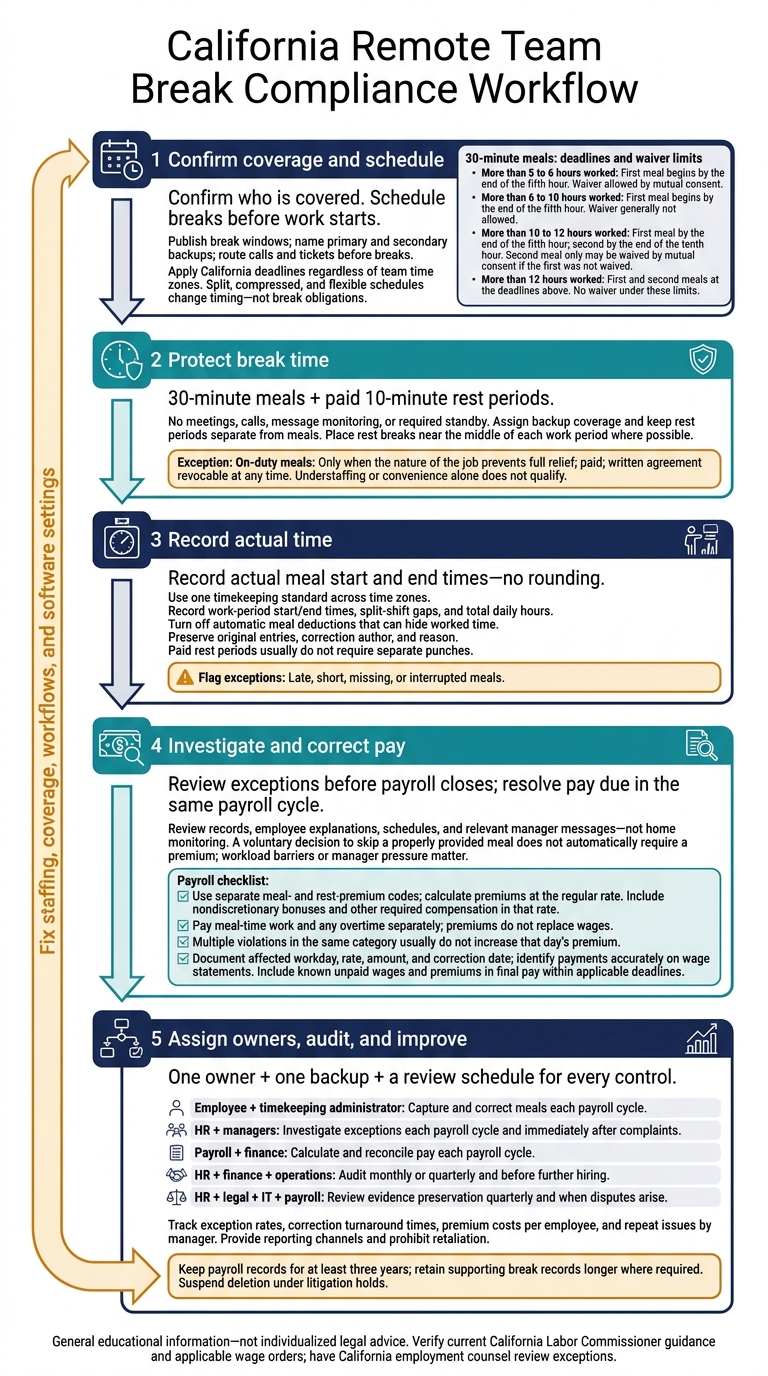
California Remote Team Break Compliance Workflow
California Meal & Rest Break Compliance: Avoiding PAGA Liability for Employers
sbb-itb-a23bd6a
Schedule Breaks and Maintain Coverage
Once you confirm who is covered, build the shift around California break deadlines before work starts. Publish break windows at the start of the shift, name primary and secondary backups, and set calls or tickets to route automatically before each break.
Use overlapping time zones to cover the work, not to keep employees on standby. Your coverage plan must still meet California meal and rest deadlines.
Meal Deadlines, Waivers, and On-Duty Meals
| Hours worked | Meal requirement and deadline [5] | Waiver allowed? |
|---|---|---|
| More than 5 to 6 | First 30-minute meal begins by the end of the fifth hour | Yes, by mutual consent |
| More than 6 to 10 | First meal begins by the end of the fifth hour | Generally no |
| More than 10 to 12 | First meal by the end of the fifth hour; second by the end of the tenth hour | Second only, by mutual consent, if the first was not waived |
| More than 12 | First and second meals at the deadlines above | No waiver under these limits |
Full relief means no work duties. Pause routing, mute notifications, and remove escalation responsibilities.
Use a paid on-duty meal period only when the nature of the job prevents full relief. This requires a written agreement that the employee can revoke at any time. Document why the role requires an on-duty meal and confirm that it is paid. Understaffing, convenience, or customer deadlines alone do not qualify.
Paid Rest Breaks and Meeting Schedules
Keep rest breaks outside meetings. Schedule one for shorter shifts, two for mid-length shifts, and three for longer shifts, following the hours-based rule above.[7]
Place breaks near the middle of each work period where possible. Label them as paid rest with no work required, and rotate coverage so work does not fall back on the person taking a break. Calls, message monitoring, and standby duties do not provide full relief. Keep rest periods separate from meals.
Split Shifts, Compressed Days, and Flexible Schedules
Different schedules change break timing, not your break obligations.
| Schedule | Break triggers | Main risk | Practical control |
|---|---|---|---|
| Standard | Hours worked and meal deadlines | Meetings push meals past legal deadlines | Reserve break windows before booking meetings |
| Split | Work periods and total daily hours | Treating an employer-created unpaid gap as a compliant meal; missing a split-shift premium | Identify genuine meals and review how the gap is classified |
| Compressed | Longer days may require additional meals and rest periods | Missing required breaks on longer workdays | Review alternative-workweek requirements and schedule every required break |
| Employee-controlled flexible | Actual hours worked and statutory deadlines | Treating employee-selected pauses as compliant breaks or valid waivers | Allow timing choices within compliant limits; record actual hours |
A split shift generally involves separate work periods in one day with a long unpaid interval. It can also trigger a separate split-shift premium. Classify the gap correctly and calculate any premium under the applicable wage order. Do not relabel a split shift as lunch.
Before introducing compressed schedules, check the applicable alternative-workweek voting, written-schedule, notice, and payroll requirements. An informal schedule does not create a valid waiver.
Record actual break times and track any premium pay.
Manage Break Records and Premium Pay
Record Meals and Correct Time Entries
Scheduled breaks need records that show what happened. Use one timekeeping standard across time zones. Record actual meal start and end times without rounding punches.[10][11] Record work-period start and end times, split-shift gaps, and total daily hours too.[17][18]
Flag late, short, missing, or interrupted meals. Turn off automatic meal deductions that can hide worked time. Give employees a simple correction form or payroll ticket, and keep the original entry, who changed it, and why. Paid rest periods usually do not need separate punches.[17][18]
A handbook policy alone does not prove employees had a compliant break opportunity. For remote teams, missing punches matter as much as missing breaks. Send missing or noncompliant meal records for violation review. Records showing a late, short, or interrupted meal can create a rebuttable presumption of a violation.[10][15][16]
Review employee explanations, schedules, and manager messages, not home monitoring. Calendar blocks show planned breaks, not proof of uninterrupted time. Keep payroll records for at least three years, retain supporting break records longer where required, and suspend deletion under litigation holds.[9][12]
Calculate Break Premiums and Unpaid Wages
When records show a missed break, resolve any pay due in the same payroll cycle. Use separate payroll codes for meal and rest premiums, calculating each at the regular rate.[14][13][4] Multiple violations in the same category usually do not increase that day’s premium.
Include nondiscretionary bonuses and other required compensation in the regular rate. Pay all time worked during a meal, plus any overtime, separately. A break premium does not replace those wages.
Investigate exceptions before payroll closes. An employee’s voluntary choice to skip a properly provided meal does not automatically require a premium. But workload barriers or manager pressure can undermine that conclusion.[10][15][16]
Pay amounts due promptly, identify premium payments accurately on wage statements, and document the affected workday, rate, amount, and correction date.[14] Include known unpaid wages and premiums in final pay within California’s applicable deadlines. Do not wait for a routine audit.
Assign Responsibilities and Audit Break Compliance
For distributed teams, name one owner, one backup, and a review schedule for each control. With teams across time zones, you cannot rely on one office to watch the clock.
HR and finance should track exception rates, correction turnaround times, premium costs per employee, and repeat issues by manager. These measures help you spot where staffing or workflow changes are needed before further hiring adds pressure.
Give employees access to HR, payroll, and a manager outside their reporting line. Prohibit retaliation for reporting missed breaks, correcting records, or requesting premiums. Review adverse actions involving employees who report concerns.
| Control | Owner | Evidence | Review frequency | Corrective action |
|---|---|---|---|---|
| Capture and correct meals | Employee and timekeeping administrator | Unrounded punches, correction history | Each payroll cycle | Fix entries and system settings |
| Investigate break exceptions | HR and managers | Time records, schedules, relevant calendars, messages, complaints | Each payroll cycle; immediately after complaints | Assess premiums; remove workload or coverage barriers |
| Calculate and reconcile pay | Payroll and finance | Regular-rate calculations, payroll register, wage statements | Each payroll cycle | Pay shortages promptly; correct statements |
| Audit patterns and reporting | HR, finance, and operations | Exception rates, correction times, premium costs, complaints | Monthly or quarterly; before further hiring | Change staffing or workflows; escalate systemic issues |
| Preserve evidence | HR, legal, IT, and payroll | Retention rules, correction logs, hold notices | Quarterly and when disputes arise | Suspend deletion; preserve relevant records |
Prevent Common Remote Break Violations
The most common violations happen when schedules treat breaks as optional.
Remove Required Availability During Breaks
Remote work does not excuse break compliance. Employees must not be required to stay reachable during meals or rest breaks. In Augustus v. ABM Security Services, the California Supreme Court rejected on-call rest breaks: employees must be relieved of duties and employer control during rest periods.[6][20]
Do not schedule meetings, route tickets, or require Slack monitoring during these breaks. Any required monitoring defeats a compliant break.
Build coverage into your schedule. End meetings before meals, assign a rotating backup, transfer calls and tickets, and turn off required notifications. Train managers not to reward skipped breaks or expect immediate replies.
If a break is interrupted, document it and send the record to payroll for review. Policy wording and software defaults need the same scrutiny as daily schedules.
Fix Invalid Waivers and Noncompliant Policies
Employee consent cannot cure a noncompliant waiver. Blanket acknowledgments do not create valid waivers. Replace them with documentation that meets the applicable conditions. Silence or informal agreement does not waive rest-period obligations.[8][3][19]
Check that your headquarters policies and software apply California’s waiver limits. Remove automatic break deductions and keep rest periods paid.
If unpaid premiums or recurring exceptions keep appearing, address the cause: your schedule, coverage assignments, or service expectations.
Conclusion: Put California Break Rules into Practice
For distributed California teams, compliance rests on correct classification, protected break time, and accurate payroll. Start with classification, then apply California’s meal, rest, and waiver rules to each remote workday.[5][2][21] Remote schedules increase the risk of missed deadlines, so map each workday against California’s deadlines before it starts.
Give HR, managers, and payroll clear responsibilities across time zones. Keep breaks free from meetings, chat, calls, and monitoring, and audit time records monthly or quarterly. Use one shared process for scheduling, tracking, and payroll. Investigate missed or interrupted breaks, correct time-record errors, and pay required wages or premiums when due.
Check your process against current Labor Commissioner meal-period guidance, rest-period guidance, and applicable wage orders. Have California employment counsel review exceptions and corrections. This guide provides general educational information, not individualized legal advice.
Recruitment Support for Distributed Teams
If you’re also scaling hiring, recruitment support can help manage the workload, but it does not replace compliance controls. Rent a Recruiter provides embedded recruitment support for growing distributed teams. Book a Call to discuss your hiring needs.
FAQs
Do California break rules apply if our headquarters is elsewhere?
California’s break rules apply to remote employees physically working in California, regardless of where your company is headquartered. The employee’s work location determines which meal and rest break requirements apply, not your office address.
Follow the strictest applicable state standards. For California-based staff, this means a 30-minute, duty-free, unpaid meal break for shifts exceeding five hours and a paid 10-minute rest break for every four hours worked.
How many paid rest breaks does each shift require?
In California, nonexempt employees are entitled to one paid 10-minute rest break for every four hours worked, or a “major fraction” of four hours, during each shift [1].
Can missed meal and rest breaks trigger two premiums in one day?
Yes. Under California law, an employer may owe up to two premium payments in a single workday: one hour of premium pay for a missed, late, or interrupted meal break, plus one hour for a missed, late, or interrupted rest break.
Meal and rest break requirements are separate. If you fail to provide both types of required breaks, you may owe both premiums.