
If your diversity hiring effort sits outside headcount planning, stage data, and recruiter capacity, it will miss target and cost you time.
I see the fix as simple: treat diversity hiring like a hiring system, not a campaign. That means tying targets to specific roles and dates, checking where candidates drop out, using the same scorecards at each stage, and making sure your team has enough hiring capacity to run the process properly. For scaling companies in SaaS, Technology, IT, Fintech, Engineering, Security, Insurance, and Professional Services, that leads to better hiring outcomes, less wasted recruiter effort, and tighter control over time to fill.
In short, I would focus on four things:
- Set role-level targets with a baseline, owner, and review date
- Fix job design early so weak requirements do not cut the pool before a role opens
- Standardise selection so hiring decisions do not shift by team or interviewer
- Track funnel drop-off and team capacity so you know whether the issue is sourcing, assessment, offers, or recruiter bandwidth
This is the core idea: you do not hit representation goals by asking for more diverse candidates. You hit them by building a hiring process that your team can run month after month, with clear data and clear ownership.
If your team is hiring at pace and internal bandwidth is tight, embedded recruitment can help keep sourcing, screening, interview co-ordination, and reporting on track without pushing more admin back onto your managers.
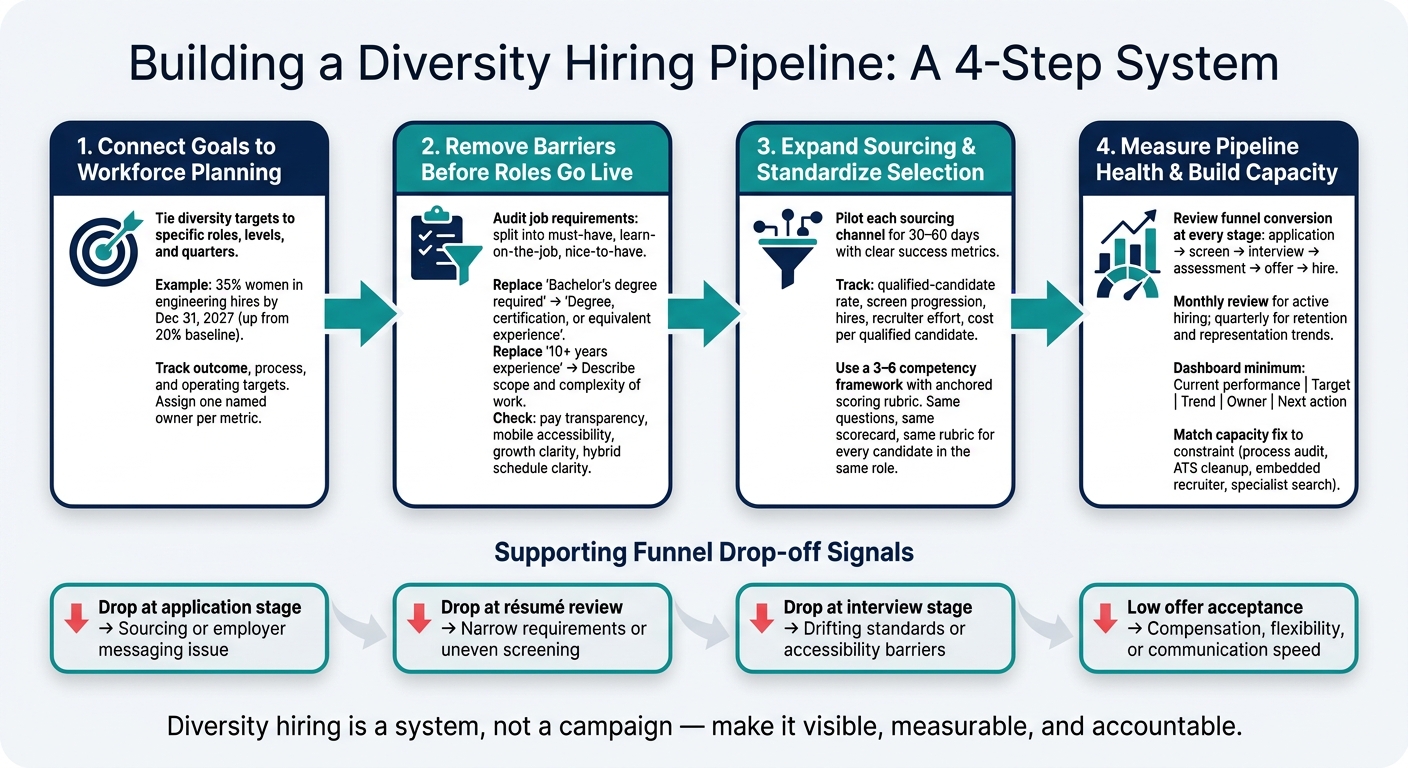
How to Build a Diversity Hiring Pipeline: 4-Step System
Building a Pipeline of Diverse Candidates
sbb-itb-a23bd6a
Connect diversity goals to workforce planning
Start with your headcount plan. Then tie diversity targets to each role, level, and quarter.
Lay out expected hires by quarter, broken down by role, level, and location. Include priority roles and target start dates. Mark which roles are backfills and which are growth hires. Then flag the roles where representation gaps are biggest today. That’s where targets are most likely to move the needle.
Company-wide goals sound good, but they’re hard to run. A role-level target gives your team something specific to act on. For example, targeting 35% women among engineering hires by December 31, 2027, up from a 20% baseline, gives recruiters and hiring managers a clear hiring goal.[1] Once those targets are in place, the next job is to remove barriers before roles go live.
Set targets tied to roles, timelines, and funnel stages
Use your current data to track representation at each stage of hiring: applicants, screens, interviews, offers, and hires. Look at two to three years of history so you can spot patterns instead of reacting to short-term swings.[1] If hiring volume is low, small samples can skew the picture, so use ranges or minimum thresholds.
Map each target to a funnel stage. That helps you see where representation drops off.
Build targets across three areas:
- Outcome targets: representation among new hires, 12-month retention, or promotion rates
- Process targets: interview progression rates, offer acceptance by segment, or the share of priority roles sourced through at least two qualified channels
- Operating targets: hiring-manager training and scorecard use
Use all three. If performance misses target, the problem may sit in sourcing, interviews, or offers. This gives you a clearer view of where to act, and it saves time when teams need to fix issues fast.
Assign owners and use a simple planning table
This is where many plans break down. Every metric needs one named owner. One person must be on the hook if performance slips.
Recruiters should maintain funnel data and flag stage-level gaps. Hiring managers should complete scorecards and take part in structured interviews. People leaders should own data quality and compliance.
A simple planning table keeps the plan visible. It also gives you a monthly or quarterly operating rhythm, instead of a target that gets reviewed once and forgotten.
| Goal | Current baseline | Target | Owner | Timeframe | Data source |
|---|---|---|---|---|---|
| Women represented among engineering hires | 20% of 2026 hires | 35% of hires | VP of Engineering + recruiter | Q1 to Q4 2027 | ATS and HRIS |
| Underrepresented candidates reaching first interview | 18% of applicants | 28% of applicants | Recruiting lead | Monthly review | ATS funnel report |
| Offer acceptance gap | 72% vs. 86% overall | Gap below 5 percentage points | People leader + hiring managers | By Q3 2027 | ATS and exit survey |
| 12-month retention for new hires | 78% baseline | At least 85% | Department leaders | Quarterly cohort review | HRIS |
Define every metric clearly. For example, decide whether "new hire" means accepted offer or start date. Then set the response if a metric misses target. That’s what turns a planning document into an operating tool.
Remove barriers before roles go to market
Once targets and owners are set, deal with the role itself before it goes live. Start with the roles and job families where representation gaps are biggest, or where hiring volume is highest.
A lot of diversity pipeline issues begin in the job description. Tight requirements, fuzzy scope, and bland inclusion copy cut down the qualified applicant pool before the role even opens. A short review before each post goes live can save time, cut drop-off, and improve hiring results.
Audit job requirements, language, and accessibility
Break requirements into must-have, learn-on-the-job, and nice-to-have. Then keep only what has a direct link to performance.
For qualifications, swap "bachelor’s degree required" for "degree, certification, or equivalent professional experience" unless a degree is needed by law, licensing, or a required technical standard. For experience thresholds, describe the actual work instead of using a year count. For example, say "has led cross-functional delivery of a product used by external customers" instead of "8+ years required."
Before publishing, check:
- qualification filters
- application length
- accessibility
- pay transparency
- growth clarity
On pay, publish a salary range in U.S. dollars and state whether compensation is annual, hourly, or includes equity, especially where state or local law requires it. On growth, spell out what training is available, when reviews happen, and what the next likely role looks like. On accessibility, make sure the application works on mobile, supports keyboard navigation and screen readers, and makes accommodation instructions easy to find.
Use the table below to catch common issues before a role goes live:
| Requirement type | Common problem | More inclusive alternative |
|---|---|---|
| "Bachelor’s degree required" | Excludes equivalent experience | "Degree, certification, or equivalent professional experience" |
| "10+ years of experience" | Excludes nontraditional career paths | Describe scope and complexity of work required |
| "Subjective fit" | Encourages bias | Define observable behaviors and collaboration expectations |
| "Hybrid schedule not defined" | Leaves schedule unclear | State office days, core hours, and flexibility options |
Make employer messaging specific and credible
Once the posting is clearer, use the message itself to show how the process works.
Generic inclusion statements don’t build trust. Specific details do. State the interview format up front, define remote or hybrid expectations, name development check-ins, and describe structured onboarding or ERGs if they exist.
Set a baseline before you update the posting. Then track qualified applicant rate, application completion rate, and early drop-off by role and source. That gives you a simple read on business impact: more qualified applicants, fewer avoidable drop-offs, and less wasted hiring time.
With roles written clearly and made easier to access, the next step is to widen sourcing and standardise selection.
Expand sourcing and standardize selection
Fixing the job description is only part of the job. If sourcing and evaluation stay the same, hiring outcomes usually stay the same too.
Once targets are set, the next move is simple: build sourcing channels and selection methods that can support the volume and quality you need. For scaling teams, that matters because more applicants do not mean better hiring. A stronger pipeline does.
Build sourcing channels that match your hiring demand
Your channel mix should reflect hiring demand and the role itself. A niche Engineering hire and a high-volume Customer Support hire won’t come from the same places, and they should not be measured the same way.
The goal is not to flood the funnel. It is to build a qualified pipeline you can convert.
Track each channel against business-facing metrics:
- qualified-candidate rate
- screen progression
- hires
- recruiter effort
- cost per qualified candidate
Pilot each channel for 30 to 60 days against clear success metrics. That gives you enough data to see what is working, what is wasting recruiter time, and where spend is going with little return.
Once you lock in the channel mix, the next rule is non-negotiable: every candidate for the same role should be screened the same way.
Use structured screening, interviews, and work-sample assessment
Set evaluation criteria before anyone looks at a single résumé. If you decide what matters after candidates enter the process, standards drift, and hiring teams start making calls on instinct.
Separate must-haves from preferences. Then tie each one to the work the person will actually do. For example, designing and maintaining production data pipelines is far more useful than a vague requirement or a prestige signal.
Build a 3- to 6-competency framework and define what below expectations, meets expectations, and exceeds expectations look like in practice. That gives recruiters and hiring managers a shared standard, not just a loose impression.
From there, keep the process consistent:
- use the same core screening questions for every candidate
- use the same interview questions for the same role
- use the same scoring rubric across the panel
Interviewers should record written evidence before any group discussion starts. That one step can cut noise, cut bias, and make debriefs far more useful.
If a work sample makes sense, keep it proportionate. Use a short, realistic task with clear instructions, a stated time expectation, and a job-related scoring rubric. Also provide an accessible format and a clear process for requesting reasonable accommodations.
Use this stage-by-stage structure:
| Hiring stage | Evaluation standard | Decision owner | Funnel metric reviewed |
|---|---|---|---|
| Application review | Must-have qualifications tied to job duties | Recruiter or trained screener | Qualified-candidate rate by source |
| Phone screen | Consistent questions covering motivation, availability, compensation, and minimum competencies | Recruiter | Screen-to-interview progression |
| Structured interview | Same core questions and anchored scorecard for all candidates | Hiring manager and trained panel | Interview pass rate |
| Work sample | Same task, instructions, time expectation, and job-related rubric | Hiring manager or assessor | Assessment completion and pass rates |
| Offer stage | Consistent compensation framework and timely communication | Hiring manager with HR or finance | Offer rate and acceptance rate |
Train interviewers before the first interview, not halfway through the process when results already look messy. Practice scoring sample answers on an independent basis, compare ratings, and agree on what strong, acceptable, and weak evidence looks like.
After interviews, run a short calibration meeting to resolve scoring gaps using the rubric. Do not average opinions. Do not defer to the most senior person in the room. That might feel efficient, but it weakens decision quality.
The EEOC treats interviews, applications, and performance tests as selection procedures that should be evaluated for job relevance and potential adverse impact.[2]
After you standardize selection, the next job is to find where the funnel still leaks.
Track where diverse candidates drop out of the funnel
Once sourcing and selection are running, review the funnel stage by stage. Using voluntary self-ID data, where lawful, review results by group in aggregate and with privacy safeguards.
Calculate conversion at each step: application to qualified review, screening, interview, assessment, offer, and hire.
The pattern usually tells you where the problem sits.
A drop at the application stage points to a sourcing issue or an employer-message issue. A sharp fall during résumé review often points to narrow requirements or uneven screening. A drop during interviews can mean interviewer standards are drifting or the format is hard to access. A low offer-acceptance rate often comes back to compensation, flexibility, communication speed, or lost trust during the process.
If broader sourcing is bringing in more applicants but hiring results are not improving, sourcing is no longer the main constraint. At that point, review the operating mechanics:
- did evaluation criteria shift mid-process?
- do scorecards include actual evidence?
- do assessment tasks ask for unpaid labour or rely on technology some candidates cannot access?
Sometimes the issue is not process design but capacity. If recruiter bandwidth is the constraint, embedded recruitment can help maintain sourcing, interviews, and funnel reporting without letting quality slip.
With sourcing and selection in place, the next step is to measure funnel health and capacity.
Measure pipeline health and build the capacity to sustain it
Even a well-built hiring process can slow down if you don’t report on it consistently, or if your team simply doesn’t have the recruiter capacity to keep it moving.
Track the metrics that show whether the pipeline is working
Track representation and conversion at each stage. Then go a step further. Watch time to fill, source of hire, offer acceptance rate, candidate response rate, and early retention at 90 days, 6 months, and 12 months. Quality of hire is also worth measuring through ramp time, early performance, manager satisfaction, and retention.[3]
The key is to make this a repeatable review cycle, not a one-off report.
Set a baseline. Define a target linked to a specific role and funnel stage. Review the data. Find the biggest drop-off. Test one change. Then measure what moves.
Run this monthly for active hiring. Review broader representation and retention patterns quarterly. A simple dashboard can keep this work inside your normal operating rhythm. At a minimum, include:
- Current performance
- Target
- Trend
- Owner
- Next action
That gives you a clear line of sight into what’s working, what’s slipping, and where time or budget should go next.[4]
If your metrics look healthy but hiring is still moving too slowly, the issue may not be sourcing. It may be capacity.
Close recruiter bandwidth gaps with a repeatable hiring model
Before you add headcount or bring in outside support, diagnose the actual constraint.
Candidate supply is not always the issue. In many teams, the drag comes from limited sourcing capacity, overloaded recruiters, inconsistent hiring-manager decisions, or poor reporting.
Match the fix to the constraint, not the symptom.
| Internal capacity gap | Typical evidence | Appropriate response |
|---|---|---|
| Unclear or inefficient process | Repeated approvals, duplicated work, unclear ownership | Process audit and redesign |
| Weak reporting | Missing source, stage, demographic, or outcome data | Applicant-tracking-system cleanup, dashboard setup, and reporting standards |
| Inconsistent hiring-manager decisions | Late feedback, incomplete scorecards, variable standards | Structured interview training, calibrated scorecards, and decision-time expectations |
| Short-term hiring spike | Surge after funding, product launch, or seasonal demand | Temporary recruiter or contract recruiting support |
| Sustained hiring demand | Multiple recurring roles, insufficient internal capacity | embedded recruitment with an experienced recruiter integrated into the team |
| Highly specialized, one-off role | Single hard-to-fill role requiring niche market access | Targeted placement or specialist search |
This matters more than many teams think. Add a recruiter to a broken process, and you just get broken results at a higher pace.
Conclusion: Turn diversity goals into a measurable hiring system
A diversity-focused talent pipeline is not a side project. It happens when five disciplines work together: linking diversity goals to workforce planning, removing unnecessary barriers from job design, broadening sourcing channels, standardizing selection, and reviewing funnel performance on a set cadence.
Representation targets are not a substitute for fair, job-related assessment. They are a reason to make the hiring process visible, measurable, and accountable.
For scaling SMEs with sustained hiring demand, Rent a Recruiter places experienced recruiters inside your team to manage sourcing, screening, coordination, and funnel reporting.
FAQs
How do we set realistic diversity hiring targets?
Start with baseline metrics from your ATS or HRIS. Look at demographic data across the full hiring funnel, from application through to offer and hire. That gives you a clear view of where gaps sit today, not where you assume they are.
Then layer in local labour market data, industry trends, and your candidate pipeline. The point is simple: set goals based on what your market can support, what your team can deliver, and where your hiring plan is headed.
Your targets should be specific and measurable. Tie them to your business growth plans over the next 6 to 18 months, so hiring goals match headcount demand, budget, and team build-out.
Review progress quarterly. That helps you spot drop-off points early, fix process issues before they compound, and keep hiring outcomes on track.
What metrics matter most in a diversity hiring funnel?
Key metrics to track include:
- representation at application stage
- diversity sourcing ratio
- stage-to-stage conversion rates by demographic group
- offer acceptance rates by demographic group
- pipeline-to-hire conversion rate
You should also track time-to-hire for diverse candidates and leadership representation. These numbers show where drop-off happens, where delays build up, and whether hiring outcomes line up with your DEI goals.
Use the four-fifths (80%) rule to flag adverse impact. If the selection rate for one group falls below 80% of the highest-performing group, that’s a clear signal to review the process. It won’t tell you the whole story on its own, but it gives you a practical way to spot risk early and act before it affects hiring results or exposes the business to compliance issues.
When should we add recruiting capacity?
Add recruiting capacity when your internal team is stretched thin, especially during rapid growth or a sudden spike in hiring.
This also matters when your hiring process lacks structure. That’s when rushed decisions creep in, interview feedback gets messy, and bias starts to shape outcomes.
An embedded recruiter gives you extra capacity, but more than that, they bring order to the process. They can help you build stronger pipelines, cut time-to-fill, and save over 80 hours of admin time per month.
For scaling teams, that means less time lost to hiring admin, better decision-making, and a process that stands up under pressure.