
If you audit every recruitment vendor once a year by default, you are probably wasting time on some suppliers and missing risk in others.
I’d set audit timing by vendor risk, hiring volume, data access, and business reliance. For most scaling companies, that means annual reviews for high-risk vendors, 6 to 18 month reviews for vendors tied closely to hiring output, and 18 to 36 month reviews for low-use suppliers. Done well, this helps you cut wasted agency spend, spot weak supplier performance earlier, and keep HR, finance, and procurement aligned.
Here’s the short version:
- Critical vendors: full audit every 12 months, with quarterly check-ins
- High-risk vendors: full audit every 12 to 18 months, with semiannual reviews
- Medium-risk vendors: full audit every 18 to 24 months
- Low-risk vendors: full audit every 24 to 36 months or at renewal
- Audit sooner after fee jumps, SLA misses, data issues, ownership changes, or a drop in hiring output
A fixed calendar date is not enough. Your audit cycle should follow where money, hiring dependency, and supplier risk are highest.
How to Plan Audits on Vendors Using a Vendor Audit Schedule
Reviewing embedded recruitment case studies can help you determine the right audit frequency based on real-world performance data.
sbb-itb-a23bd6a
Set audit frequency by vendor risk, not by habit
A blanket annual schedule burns time on low-risk vendors and still leaves gaps with higher-risk ones. Set audit cadence by risk and business exposure, not by the calendar.
The four factors that should drive audit cadence
Four inputs should drive audit cadence.
The first is data sensitivity. Vendors that store candidate records, run background checks, or manage onboarding workflows handle personally identifiable information. If controls are weak, you face privacy and compliance risk.
The second is impact on hiring flow. If a vendor supports a large share of your annual hires or sits inside a key pipeline, it’s harder to replace. When that vendor underperforms, hiring slows down.
The third is hire volume and role criticality. A vendor filling a high number of roles, or a smaller number of business-critical roles, carries more weight for the company. The effect shows up in hiring output, team capacity, and missed growth targets.
The fourth is regulatory complexity. Vendors working across fintech, insurance, healthcare, security, cross-state hiring, or contingent labor face tighter screening, data, and worker-classification rules.
Use this four-tier model.[3][4][5][6]
| Risk Tier | Typical Audit Cadence | Best Fit |
|---|---|---|
| Critical | Annual full audit with quarterly or semiannual interim checks | Vendors with sensitive data access or core hiring dependency |
| High | Every 6 to 12 months | Vendors with meaningful operational or privacy exposure |
| Medium | Every 12 to 24 months | Vendors with limited but relevant exposure |
| Low | Every 24 to 36 months or at renewal | Vendors with minimal data and low operational impact |
Use these tiers to set the review cadence in the next section.
How company size and growth stage change the answer
Company size and growth stage change the right answer.
A smaller SaaS company with limited vendor exposure may keep primary vendors on an annual or 18 to 24 month cycle. A larger fintech company with multi-state hiring and tighter data rules may need annual audits plus interim checks.[3][4][5]
As the business grows, the vendor mix changes. Audit timing usually changes with it.
Build a vendor inventory before setting audit dates
Before you assign any tier, build a simple inventory of every recruitment vendor and what it actually does. For each vendor, record:
- Service type
- Annual spend
- Data access
- Hiring volume
- States supported
- Renewal date
- Internal owner in HR, talent, or finance[1][2]
This inventory helps with tiering, accountability, and concentration-risk checks. If one vendor controls more than half of your annual hires, that relationship likely belongs in a higher risk tier.
You can’t set a defensible audit cadence if you don’t know what each vendor touches.
Once each vendor is inventoried, assign a tier and a review date.
Recommended audit frequency by risk tier
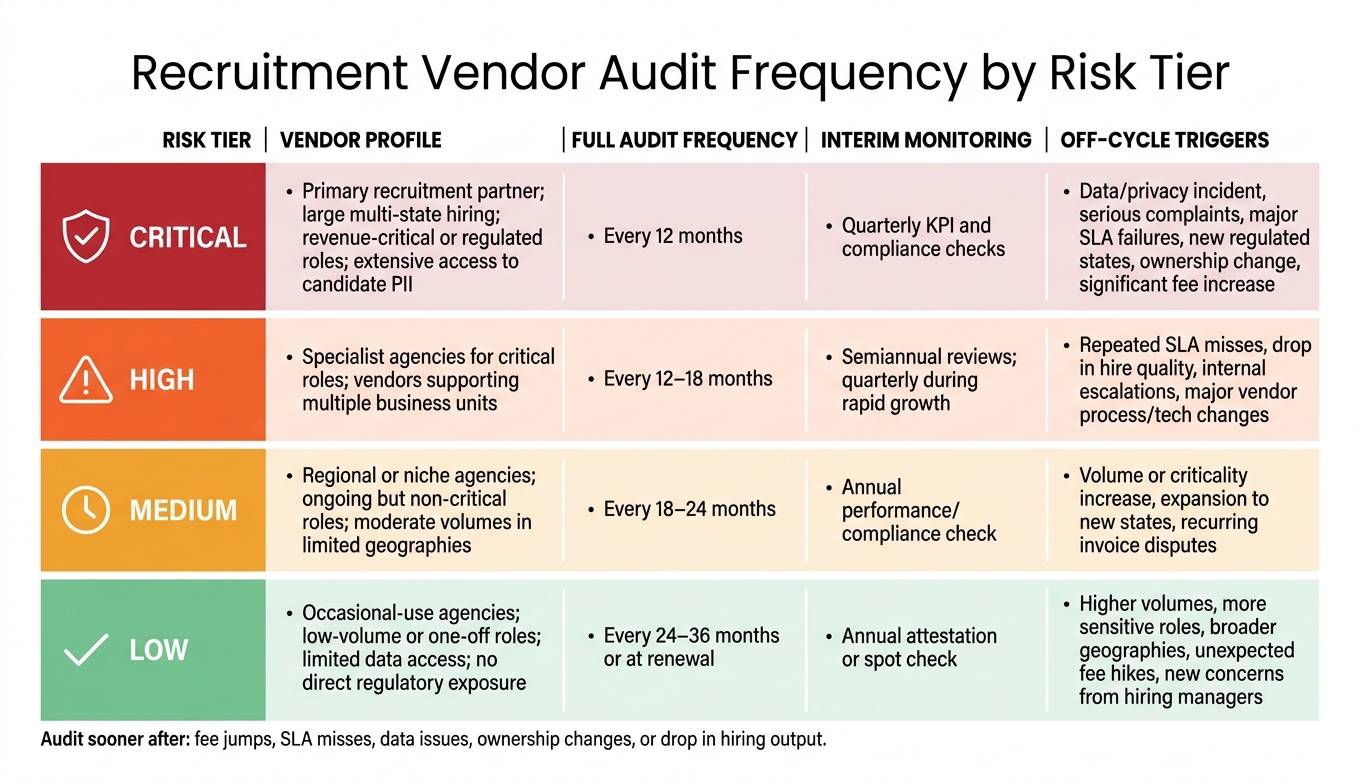
Recruitment Vendor Audit Frequency by Risk Tier
Match each tier to a clear calendar rhythm. The table below turns the risk model into timing you can actually schedule and manage.
| Risk Tier | Typical Vendor Profile | Full Audit Frequency | Interim Monitoring Frequency | Off-Cycle Review Triggers |
|---|---|---|---|---|
| Critical | Primary recruitment partner handling large, multi-state hiring volume; vendors filling revenue-critical or regulated roles; vendors with extensive access to candidate PII | Every 12 months | Quarterly KPI and compliance checks | Data or privacy incident, serious candidate or worker complaint, major SLA failures, entry into new highly regulated states, leadership or ownership change, significant fee or scope increase |
| High | Specialist agencies for critical roles or vendors supporting multiple business units | Every 12 to 18 months | Semiannual reviews; quarterly during rapid growth or major changes | Repeated SLA misses, noticeable drop in hire quality, internal escalations, significant process or technology changes at the vendor |
| Medium | Regional or niche agencies supporting ongoing but non-critical roles; moderate volumes in limited geographies | Every 18 to 24 months | Annual performance/compliance check | Increase in volumes or role criticality, expanding support to new states, recurring invoice disputes or minor complaints |
| Low | Occasional-use agencies for one-off or low-volume roles; limited data access and no direct regulatory exposure | Every 24 to 36 months | Annual attestation or spot check | Vendor starts handling higher volumes, more sensitive roles, or broader geographies; unexpected fee hikes; new concerns raised by hiring managers or finance |
Use the table as your baseline. The notes below show what each cadence looks like in day-to-day vendor management.
Critical and high-risk vendors: annual full audits with interim checks
For critical vendors, those handling a large share of your annual hires, filling revenue-critical roles, or working with sensitive candidate data, a full audit every 12 months is the starting point. That gives you a set review point for the areas that carry the most legal, financial, and hiring risk.
Between annual audits, quarterly KPI checks help you spot drift early. That matters because problems rarely stay small. A missed SLA, rising invoice errors, or weak data handling can turn into cost, delay, or compliance trouble if no one catches it. Many firms switch to flexible embedded recruitment to maintain better oversight and control over these risks.
Keep the annual review tight and focused on the controls that matter most. Interim checks should cover KPIs, invoice trends, and any open issues that still need action.
High-risk vendors follow the same basic model, just on a slightly longer cycle. Full reviews every 12 to 18 months are usually enough, with semiannual monitoring in between. If your business is in a period of fast hiring or major change, move those check-ins to quarterly so you keep a close view of risk and performance.
Medium and low-risk vendors: lighter reviews every 18 to 36 months
Medium-risk vendors don’t need the same level of scrutiny. A full review every 18 to 24 months, paired with an annual check, is usually enough to confirm performance is steady and no compliance gaps have appeared.
That annual check does not need to become a heavy audit exercise. In many cases, a structured 60-to-90-minute review is enough. Cover KPIs, sample documentation, and any policy changes. You get oversight without burning time from HR, procurement, finance, or hiring leaders.
Low-risk vendors can move to a 24-to-36-month cycle. An annual attestation confirming no major changes in ownership, data handling, or geographic scope is normally enough. For stable, low-risk vendors, a short written attestation plus an invoice spot check gives you a sensible level of control without adding admin for the sake of it.
When to audit sooner than planned
Even a good schedule needs room for exceptions. Sometimes the calendar says wait, but the risk says act now.
Audit off-cycle when waiting would increase legal, financial, or operational exposure. This could happen after a data or privacy issue, repeated SLA failures, a sharp drop in hire quality, a move into new states, or a change in ownership or leadership.
Keep the off-cycle review narrow. Deal with the risk that triggered it, fix what needs fixing, and decide whether the vendor should move into a tighter audit cadence from that point on.
Turn audit frequency into a working operating rhythm
Once you’ve set audit cadence by risk, put it into dates, owners, and checkpoints. The aim is simple: build audit work into the talent acquisition strategies and business rhythm you already have, not pile on a separate admin process.
Align reviews with contract renewals and quarterly hiring cycles
The easiest way to keep audits on track is to link them to dates that already matter.
If a vendor’s contract renews on 03/31/2027, schedule the full audit 30 to 60 days before renewal. That gives HR, talent acquisition, finance, and procurement time to deal with issues before anything gets signed. Interim checks can then sit at quarter-end points like 06/30/2027 and 09/30/2027, when your team is already looking at hiring output and spend.
Use your tracker to set:
- A full audit date for each vendor
- Interim check dates based on risk tier
- A named internal owner for each vendor
That last point matters. A calendar is only useful when someone is clearly accountable for what happens next.
Assign clear ownership across HR, talent, finance, and procurement
Give each vendor one clear owner.
HR or talent should own performance. Finance should own spend. Procurement or operations should own contract dates and record-keeping. That split keeps decisions close to the people who can act on them, and it stops issues from getting stuck between teams.
Scorecards help those owners stay focused between full audits.
Use scorecards and spot checks between full audits
Full audits catch major issues. Scorecards catch drift early, before it turns into wasted spend or weaker hiring results.
Use monthly or quarterly scorecards to track:
- Time-to-fill
- Offer acceptance rate
- Candidate response time
- SLA adherence
Escalate when offer acceptance rates drop from 85% to 60% across two consecutive quarters, or when candidate response times go past two business days. One bad month can happen. Patterns are what cost you money. Review scorecard results against prior periods, not on their own.
For critical vendors, run scorecards monthly. For most strategic vendors, quarterly is enough. What matters is steady visibility, so your team can step in before small problems show up as audit findings.
Conclusion: Match your audit cadence to growth, risk, and internal capacity
Once audits are part of your operating rhythm, the last step is simple: match the cadence to your actual exposure.
Audit frequency should reflect vendor risk and how much your business depends on that vendor. A high-growth SaaS company running dozens of hires each quarter through one main vendor faces a very different level of risk than a professional services firm that uses a niche agency from time to time.
When cadence lines up with risk and reliance, the outcome is clear: right-sized audits cut risk without piling on admin. The aim is not to run more audits. It’s to run them at the right time.
If you’re using an embedded recruiter, they can help bring structure to vendor tracking, scorecards, and audit ownership.
A simple next step for HR and talent leaders
The easiest place to start is by turning the framework into a live calendar. Pull your current vendor list and assign each vendor a risk tier, critical, high, medium, or low, based on hiring volume, role criticality, data access, and regulatory exposure.
Then set the next audit date for each vendor in a shared calendar and give it a named owner.
That one step gives you more control straight away. You can see what needs review, who owns it, and where supplier risk may be building before it turns into a hiring or compliance issue.
FAQs
How do I assign a risk tier to each vendor?
Assess each recruitment vendor based on what happens to your business if they fail and how fast you could replace them.
This gives you a simple way to sort vendors by risk, not just spend. A low-cost supplier can still create a major hiring problem if they sit inside a core workflow. On the other hand, a higher-cost vendor may be easier to switch if the service is less tied to day-to-day delivery.
Use three risk levels:
- Critical: tied to core workflows; failure causes immediate disruption
- Important: has a clear impact on hiring, but is easier to replace
- Standard: low-risk services that are easy to swap out
Record each assessment in a vendor risk register so you can review it later, track changes, and spot gaps before they affect hiring outcomes.
What should a recruitment vendor audit include?
A recruitment vendor audit needs a clear scope, clear criteria, and findings backed by evidence. It also needs risk ratings that link straight to business impact: cost, hiring delays, and compliance exposure.
You are not just checking whether a vendor says the right things. You are checking whether the process stands up under pressure, leaves a clear paper trail, and protects your business when hiring volume picks up.
The audit should test the core hiring controls and records across the full process, including:
- requisition approval
- job postings
- screening criteria
- interviews
- background checks
- offers
- onboarding
- record retention
- rejected-candidate logs
It should also review how the vendor handles candidate data privacy, AI use, security access, and audit trails. That matters for more than governance. Poor controls here can mean extra legal risk, slower hiring decisions, and wasted internal time fixing issues after the fact.
Each finding should be practical and owned. That means one owner per issue, one due date, and evidence of closure. If there is no owner, no deadline, or no proof the issue was fixed, the risk is still sitting on your desk.
Who should own vendor audits internally?
Assign one named owner to each audit action or record set. That simple step closes accountability gaps and makes it clear who is responsible when documents are missing, reviews are late, or approvals stall.
In most companies, HR managers own compliance records and hiring files. Hiring managers own role definitions and selection records. Leadership owns strategic alignment and approval decisions.
For critical vendors, assign one dedicated owner to manage the risk file, review alerts, and coordinate with finance or talent teams. Without that single point of ownership, vendor checks can drift, and that creates delay, cost, and risk you could have avoided.