
A weak recruitment contract can cost you 20% to 30% per hire, lock you into poor delivery, and leave you carrying data and fee risk long after the search ends.
If you are scaling in SaaS, Technology, IT, Fintech, Engineering, Security, Insurance, or Professional Services, I would keep my review tight around five contract areas: scope, fees, data, liability, and termination. Those five points decide what you pay, what you control, and what happens when a hire or vendor relationship goes wrong.
Before you sign, I would make sure the agreement covers:
- Clear scope and reporting, tied to each role or SOW
- Fee triggers and replacement terms, including a 60 to 90-day warranty period
- Candidate data rules, including use, storage, and deletion
- Liability and insurance cover, especially for contractor or EOR setups
- Exit terms, including notice periods, fee tails, and access removal
For many scaling teams, this is where hiring cost starts to drift. Agency fees often sit at 20% to 30% of first-year salary, while unclear terms can add extra spend through bypass disputes, repeat searches, or post-termination fees. If you want more control over delivery and cost, embedded recruitment is often a cleaner model than commission-led agency hiring.
Below, I break down the five clauses I would review first if the goal is simple: lower risk, tighter spend, and better control of hiring outcomes.
Recruiting Agency Contracts : Everything you Need to Know (and more) 2023 UPDATE
sbb-itb-a23bd6a
Why These 5 Contract Provisions Matter for High-Growth SMEs
When your company is scaling fast, gaps in a contract get expensive fast. For high-growth SMEs, a recruitment vendor agreement is not just admin. It is the document that decides who controls hiring, who owns the data, and who carries the cost when something goes wrong.
These clauses shape four things that matter to leadership teams: cost, data, liability, and exit rights. Once those terms are pinned down, liability usually becomes the next pressure point.
Loose vendor terms can lead to misclassification penalties, privacy disputes, and avoidable legal cost. That is why liability wording needs to be explicit, not left open to interpretation.
These provisions give you operational predictability. Clear scope language ties the vendor to a defined outcome instead of open-ended work. Replacement guarantees, usually covering 1 to 3 months after hire, help protect you from the cost of a bad hire at a point when every hire matters [1]. And clear termination clauses help you avoid vendor lock-in that leaves you paying for poor performance [4].
Start with scope of services and service-level metrics, because they set the standard for performance from day one.
1. Scope of Services and Service Level Metrics
Scope is where hiring expectations become clear vendor output. If this part is loose, you get scope creep, missed handoffs, and arguments about what was or was not included. Your contract should state exactly what the vendor must deliver, and when.
Keep the scope tight. Review our hiring resources for more templates and guides. You want the vendor accountable for named deliverables, not vague support that can stretch in any direction.
Operational Clarity
Each engagement should sit under a specific Statement of Work (SOW) or a vacancy-level appendix, not just a broad master agreement. That appendix should set out the role, the key candidate requirements, sourcing channels, how many candidate submissions are expected, the submission format, and deadlines for each hiring stage [1].
It should also state how acceptance is recorded, including written confirmation that the candidate started. That matters because it removes any doubt about the point at which the vendor has met its obligation [1][3].
Risk Reduction
Add a candidate non-solicit clause. This stops your company from hiring a submitted candidate through a side route for 6 to 12 months without paying the vendor. If that clause is breached, the usual remedy is 100% of the original service cost [1].
Communication Cadence
Require weekly status reports that show pipeline activity and search progress [1]. On top of that, set a clear submission-to-interview rate target. It gives you a simple way to check whether the vendor has understood the hiring brief, or whether time is being lost on weak submissions.
Compliance Coverage
Set out how candidate submissions can be used during the engagement.
| Metric | Recommended Requirement | Why It Matters |
|---|---|---|
| Speed | Time-to-Fill | Measures hiring speed |
| Quality | Deadline for shortlist submission | Keeps delivery on schedule [1] |
| Responsiveness | Weekly status reports | Keeps search progress visible [1] |
| Performance | Submission-to-interview rate | Confirms the vendor understands the brief [1] |
Once the scope is fixed, align fees and replacement terms to that same SOW.
2. Fees, Payment Terms, and Replacement Guarantees
For high-growth SMEs, fee terms shape spend, and replacement guarantees help protect hiring quality. Once scope is agreed, the next step is to lock down fees, payment timing, and replacement rights.
Cost Predictability
Traditional commission-based recruitment usually costs 20% to 30% of a candidate’s annual salary [6]. That can add up fast, especially when you’re hiring across several roles. You can compare agency fees vs embedded recruitment to see the potential impact on your bottom line.
Your contract should set out the fee model clearly from day one. That might be a commission, flat fee, retained fee, or monthly subscription model. It should also state any extra charges for niche roles, employer branding add-ons, or admin costs [6].
Two payment models come up most often:
- Split payment: 50% due when the candidate signs the offer, and 50% after the warranty period ends [1]
- Single payment: 100% due within 7 days of the candidate’s start date [1]
Either can work. What matters is that the trigger is crystal clear. If you’re hiring across borders or operating in a volatile market, it also makes sense to tie payment to a stable currency like USD or EUR and define the exchange-rate method in advance [1].
Late-payment penalties should be written into the contract too. It sounds minor until an overdue invoice starts putting pressure on cash flow [1].
Operational Clarity
The contract needs to say exactly what triggers payment. In plain terms, what event creates the payment obligation? That should be tied to a specific document, usually a signed offer letter or email confirmation [1].
You should also make sure fees apply regardless of how the candidate is engaged [1]. If a candidate first introduced by the vendor is later hired as a freelancer, consultant, or through a third-party setup, the agreed fee should still stand.
Without that clause, it’s easy for disputes to creep in later.
Risk Reduction
A 90-day replacement window is common [1]. If a placed candidate resigns or is terminated during that period, the vendor runs one replacement search at no extra cost. That gives you a layer of protection if an early hire doesn’t work out.
The contract should also spell out what sits outside that guarantee. Common exclusions include force majeure, team cuts, or gross misconduct or material policy violations by the candidate [1].
| Condition | Recommended Terms | Purpose |
|---|---|---|
| Replacement Window | 90 calendar days | Protects client from early turnover [1] |
| When Payment Is Due | 7 days after start date | Removes ambiguity on when payment is due [1] |
| Re-employment Window | 6 to 12 months after submission; full fee applies if candidate is hired within this period | Prevents delayed hiring to avoid fees [1] |
| Bypass Protection | Fees apply regardless of how the candidate is engaged | Covers freelancer, consultant, and third-party arrangements [1] |
Once cost and replacement terms are fixed, move to data protection, confidentiality, and candidate ownership.
3. Data Protection, Confidentiality, and Candidate Ownership
Once the commercial terms are agreed, the next issue is simple: who can collect, use, store, and delete candidate data. After that, you need clear liability if something goes wrong.
Compliance Coverage
Your contract should name the privacy laws that apply and set out the client’s duty to protect candidate PII during the hiring process. It should also state how long rejected candidates’ personal data can be kept before deletion [1].
If the vendor uses AI-powered recruitment tools for sourcing, add a written opt-out from model training. That gives you a clear paper trail and helps limit data use beyond the scope of the engagement.
Risk Reduction
Two clauses do most of the work here.
A candidate data use restriction should stop the vendor from sharing candidate profiles without written consent. It should also stop your team from reusing those profiles internally for roles outside the original engagement [1].
A no unauthorized sharing clause should block any transfer of submitted candidate data to third parties unless there is a separate written agreement in place [1].
Why does this matter? Because loose wording here can create risk fast. A profile sent outside the agreed process is not just a compliance issue, it can turn into a commercial dispute as well.
Operational Clarity
Candidate ownership needs to be set out in writing. The vendor keeps its talent pipeline, while interview notes, assessments, and other work product created during the engagement transfer to the client once payment is made [2][4].
On exit, require written deletion certification for all confidential data and any unused candidate records [4]. That gives you a clean handover and cuts down the chance of data sitting in the wrong place after the contract ends.
| Provision | What It Covers | Recommended Term |
|---|---|---|
| Candidate Data Use Restriction | Prevents internal reuse or third-party transfer of candidate data | No transfer without written consent [1] |
| No Unauthorized Sharing | Bars vendor from sharing profiles with third parties | Written consent required for any transfer [1] |
| Data Deletion on Exit | Ensures a clean break post-termination | Written deletion certification required [4] |
With candidate data and ownership defined, the contract should next set out liability, indemnity, and insurance cover.
4. Compliance, Indemnification, and Insurance Requirements
Once data rights are set, the next step is liability and insurance. If something goes wrong, you do not want the cost landing on your business.
Worker Classification and Employer-of-Record Liability
If the vendor is supplying contractors or temporary workers, the contract should clearly state that the vendor is the Employer of Record (EOR). That puts legal responsibility for employment taxes, workers’ compensation, and benefits on the vendor.
This matters in the U.S. because worker misclassification can lead to payroll tax exposure and wage claims. Your contract should place that risk with the vendor [5].
Risk Reduction
Many vendor agreements cap liability at 12 months of fees [4]. That may be fine for lower-risk issues, but it is not enough for data breaches or IP infringement.
Push back if the same cap applies to those claims. A better position is to negotiate super-caps of at least 3x total contract fees for higher-risk areas, and make sure gross negligence is uncapped [4].
You should also watch for one-sided indemnity language. Some vendors protect themselves while leaving your company exposed. If freelancers or subcontractors are part of the delivery model, the contract should make the vendor liable for their actions, misconduct, or payment failures too [4][5].
Insurance Requirements
Before work starts, require a COI. You should also require 30 days’ written notice before any cancellation or change in coverage.
At a minimum, the vendor should carry:
- Professional liability (errors and omissions)
- General liability
- Cyber liability
- Workers’ compensation, if vendor staff will be on-site at your location
| Insurance Type | What It Covers | Why It Matters for SMEs |
|---|---|---|
| Professional Liability (E&O) | Errors in candidate screening or placement | Helps protect against process mistakes and placement-related claims |
| Cyber Liability | Data breaches involving candidate PII | Critical when vendors manage large candidate databases |
| General Liability | Third-party bodily injury or property damage | Standard coverage for vendors working on-site |
| Workers’ Compensation | Injuries to vendor staff during the engagement | Important if vendor personnel work at your premises |
Next, review term, termination, and post-termination duties.
5. Term, Termination, and Post-Termination Obligations
This section should spell out how the contract ends and what happens after it ends. If you get this right, you cut legal, operational, and cost risk when the vendor relationship stops.
By the time fees, data, and liability are settled, exit terms do one more job. They stop the contract from turning into a lock-in.
Risk Reduction
Your contract should set clear notice periods and a clear right to terminate for cause. You should also allow immediate termination for data security breaches, SLA failures, or gross negligence [2].
Notice periods matter because they give you room to manage a clean handover instead of scrambling mid-hiring cycle.
Add a non-solicit clause that stops the client from hiring the vendor’s staff or recruiters for 6 to 12 months after termination [1].
That helps you avoid a messy exit that disrupts active hiring.
Cost Predictability
Define the tail period in plain terms. If you hire a vendor-submitted candidate within 6 to 12 months after termination, the fee should still apply [1].
This is one of those clauses that can hit your budget later if it is vague.
You should also state that any replacement warranty survives termination for hires made during the contract term [1]. That protects you from paying twice if a hire falls through after the contract has ended.
Compliance Coverage
Survival clauses are non-negotiable. The contract should clearly state that confidentiality, IP assignment, indemnification, data protection, and non-solicit duties stay in force after termination, along with ownership of all work product created during the engagement [1][2].
If this is left fuzzy, you can end up with disputes over data, search work, and materials your team thought it already owned.
Operational Clarity
Exit duties should cover knowledge transfer and document handoff, return of company property, and immediate access removal from internal systems, cloud environments, or repositories [2].
You should also require the vendor to return or certify destruction of candidate files and proprietary search strings when the contract ends [1]. That keeps offboarding clean and lowers security risk.
Be direct about open searches too. State whether they end at once or whether the vendor can finish work for candidates already at interview or offer stage.
| Exit Obligation | Why It Matters |
|---|---|
| Notice Period | Gives you time to transition without a hiring gap |
| For-Cause Trigger | Allows immediate exit for breaches or non-performance |
| Transition Support | Ensures knowledge transfer, asset return, and access revocation |
| Candidate Tail Period | Defines when vendor fees still apply after termination |
| Survival Clause | Keeps confidentiality, IP, indemnification, and data protection in force |
Key Clauses to Review Inside Each Provision
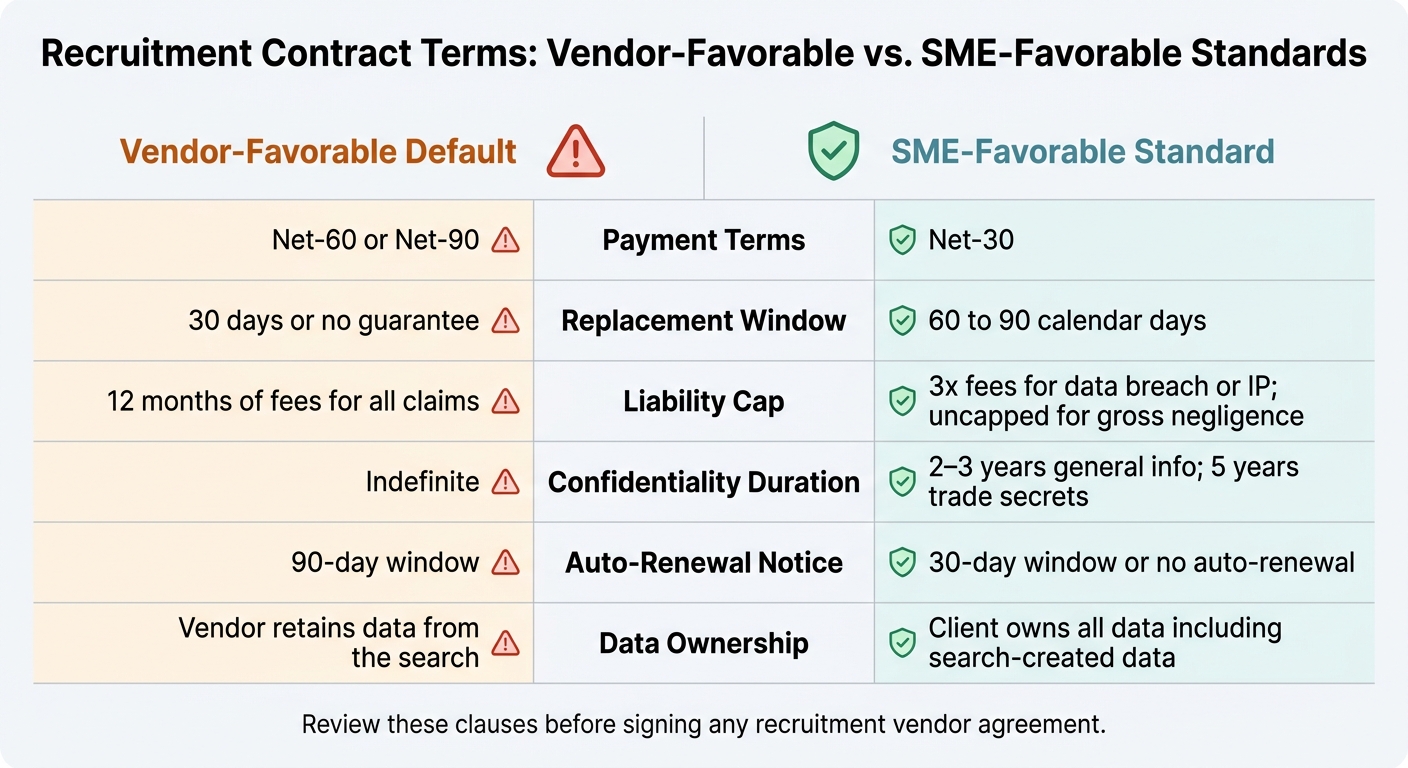
Recruitment Contract Terms: Vendor-Favorable vs. SME-Favorable Standards
Use this clause-level checklist to spot the language that can weaken the five provisions above.
On scope and reporting: Check per-role delivery targets and reporting cadence. If those points are vague, it gets hard to measure output, manage delays, or hold the vendor to account.
On fees and payment: Confirm Net-30 payment terms and pin down the invoice trigger, whether that is a signed offer, start date, or warranty end. Review fee-bypass language so it covers any freelancer, consultant, or outsourced worker. Also check for a 90-day replacement window, how many replacement attempts are allowed, and any listed exceptions such as company downsizing, force majeure, or employer misconduct or material breach [1].
On data and candidate ownership: Confirm limits on candidate use and check whether the vendor works in your ATS or uses its own system [6]. That point matters more than it looks. If candidate data sits outside your stack, you can lose visibility, control, and part of the value you paid for.
On liability and indemnification: Push for a higher liability cap for data breach and IP claims. Make sure gross negligence stays uncapped. Ask for a certificate of insurance before signing. Then check that indemnity language covers the vendor’s own negligence or misuse of data, not only third-party claims [4].
Use the matrix below to compare vendor-friendly defaults with SME-favorable terms at a glance.
| Clause | Vendor-Favorable Default | SME-Favorable Standard |
|---|---|---|
| Payment Terms | Net-60 or Net-90 | Net-30 [4] |
| Replacement Window | 30 days or no guarantee | 60 to 90 calendar days [1] |
| Liability Cap | 12 months of fees for all claims | Higher cap (3x fees) for data breach or IP; uncapped for gross negligence [4] |
| Confidentiality Duration | Indefinite | 2 to 3 years for general info; 5 years for trade secrets [4] |
| Auto-Renewal Notice | 90-day window | 30-day window or no auto-renewal [4] |
| Data Ownership | Vendor retains data created from the search | Client owns all data, including data created from the search [4] |
After the core terms, look for hidden post-termination restrictions that keep running after the deal ends. Pay close attention to non-solicit language buried inside the NDA, and narrow it to the project team rather than the vendor’s full employee base [4]. That small edit can protect your hiring freedom and cut legal friction later.
Contract Comparison Tables
These tables help you compare common recruitment contract models before you sign.
Contingent, retained, and embedded recruitment work in very different ways. The biggest differences usually come down to when you pay, how risk is shared, and what happens if a hire does not work out.
| Feature | Contingent Model | Retained Model | Embedded (Monthly) Model |
|---|---|---|---|
| Typical Fee | 20% to 30% of first-year salary [6] | 20% to 30% of first-year salary, usually split into two payments [6] | Fixed monthly retainer [6] |
| Payment Trigger | 100% due within 7 days after the candidate starts [1] | 50% at offer acceptance; 50% after the 90-day warranty period [1] | Monthly subscription, regardless of hire count [6] |
| Replacement Guarantee | 60 to 90 calendar days [1] | 90 days, standard [1] | Ongoing search and replacement support [6] |
| Post-submission fee window | 6 to 12 months from submission [1] | 12 months from submission [1] | Often client-owned [6] |
| Who bears the risk | Higher risk sits with the vendor | Shared between client and vendor | Higher commitment on the client side |
For hiring leaders, this is where contract structure starts to hit the bottom line. A contingent agreement may look low-risk at first, but short payment windows and long ownership periods can create cost later. An embedded recruitment model shifts the setup. You commit to a fixed spend, but you usually get more control over process, pipeline, and candidate ownership.
This next table shows which clause controls each risk. That matters because small wording changes can lead to extra fees, weaker protection, or less room to act if something goes wrong.
| Risk Category | Governing Provision | Typical Allocation or Penalty |
|---|---|---|
| Data Breach | Data protection clause | Prohibition on transferring resumes to third parties [1] |
| Screening Error | Scope, selection criteria appendix | Vendor must replace the candidate if documented criteria aren’t met [1] |
| Worker Classification Dispute | Scope of cooperation clause | Fee applies regardless of employment form, full-time, freelance, or consultant [1] |
| Vendor Bypass / Poaching | Non-poaching clause | 12-month ban; penalty of 100% of the original service cost [1] |
A clause like fee applies regardless of employment form can have a direct cost impact. If you bring someone in as a contractor or consultant instead of a full-time employee, you may still owe the full fee [1]. That is exactly the sort of detail that gets missed when teams move fast.
Exit terms matter just as much. They shape how easy it is to end the relationship and what costs can follow after the contract closes.
| Term Type | Standard Provision | Post-Termination Rule |
|---|---|---|
| Notice Period | 30-day written notice | New searches stop immediately |
| Cure Period | 15 to 30 days to remedy service failures | Right to fix issues before termination is triggered [1] |
| Lock-in Term | Project-based or 3 to 6 months for embedded models | No further monthly fees after the notice period ends [6] |
| Post-Termination Candidate Fees | 6 to 12 months from date of submission [1] | Full fee due if a submitted candidate is hired within 12 months, even for a different role [1] |
Post-termination candidate fee clauses are often where companies get caught. You may end the contract, pause hiring, then come back months later and hire someone who was introduced earlier. If the contract gives the vendor a 12-month fee window, the full fee can still apply, even if the role has changed [1].
For CFOs, HR leaders, and Talent teams, these tables are not just legal admin. They are a way to check cost exposure, lock-in, and hiring control before those terms hit your budget.
What to Check Before Signing
After you’ve reviewed the clause-level wording, do one last sign-off check. This is where you confirm the contract works in practice, not just on paper.
Before signing, legal, HR, and finance should each review the agreement through their own lens: compliance, liability, and cost control. Legal should also confirm the contract lines up with data protection and equal employment opportunity rules, especially if hiring crosses borders [6].
Pay close attention to candidate data. You need to know who owns submitted candidate data, whether you can reuse it for future roles, and whether the vendor’s ATS limits your access or control.
Then look at the commercial terms. Verify the exact fee trigger, the definition of "hire", and the replacement window. Check how many free replacement attempts are included too.
For high-growth SMEs, these checks help protect budget, data, and hiring speed before the contract is signed. They’re the areas most likely to create cost, control, or compliance problems later.
| Pre-Signing Check | What to Verify |
|---|---|
| Candidate data ownership | Can you retain and contact candidates for future roles without violating transfer restrictions? [1] |
| Fee trigger definition | What exact event triggers payment? [1] |
| Insurance and liability | Does the vendor’s contract assign employment-tax, insurance, and breach liability clearly? [6] |
| Non-poaching terms | Does any post-submission hiring restriction block you from hiring the candidate through another channel? [1] |
| Scope flexibility | Can the engagement scale with hiring demand? [6] |
Once these checks pass, the contract is ready for final approval.
Conclusion
Once you review the contract at clause level, the picture gets pretty clear. A recruitment vendor agreement does more than set terms with a supplier. It shapes cost control, data use, liability, and your ability to change course later. These five clauses have the biggest impact on performance, risk, and hiring flexibility as your company grows.
Set the same baseline across every vendor template:
- Net-30 payment terms
- A 90-day replacement window
- Explicit AI data-use limits
- Clear indemnification
- A 30-day auto-renewal notice
That kind of consistency cuts missed risk across every agreement you sign. It also saves time for legal, HR, and finance because each review starts from the same position, not from scratch. [1][4]
State law can affect whether clauses hold up, especially around non-solicit terms, data use, and worker classification. That is why legal counsel review is needed before you sign any final agreement, particularly for executive hiring or where large volumes of data are being shared. [4]
The aim is consistency, not perfection. When your vendor agreements follow the same core structure, your teams know what to check, approvals move faster, and your business keeps control as hiring volume grows.
FAQs
What should I negotiate first?
Start by putting a Master Service Agreement (MSA) and Statement of Work (SOW) in place.
These documents should spell out termination terms, deliverables, timelines, and intellectual property rights from the start. Get this agreed before any hiring work begins, and you create a clear framework for the engagement.
That matters for one simple reason: clarity upfront saves time, cuts risk, and avoids cost later.
When the MSA and SOW are clear, you know who owns what, what gets delivered, when it gets delivered, and what happens if priorities shift. It sets accountability on both sides and gives your team a clean operating model before recruitment starts.
How long should a replacement guarantee last?
There’s no single fixed term, but recruitment industry standards often point to 1 to 3 months. Your contract should spell out the timeframe in plain terms, so both parties know exactly what happens if a hire leaves without warning.
You’ll also want to set out how many replacement attempts are included, and list any exceptions, such as layoffs or gross misconduct. That gives you clearer expectations, less room for dispute, and better control over hiring risk.
Who owns candidate data after the contract ends?
Candidate data ownership should stay with your organisation.
Your contract should make that clear from the start. The recruitment partner should use your templates, your approval steps, and your ATS for logging activity. That keeps records in one place, gives you a clean audit trail, and stops data from being scattered across outside systems.
It also protects your team if the relationship ends. Offboarding should include a secure handover of all candidate data to your team, followed by deletion by the vendor, in line with your Data Processing Agreement.
This matters for more than compliance. It gives you control, cuts admin later, and helps you avoid the mess of rebuilding hiring records when you need them most.