
If your recruiter and hiring manager are not aligned, hiring gets slower, costs go up, and good people drop out.
I’d boil this down to one simple point: the recruiter should own the process, and the hiring manager should own the hiring decision and new hire outcome. When that split is clear, you cut wasted manager time, reduce delays, and improve hiring quality. When it is not, roles stay open longer, teams carry the gap, and revenue plans take a hit.
A few points matter most:
- Recruiters own flow: sourcing, screening, scheduling, feedback follow-up, and offer coordination
- Hiring managers own fit: role scope, must-haves, interview assessment, final decision, and ramp-up
- Shared discipline drives results: a tight intake, scorecards, and 24 to 48 hour feedback SLAs
- The cost of poor alignment is high: 33% of new hires leave in the first six months, and 66% of candidates walk away when hiring takes too long
- When internal capacity is stretched, embedded recruitment can give you more control, lower hiring admin, and lower spend versus agency-heavy hiring
Here’s the short version. If you want better hiring outcomes in SaaS, Technology, IT, Fintech, Engineering, Security, Insurance, or Professional Services, you need clear ownership, fast handoffs, and one person driving each decision point.
DRAMATICALLY Improve Recruiter-Hiring Manager Relationships
sbb-itb-a23bd6a
Quick Comparison
| Area | Recruiter | Hiring Manager |
|---|---|---|
| Main focus | Process and pipeline | Role fit and team outcome |
| Core tasks | Sourcing, screening, scheduling, candidate updates, offer process | Defining the role, assessing fit, final decision, onboarding ownership |
| Main risk if weak | Slow process, thin pipeline, poor candidate experience | Bad hires, delayed feedback, weak retention |
| Success measures | Time-to-fill, cost-per-hire, pipeline flow | Quality of hire, retention, team output |
| Best use of time | Running the hiring workflow | Making hiring decisions and leading ramp-up |
If you are scaling and your managers are losing hours to hiring admin, this is usually where to rate your recruitment process to fix the problem first.
What the recruiter owns in the hiring process
The recruiter owns process execution. That covers sourcing, screening, scheduling, communication, and offer logistics. They keep the hiring process moving and manage candidate flow. The hiring manager owns role fit and makes the final decision.
This split matters. When each person sticks to their lane, you save manager time, cut delays, and keep hiring on track.
Pipeline building, screening, and market insight
Recruiters turn a hiring manager’s brief into a sourcing plan. In practice, that means writing the job post, choosing the right channels, reaching passive talent, and building a pipeline based on the actual market, not just whoever applies inbound.
They also screen resumes and run phone screens against agreed criteria. That protects hiring manager time and keeps the process tight. Instead of dragging managers into early-stage filtering, the recruiter brings forward people who meet the brief.
Recruiters should also bring market insight to the table. That includes candidate availability, salary trends, and how competitive the role is. If the salary is below market, or the talent pool is thin, they need to flag that early and help reset expectations before time gets burned. Access our hiring resources for more tools to streamline your process.
Done well, this helps you avoid a common hiring mistake: running a process for weeks before anyone says the role was priced wrong from day one.
Recruiters should use market data to shape:
- Sourcing approach
- Compensation expectations
- Hiring timeline
Once the pipeline is in place, the recruiter keeps interviews moving and feedback lined up.
Interview coordination, communication, and offer logistics
After screening, the recruiter owns interview coordination, communication, and feedback flow. That includes scheduling across stakeholders, collecting structured feedback after each stage, and keeping candidates informed throughout the process.
This isn’t admin for admin’s sake. Slow communication leads to candidate drop-off. Good people don’t wait around forever, especially in SaaS, Technology, IT, Fintech, Engineering, Security, Insurance, and Professional Services. If feedback drags, your pipeline weakens and time-to-hire grows.
The recruiter keeps that from happening. They push for fast feedback, keep everyone aligned, and make sure candidates aren’t left in the dark.
At offer stage, the recruiter handles offer prep, negotiation, and onboarding handoff. That lets the hiring manager stay focused on assessment and the final call.
That division of work sets up the hiring manager’s role in defining the position and making the final decision.
What the hiring manager owns in the hiring process
If the recruiter owns execution, the hiring manager owns definition and decision. Put simply, the hiring manager decides what the role needs to achieve and whether the person hired will fix that problem.
The recruiter runs the process, often acting as Recruitment as a Service to ensure execution stays on track. The hiring manager owns whether the hire solves the team’s need.
Role definition, success profile, and shortlist review
The hiring manager’s first job is to define the business problem behind the role. That includes the must-have skills and what success looks like in the first 90 days. If this part is vague, the search drifts. Time gets lost, interview capacity gets wasted, and hiring slows down.
A structured intake conversation at the start of the search gets the hiring manager and recruiter aligned on those priorities.
The hiring manager should bring:
- 2 to 3 non-negotiables
- team context
- 90-day expectations
The recruiter then turns that input into a sourcing plan and job description.
This is the point where recruiter execution becomes a targeted search. Without that shared intake, you’re not running a focused hiring process, you’re just reacting to CVs.
When the recruiter delivers a shortlist, the hiring manager reviews it against the role’s must-have criteria and gives final approval for candidates to move into interviews.
Interview evaluation, final decision, and onboarding accountability
Once candidates reach the interview stage, the hiring manager leads the core evaluation. That means assessing technical ability, functional fit, and how the person would work within the team.
After interviews, the hiring manager makes the final call on candidate fit [6][1]. The recruiter can flag process concerns and share market context, but the hiring manager owns the selection decision.
That ownership doesn’t stop when the offer is accepted. The hiring manager is responsible for new-hire integration and stays accountable for quality of hire at 90 days and one year.
That matters for business results. A hire is not a win just because the role is filled. It only counts if the person ramps well, performs in the role, and stays long enough to add value.
Those role boundaries matter most when you compare ownership, metrics, and handoff points.
Recruiter vs. hiring manager: key differences in ownership and success metrics
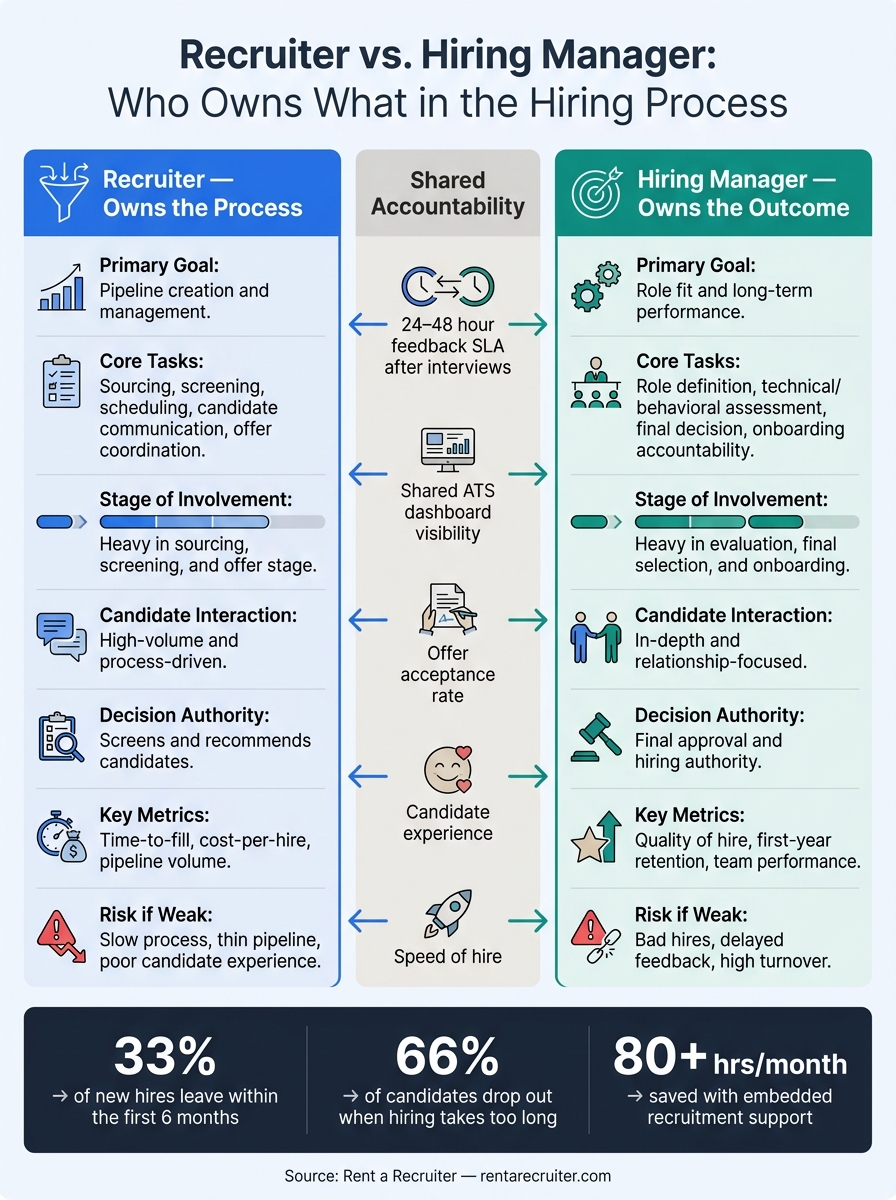
Recruiter vs. Hiring Manager: Who Owns What in the Hiring Process
Recruiters own the process. Hiring managers own the outcome.
That distinction matters because each role is measured in a different way. The recruiter is judged on pipeline flow and process health. The hiring manager is judged on quality of hire, retention, and team output. If you blur those lines, hiring slows down, accountability slips, and costly mistakes creep in.
Where responsibilities differ
Use this split to define ownership at each stage and set clear success measures.
| Recruiter | Hiring Manager | |
|---|---|---|
| Primary goal | Pipeline creation and management [1] | Role fit and long-term performance [1] |
| Stage of involvement | Heavy in sourcing, screening, and offer stage [6] | Heavy in evaluation, final selection, and onboarding [6] |
| Day-to-day responsibilities | Resume screening, outreach, scheduling, coordination [1] | Technical and behavioral assessment, team alignment [1] |
| Candidate interaction | High-volume and process-driven [1] | In-depth and relationship-focused [1] |
| Decision authority | Screens and recommends candidates [3] | Final approval on candidate fit and hiring authority [3] |
| Core metrics | Time-to-fill, candidate volume, cost-per-hire [1] | Quality of hire, first-year retention, team performance [1][3] |
| Risk when underperforming | Weak pipeline, poor candidate experience, bottlenecks [4] | Bad hires, turnover, slow feedback that causes candidate drop-off [2][5] |
For hiring leaders, this is where many teams get stuck. A recruiter can bring in strong shortlisted talent, but if the hiring manager delays feedback or changes the brief halfway through, the process breaks. On the other side, a hiring manager can know exactly what great looks like, but without enough top-of-funnel activity, there is nothing to assess.
That is why ownership needs to be clear from day one. Not just in theory, but in the actual workflow.
Where accountability overlaps
Even with clear ownership, both roles share responsibility for speed, experience, and offer acceptance. Neither can carry those results alone.
This is where scaling companies either tighten the process or lose good people. In fact, 66% of candidates report giving up on a promising job opportunity because the hiring process took too long [5]. That is not just a hiring issue. It is a direct hit to delivery plans, team capacity, and revenue goals.
Shared metrics need shared operating rules, not vague ownership.
A simple setup usually works best:
- Agree on a 24 to 48 hour feedback window after interviews [4]
- Use a shared ATS dashboard so both sides can see pipeline status in real time [1]
- Define each handoff clearly, including interview feedback, shortlist approval, and offer discussion
In most cases, the recruiter handles formal terms, while the hiring manager sells the vision and opportunity [1][7]. That split makes sense. One drives process control. The other drives team fit and close-rate.
When those handoffs are spelled out, overlap stops being a problem. It becomes coordination with pace, which is what keeps hiring moving when the business needs results fast.
How collaboration should work in practice
Clear ownership only works if it turns into a repeatable workflow. If the split between recruiter and hiring manager stays vague, hiring slows down fast.
The ideal workflow from intake to onboarding
Start with a structured 45-minute intake. A poor intake leads to off-target shortlists, wasted sourcing time, and slower decisions. The intake should answer two core questions: What business problem does this hire need to solve? and What are the two or three non-negotiable skills? [8]
From there, the hiring manager signs off on the role requirements, and the recruiter turns that into sourcing activity.
The simplest approach is a clear workflow from intake through to onboarding:
| Stage | Who Leads | What Good Looks Like |
|---|---|---|
| Intake meeting | Both | Role requirements, must-haves, compensation, and timeline agreed before sourcing begins |
| Job description & sourcing brief | Hiring manager approves; recruiter converts | Role brief supports sourcing |
| Candidate screening | Recruiter | Qualified shortlist delivered |
| Shortlist review | Hiring manager | Prompt feedback on candidates |
| Interviews & scorecard feedback | Hiring manager | Consistent evaluation against agreed criteria |
| Offer approval | Hiring manager decides; recruiter coordinates | Final decision and offer logistics confirmed |
| Onboarding transition | Hiring manager | Smooth handoff into onboarding |
A weekly pipeline review helps you adjust the brief, shortlist, and timeline fast. That matters more than most teams think. Small delays in feedback or shifting role scope can quietly add weeks to time-to-hire.
Common friction points and how to fix them
Most hiring delays come from the same few issues: weak briefs, slow feedback, uneven interview criteria, and no clear decision owner.
The fix is usually straightforward:
- Use a structured intake template so each role starts with the same baseline information
- Use scorecards so interviewers assess candidates against the same criteria
- Set feedback deadlines after interviews
- Assign one decision owner per role, so there is no confusion about who gives the final yes or no [4][6]
This is not just a process problem. It affects retention and hiring cost too.
One stat worth keeping in mind: 33% of new hires quit within the first six months, often because there was not enough clarity during hiring about whether the role was a true fit [2].
When embedded recruitment support helps scaling teams
When hiring volume increases, that rhythm often breaks. Internal teams get stretched across multiple open roles, and admin starts to pile up. When that happens, vacancies can sit open for more than 60 days [6].
That is where embedded recruitment support can help. An embedded recruiter works inside your team, owning process design and day-to-day execution, while the hiring manager keeps control of role definition and final selection [3][6].
Rent a Recruiter places experienced recruiters inside scaling teams within days, bringing structure, visibility, and end-to-end delivery. The model fits high-growth companies in technology, SaaS, fintech, engineering, and professional services. It can cut hiring costs by up to 70% and save 80+ hours a month in hiring admin.
Conclusion: Clearer role ownership leads to better hiring outcomes
Recruiters run the process and build the pipeline. Hiring managers define the role, assess fit, and make the final call.
That split sounds simple, but it’s where many teams get stuck. Recruiters own process. Hiring managers own the hiring outcome. Recruiters keep momentum, screen candidates, and cut admin before managers spend time on interviews. Hiring managers focus on evaluating fit and choosing the right person.
When that line is clear, your team wastes less time. Managers stay focused on selection and close. Recruiters keep hiring moving.
To make it work, three things matter most:
- A structured intake to fix blurry ownership at the start
- A 24 to 48 hour feedback SLA to stop drift
- One decision owner per role to keep calls clear
That cuts delay and improves hire quality. Clear ownership leads to faster decisions and better hires.
As hiring demand grows, keeping that structure in place gets harder. When hiring volume moves past internal capacity, Rent a Recruiter can embed an experienced recruiter directly into your team within days, running hiring end to end while your hiring managers stay focused on selection. Book a call to see how much your team could save.
FAQs
Who owns candidate feedback follow-up?
Candidate feedback follow-up is a shared responsibility, but ownership needs to be clear. The recruiter keeps the process moving, chases feedback when needed, and makes sure the hiring manager stays on track.
Each interviewer, including the hiring manager, is responsible for submitting completed, scorecard-based feedback by the agreed deadline, usually within 24 hours. That matters because slow feedback drags out hiring, creates bottlenecks, and puts strong candidates at risk.
Set that expectation early, during the initial intake meeting. If everyone knows the deadline from day one, you save time, cut delay, and keep the hiring process under control.
What should be covered in a hiring intake meeting?
A hiring intake meeting should bring all decision-makers into one room and turn a loose hiring request into a clear, written hiring agreement.
That matters because vague briefs slow everything down. You get mixed feedback, shifting expectations, and a hiring process that drags on. A strong intake meeting fixes that early. It gives you alignment before sourcing starts, not halfway through the process when time and money have already been lost.
Your intake should cover:
- The role’s purpose and the business problem it solves
- Success metrics for the first 6, 12, and 24 months
- Required skills vs. flexible skills
- Salary range in U.S. dollars
- Interview structure
- Final sign-off
- Hiring timeline
- Any past successes or failures in the role
Done well, this meeting becomes the baseline for the whole hiring process. It helps your team move faster, cut rework, and make better hiring decisions with less back-and-forth.
When does embedded recruitment make sense?
Embedded recruitment makes sense when your company needs to scale hiring fast, deal with sudden demand, or build a more predictable internal hiring function.
With an embedded recruiter inside your team, you get end-to-end hiring support, better structure, and clearer visibility across the process. You also cut reliance on external agencies and, in many cases, lower hiring costs by up to 70% compared with commission-based models.
There’s also the time factor. Many scaling companies save 80+ hours per month on hiring and admin work, which gives your leaders and hiring managers more time to focus on growth instead of chasing CVs, scheduling interviews, and managing agencies.