
When turnover climbs, growth gets more expensive fast. For scaling SMEs, the fix usually comes down to three things: market-aligned pay, clear career paths, and better manager discipline. Get those right, and you cut backfill costs, reduce lost productivity, and take pressure off the people who stay.
In plain terms, this is the issue: replacing one employee can cost 50% to 200% of annual salary, and poor onboarding can double the chance of a first-year exit. If you want to keep teams stable, I would focus on pay benchmarking, progression frameworks, workload planning, and structured onboarding first.
Here’s the short version:
- Pay and flexibility need to match the market, or employees will test it for you
- Career growth needs to be written down, not implied
- Managers need regular one-to-ones, clear feedback, and ownership of retention
- Workload and role clarity need fixing before burnout becomes normal
- Hiring structure matters, because poor hiring often leads to early churn
For CEOs, CFOs, and HR leaders, the business case is simple: lower turnover means lower hiring spend, less lost time, and more stable delivery. If you are scaling in SaaS, Technology, IT, Fintech, Engineering, Security, Insurance, or Professional Services, these are the retention levers most likely to affect cost and team performance first.
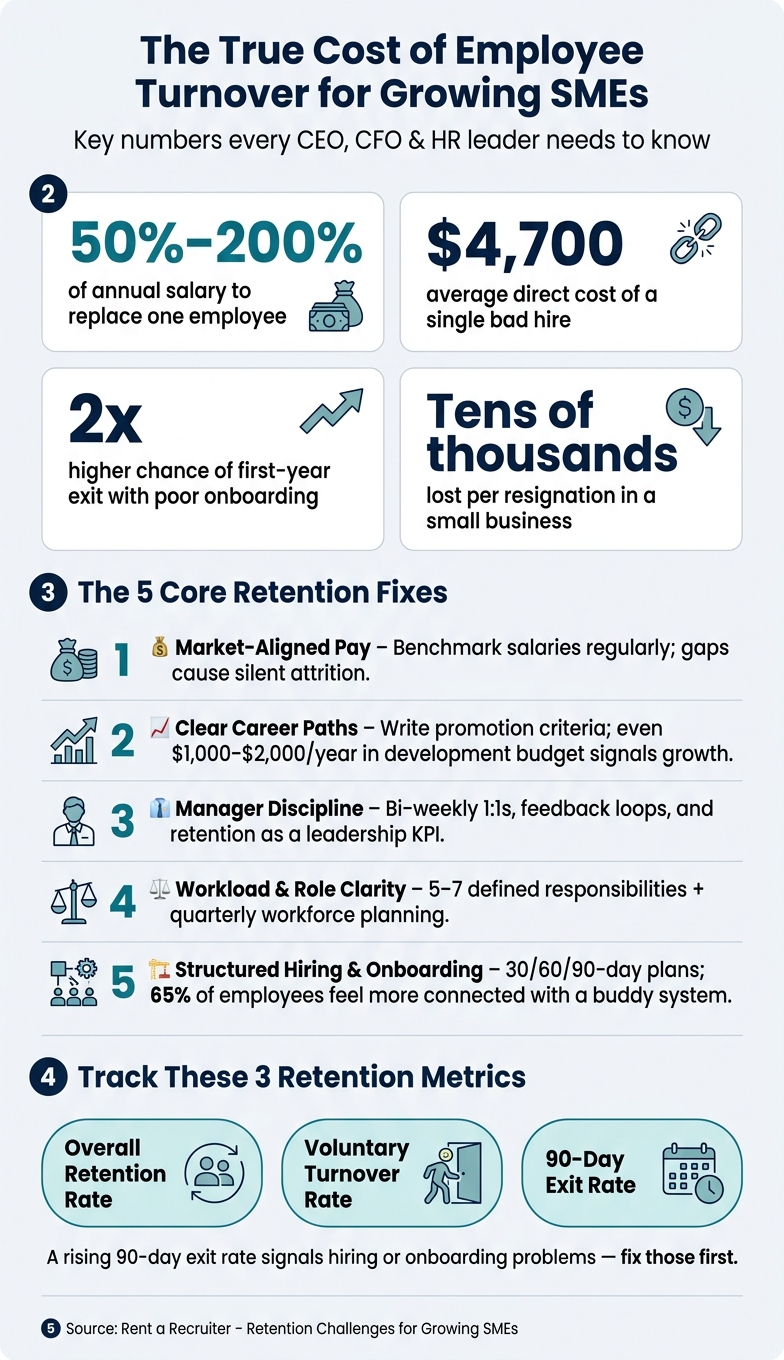
The True Cost of Employee Turnover for Growing SMEs
14 Strategies to Skyrocket Employee Retention
sbb-itb-a23bd6a
The main retention challenges growing SMEs face
As SMEs grow, the retention strain tends to show up in three areas: pay, growth, and management.
Compensation, benefits, and flexibility falling behind market rates
A lot of growing SMEs don’t benchmark pay often enough. Over time, salaries slip below market, and the issue only becomes clear when employees start getting outside offers.
Equity can help, but it doesn’t pay this month’s rent or childcare bill. That’s the gap.
Flexibility now sits alongside salary in the decision-making process. Remote work, hybrid options, and sensible scheduling are no longer nice extras for most teams. If you enforce a rigid in-office policy without a clear business case, you give away ground for no good reason.
Pay stops people from leaving. Growth gives them a reason to stay.
Career progression and development paths are unclear
Your best people want to know where they’re heading. In flat teams or fast-moving companies, that path is often blurry.
There may be no written promotion criteria. No clear milestones. No straight answer to the question, "What does growth look like here?"
When that answer is missing, strong performers start looking elsewhere for a better title, more ownership, or a learning path that feels like actual progress. If employees leave for similar pay but better titles, career growth, not compensation, is the main driver [1].
Even a $1,000 to $2,000 annual development budget sends a clear signal that growth matters [2].
Management, workload, and communication do not keep pace with growth
This is where a lot of the damage happens quietly.
As companies scale, leadership can become uneven. Managers may default to blame or pressure instead of trust and accountability. Feedback becomes patchy. Recognition fades. Decisions get made with little or no explanation.
Workload is tied to this, but it’s a separate issue. In growing SMEs, people often end up covering multiple jobs at once. Without role clarity, that turns into pressure that doesn’t let up. Work keeps piling up, ownership gets fuzzy, and employees carry the gaps until the strain stops feeling temporary and starts feeling normal.
These issues won’t be fixed with perks alone. They need system-level changes in pay planning, career paths, manager capability, and workload design.
Practical solutions that reduce turnover
These fixes do not need a full HR team. They need consistency, clarity, and early action.
If you want to lower turnover, start with the three areas employees feel first: pay, growth, and workload. Get those right, and you remove a lot of the friction that pushes people out the door.
Build a retention package employees can clearly understand and value
Start with pay. Benchmark compensation against the market using public salary data [2]. If salaries sit below the midpoint on a regular basis, you have a retention gap, and employees will spot it fast.
Flexibility matters too. Offer flexible schedules, remote work where feasible, and predictable PTO [3]. For many teams, that is not a nice extra. It is part of the deal employees use to judge whether staying makes sense.
Smaller companies can also use a PEO to access stronger group health benefits [2][5]. That is a practical way to narrow the benefits gap without building a large HR function or adding internal admin you do not have capacity for.
Once pay and flexibility are in line, the next step is to make growth easy to see.
Create visible career paths and stronger manager habits
Write the answer into your progression criteria.
In flat SME structures, management roles are often limited. That does not mean growth has to stall. Skill-based progression is a practical option. You can create senior, lead, or specialist designations tied to demonstrated skills rather than headcount growth. A skills-based progression model, moving from novice to senior based on what someone can do, not just how long they have been there, gives people a written path forward without adding new management layers [5].
Back that up with a modest annual development budget. Even $1,000 to $2,000 per employee for courses or certifications shows that growth is real, not just something mentioned in the hiring pitch [2].
Manager habits matter just as much. Bi-weekly or monthly one-on-ones focused on career goals and skill gaps, not just project updates, build trust and keep people engaged [2]. If managers only talk to employees when there is a problem, retention risk goes up. Retention should be a leadership KPI, tracked alongside financial performance [5].
When growth is clear, the next risk is overload.
Cut burnout through better workforce planning and role clarity
Start with role clarity. Move away from vague multi-role expectations. List five to seven specific responsibilities and set clear success metrics for the first six to twelve months [4][1]. When people know what they own, and what good looks like, pressure feels more manageable.
Workload planning needs the same discipline. Shifting from annual headcount budgets to quarterly planning cycles lets you re-sequence roles based on what the business needs now, not what it needed twelve months ago [4]. That helps you spot capacity gaps early, before they turn into burnout, missed targets, or another backfill hire.
Use stay interviews to surface retention risks early. Run them in group settings or through individual surveys to spot flight risks while you still have time to act [5].
Retention systems that support scale
One-off fixes can help for a while. But retention gets much easier to manage when you build repeatable systems around hiring, onboarding, and feedback.
That means turning good intentions into manager habits. The goal is simple: less guesswork, fewer early exits, and a hiring process that holds up as your team grows.
Standardize onboarding, feedback, and retention metrics
Once the main issues are addressed, retention tends to improve when those fixes become part of your standard process.
Start with a written 30/60/90-day plan. Give new hires clear expectations, clear milestones, and scheduled check-ins. That alone helps managers stay consistent instead of making it up as they go.
Add a buddy system too. 65% of startup employees report feeling more connected to team culture when one is in place [2]. That matters, especially in scaling teams where new starters can feel lost fast.
Short pulse surveys between formal reviews also help. They give you a simple way to spot disengagement early [2]. Use the same check-in rhythm across the business so managers can catch issues before probation ends, not after it.
Track a small set of core metrics as your baseline:
- Overall retention
- Voluntary turnover
- 90-day exit rate [2]
If your 90-day exit rate is rising, look at hiring and onboarding first [2]. In many cases, the problem starts there.
Build hiring capacity to reduce turnover from poor hires
Retention does not start on day one. It starts before the offer goes out.
If hiring lacks structure, the same turnover problems will keep showing up. Weak hiring leads to avoidable churn, wasted time, and extra cost. So hiring needs the same discipline as onboarding.
The average direct cost of a bad hire is about $4,700, and replacing an employee costs between 50% and 200% of their annual salary once recruiting, training, and lost productivity are factored in [1][2].
That is why internal hiring capacity matters. Clear job briefs, scored interview rubrics, realistic job previews, and structured reference checks all reduce the risk of poor hires.
If your SME does not yet have that setup, Rent a Recruiter places experienced recruiters directly into your team, often within days, to run hiring end-to-end. Clients cut hiring costs by up to 70% compared with traditional agency fees and save more than 80 hours per month in internal hiring and admin time.
For CEOs, CFOs, and HR leaders, that means lower hiring cost, less leadership drag, and more consistency when growth puts pressure on the business.
Conclusion: The fixes that keep teams stable
Retention problems rarely come from just one issue. When people systems don’t keep pace with growth, turnover climbs. And for a small business, even one resignation can cost tens of thousands of dollars [1]. The fix is not a one-off policy or a rushed HR project. It’s a system that keeps working as your headcount grows.
That means treating retention like part of how the business runs, not something left until problems show up. The core fixes are simple: pay, career paths, manager training, workload planning, and onboarding. On their own, each helps. Put together, and used consistently, they give a growing team the stability it needs to do good work.
For CEOs, CFOs, and HR leaders, the business case is clear. Lower turnover cuts hiring costs, reduces leadership time spent replacing leavers, and keeps more continuity across the business.
Poor hiring often leads to early churn, so recruitment structure matters as well. If you need to build that capacity fast, Rent a Recruiter places experienced recruiters directly into your team, often within days, to bring structure and consistency to hiring as you scale.
FAQs
What should we fix first to reduce turnover?
Start with your onboarding process. Early attrition is expensive, and it often starts fast. Research shows 20% of turnover happens within the first 45 days, and 44% of new hires regret their decision within the first week.
That has a direct business cost. You lose time, manager effort, and hiring spend, then you have to start the process again.
A structured onboarding plan helps reduce that risk. Set clear 30-60-90-day goals, build in steady check-ins, and prepare properly before day one. Pre-boarding matters more than many teams think. It gives new hires context, sets expectations, and helps them feel part of the business before they even log in.
When people have clarity on what good looks like, and regular support in the first few months, they settle in faster and are more likely to stay.
How can SMEs improve retention without a big HR team?
SMEs can improve retention with high-impact, low-cost steps that help people feel connected, supported, and clear on where they’re going.
Use structured onboarding from day one. A 30-60-90-day plan gives new hires direction. A peer buddy helps them settle in faster. Regular check-ins give managers a simple way to spot issues early, before they turn into resignations.
You also need a steady flow of feedback. Pulse surveys and stay interviews can show you what’s working, what’s frustrating people, and where small changes could save you time and hiring cost later.
Keep your mission visible in day-to-day work, not just on a slide deck or careers page. People stay longer when they can see how their work matters.
It also helps to offer flexibility where you can, recognise contributions consistently, and make growth feel real. That might mean training, stretch projects, or new responsibilities, not just promotions.
For scaling companies, this matters because retention protects hiring spend. When people stay, you cut back on backfilling, reduce team disruption, and keep momentum in the business.
When does turnover signal a hiring problem?
Early turnover is often a hiring signal, but not always for the reason people think.
When people leave soon after joining, the issue may sit in onboarding, role setup, or expectation-setting, not just recruitment. Poor 90-day retention usually points to a gap between what was promised and what the job looks like day to day.
If a lot of new hires leave within the first 45 to 90 days, that’s a red flag. In plain terms, the role may not match what was presented during the interview process.
For CEOs, CFOs, and HR leaders, this matters because early exits are expensive. You lose time, reset the hiring process, and pay twice for the same seat. Fixing the handoff between hiring and onboarding can protect retention and cut wasted spend.