
When hiring plans fail, it’s rarely about bad recruiters. The real problem? Leadership isn’t looped in early enough. Without buy-in, recruitment becomes reactive, budgets get squeezed, and timelines slip. For scaling companies, this disconnect can cost millions in lost revenue or missed opportunities.
Here’s how to fix it:
- Tie hiring to business goals: Every role should link directly to measurable outcomes like revenue, risk, or growth.
- Show the cost of not hiring: Use data to highlight risks, like delays or penalties, tied to unfilled roles.
- Speak leadership’s language: CEOs care about growth, CFOs focus on costs, and department heads need team results.
- Present a clear, data-backed plan: Use metrics like revenue lost to vacancies or cost-per-hire to make your case.
By shifting the conversation from "what this hire costs" to "what it costs if we don’t hire", you’ll align recruitment with talent acquisition strategies, secure approval faster, and build trust with leadership. For companies struggling to execute, embedded recruitment can bridge the gap, cutting costs by up to 70% while saving 80+ hours per month in admin.
Ready to turn headcount requests into strategic wins? Let’s dive in.
How HR Can Get Leadership Buy-in (Straight from a CEO)
sbb-itb-a23bd6a
Understanding Leadership Priorities and Business Goals
Before stepping into any discussion with leadership, it’s crucial to grasp their priorities fully.
Map Hiring Plans to Business Goals
Every hiring request should tie directly to a measurable business outcome, especially when hiring as you scale. This isn’t about vague goals like "team expansion" but specific triggers like a contract win, product launch, or an approved roadmap milestone. These connections make a request feel essential, not optional.
To prioritize roles, align them with business impact categories:
- Revenue-generating (e.g., Sales)
- Revenue-protecting (e.g., Customer Success)
- Risk-mitigating (e.g., Compliance)
- Mission-critical infrastructure (e.g., IT, Finance)
This framework helps leadership quickly decide what to fund first, showing that you’ve already done the heavy lifting they’d otherwise need to handle.
"A vague request signals a request to begin analysis. A specific request reads as a request for permission to act on thinking that has already been done." – Mary Beth Hazeldine, Managing Director, Winning Presentations [4]
Identify Who Approves Hiring Decisions
Not everyone in a leadership meeting has the same level of authority or focus. Understanding who makes the final call on headcount, budgets, and timelines is essential for tailoring your pitch. Typically, hiring decisions reflect three key perspectives:
| Stakeholder | Primary Priority | What They Need to See |
|---|---|---|
| CEO | Growth, vision, competitive edge | Revenue impact, strategic alignment |
| CFO | Cost, efficiency, budget control | ROI, cost-per-hire compared to benchmarks |
| Department Head | Team performance, goal delivery | Operational impact, time-to-fill by team |
Engage these stakeholders individually ahead of any formal presentation. This allows you to address objections early and ensure alignment on the urgency of the request before presenting to the group. [4]
Connect Hiring Needs to Leadership Pain Points
Leaders care about tangible risks: missed deadlines, regulatory issues, revenue declines, or team burnout. Your job is to link the hiring gap directly to these concerns.
One of the most effective strategies is to focus on the cost of not hiring. For example, in May 2026, a CTO at a mid-sized financial services firm secured approval for six engineers in just 11 minutes. How? By tying the request to a specific contract win – the Northern Trust integration. They demonstrated that without those hires, the project would face a ten-week delay, triggering a $180,000 penalty and risking $2.4 million in second-phase revenue. [4]
"The headcount requests that get approved lead with the cost of not hiring – and let the salary number sit inside that comparison rather than stand alone." – Mary Beth Hazeldine, Managing Director, Winning Presentations [4]
When you shift the conversation from "here’s what this hire costs" to "here’s what it costs if we don’t hire", you change the entire dynamic. This approach lays the foundation for a persuasive, data-driven case that resonates with leadership.
Building a Data-Driven Business Case for Hiring
Getting leadership on board means presenting data that ties hiring decisions directly to business outcomes. This section focuses on using precise metrics to validate your case, building on the idea of aligning hiring needs with business challenges.
Use Metrics to Define the Hiring Problem
Skip metrics that focus on activity, like the number of applications or job postings. Instead, zero in on outcomes such as quality of hire, revenue lost due to vacancies, and cost-per-hire compared to industry standards.
Here’s a quick breakdown of key metrics to include in executive discussions:
| Metric | What It Measures | Why Leadership Cares |
|---|---|---|
| Revenue Lost to Vacancy | The daily financial impact of unfilled roles | Links hiring delays directly to revenue losses |
| Quality of Hire Score | Combines 90-day performance, 6-month effectiveness, and 12-month retention rates | Demonstrates the long-term value of recruitment decisions |
| Cost-per-Hire | Total cost to fill a role | Highlights efficiency; the 2025 industry average is $5,475 for non-executive roles [2] |
Keep the focus on results. Detailed operational data can stay in an appendix for those who want a deeper dive. You can also explore our recruitment resources for additional templates and guides.
"Every metric you present should answer both [So What? and Now What?]. If you can’t immediately connect that number to revenue impact or competitive risk, it doesn’t belong in your deck." – John Vlastelica, Founder, Recruiting Toolbox [2]
Calculate the Cost of Delayed Hiring vs. Acting Now
For CFOs and CEOs, one of the most compelling figures is the daily cost of inaction. Use this formula to calculate revenue loss per vacancy:
(Annual revenue ÷ number of employees) ÷ 365 × average days to fill × number of open positions [2]
Take this example: A company with $50 million in annual revenue and 200 employees loses about $685 per employee per day in productivity. With 8 open roles and an average of 44 days to fill, the total loss is approximately $240,000 in output. And that’s before factoring in overtime costs, project delays, or employee burnout. [2]
In January 2026, LevelUP shared a real-world example: a vacant IT infrastructure manager role with a $150,000 salary delayed critical modernization projects worth $2 million. This vacancy alone put $130,000–$170,000 of that value at risk due to delayed upgrades and rework. [5] Framing hiring needs as a potential risk to business operations can turn a simple headcount request into a strategic priority.
Set Clear, Measurable Hiring Goals
Once you’ve established the financial impact, define specific hiring goals that connect directly to business outcomes. Avoid vague objectives like "hire faster" or "improve quality." Instead, create tiered, time-bound targets:
- Base level: Maintain current operations
- Strategic level: Fill critical gaps
- Transformational level: Build a strong talent pipeline for future growth
Additionally, consider goals beyond time-to-hire. For instance, a target like "reduce time-to-full-contribution for sales hires from 90 days to 60 days" directly ties hiring to revenue impact – a language that resonates with leadership.
"Start with the business question, not the data." – Lori Sylvia, Founder, Rally Recruitment Marketing [2]
Presenting Your Hiring Plan and Getting Leadership Approval
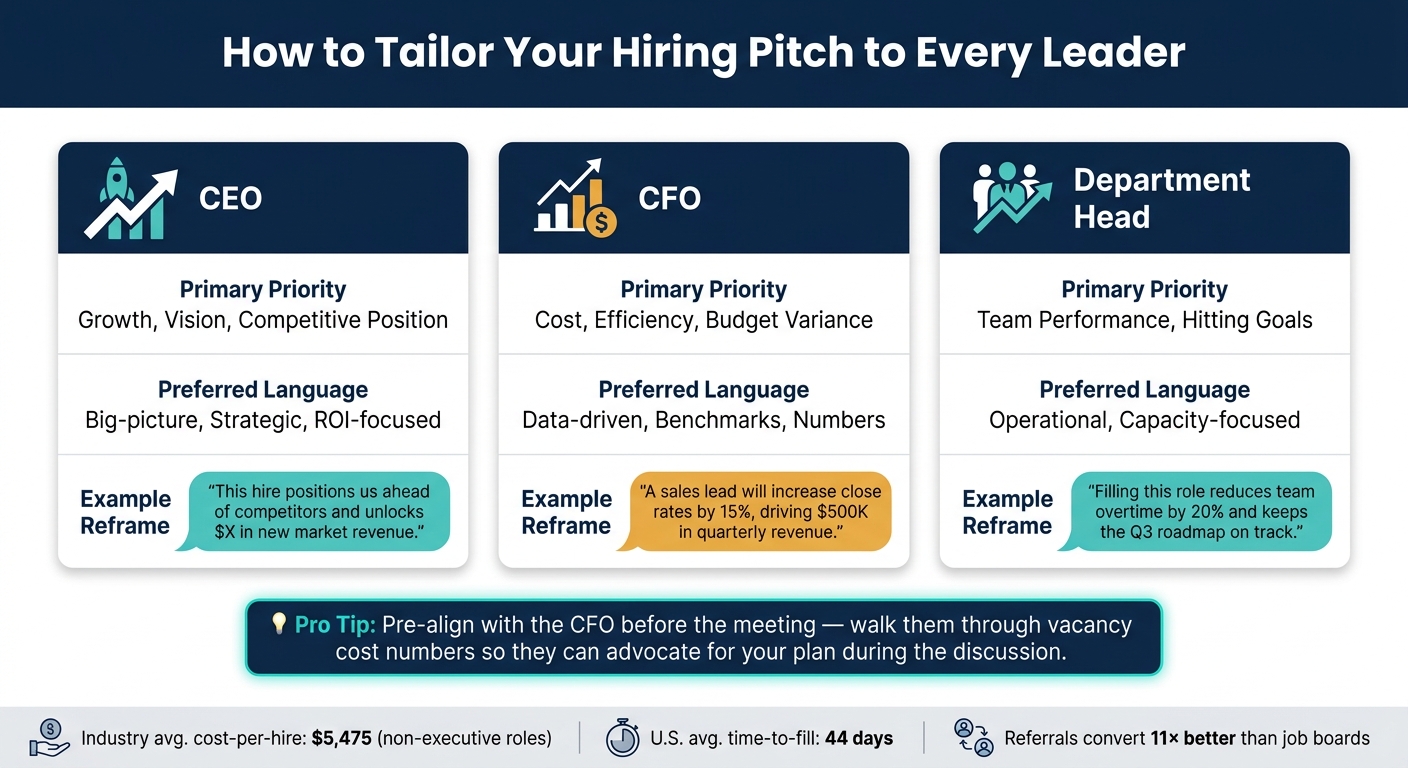
How to Tailor Your Hiring Pitch to Every Leader
Once you’ve built a solid, data-backed case, the next hurdle is presenting it in a way that turns leadership’s interest into approval. The delivery is just as important as the content.
Build a Clear, Concise Hiring Plan Presentation
For executive audiences, a streamlined five-slide presentation often works best. Here’s how to structure it:
- Start with the business problem – focus on a specific risk to an initiative, not just a general staffing shortfall.
- Quantify the cost of inaction using your vacancy cost formula.
- Frame headcount as an investment with a clear return.
- Outline the hiring timeline, ramp-up plan, and success metrics for 30, 90, and 180 days.
- End with a decision request that specifies the budget, headcount, and approval deadline.
During the meeting, aim for a concise flow: 2 minutes on essential recruitment metrics, 5 minutes for the story behind the numbers, 5 minutes on action plans and projected outcomes, and 3 minutes for discussion. Use visuals effectively – titles like "Referrals convert 11x better than job boards" are far clearer and more impactful than vague labels like "Source conversion data." [2]
"The requests that get approved aren’t the ones with the best justification. They’re the ones with the best presentation." – Mary Beth Hazeldine, Managing Director, Winning Presentations [6]
With the structure in place, tailor your delivery to address the specific concerns and priorities of each leader.
Tailor Your Pitch to Each Leader’s Priorities
A one-size-fits-all hiring plan won’t land equally well with every decision-maker. While your earlier stakeholder analysis identifies key decision criteria, the table below highlights how to adapt your messaging style:
| Stakeholder | Primary Priority | Preferred Language |
|---|---|---|
| CEO | Growth, vision, competitive position | Big-picture, strategic, ROI-focused |
| CFO | Cost, efficiency, budget variance | Data-driven, benchmarks, numbers |
| Dept. Head | Team performance, hitting goals | Operational, capacity-focused |
Adjusting your language can make or break your pitch. For instance, instead of telling a CFO, "we need a sales lead to boost morale," reframe it as, "a sales lead will increase close rates by 15%, driving $500K in quarterly revenue." [3]
Ask for Specific Decisions on Budget, Headcount, and Timelines
End your presentation with a clear ask. Specify the budget, headcount, and timelines you need. Offering tiered options – such as Tier 1 for immediate risk reduction, Tier 2 for addressing all current gaps, and Tier 3 for future growth – can shift the conversation from "should we hire?" to "what level of investment works best?" [7]
If your full request feels too ambitious, propose a phased approach. For example, suggest approving six hires now and another six next quarter. This keeps progress moving rather than stalling over a single large decision. It’s also wise to pre-align with the CFO before the meeting. Walk them through the cost-of-vacancy numbers ahead of time so they can advocate for your plan during the discussion. [7]
"Successful headcount requests don’t ask for people – they present a business case for outcomes." – Mary Beth Hazeldine, Owner & Managing Director, Winning Presentations [6]
Delivering Results and Keeping Leadership Informed
Getting leadership approval is just the beginning. The real challenge – and the key to building trust – comes after the decision is made. Consistent execution and transparent reporting turn a one-time "yes" into a long-term partnership with leadership.
Track the Right Hiring Metrics
Most recruiting reports fall flat because they focus on activity metrics (like application volumes or phone screens) instead of the business outcomes that matter to leadership. No wonder only 12% of CEOs trust the metrics shared by talent acquisition teams [2]. Every metric you present should answer two critical questions: so what? and now what? For example, if time-to-fill is increasing, explain its impact on revenue and offer actionable solutions.
Here are the metrics that resonate most with leadership:
| Metric | Why It Matters to Leadership |
|---|---|
| Quality of Hire | A top priority for 31% of organizations, as it demonstrates long-term ROI |
| Cost-per-Hire | With an average of $5,475 for non-executive roles, benchmarks help justify budgets |
| Time-to-Fill | The U.S. average is 44 days – delays directly impact operational costs |
| Source Effectiveness | Referrals convert 11× better than job boards, guiding smarter resource allocation |
(Source: [2])
Keep executive dashboards focused. Limit them to five to seven key metrics to ensure leadership stays engaged [2].
"We report mostly tactical metrics that focus on costs, rather than the strategic ones that cover HR areas that impact corporate revenue." – Dr. John Sullivan, Author and Talent Strategist [2]
Set a Regular Reporting Schedule
Once you’ve identified the right metrics, consistency is key. A disciplined reporting schedule builds trust and keeps leadership aligned. Use monthly updates for CHROs and hiring managers, quarterly business reviews (QBRs) for CEOs and CFOs, and reserve weekly updates for critical hiring surges to avoid overwhelming your audience.
When presenting at a QBR, treat it as a story rather than a data dump [2]. Use a situation-complication-resolution format: explain where things stand, highlight risks of inaction, and outline your next steps. Pair this narrative with simple, annotated visuals that make key insights easy to grasp.
Use Embedded Recruitment Support to Scale Hiring
Of course, reporting is only as good as your ability to deliver results. Today, recruiters are managing 93% more applications with 14% fewer staff [2]. This imbalance can derail hiring plans and undermine leadership confidence.
This is where Rent a Recruiter can help. By embedding experienced recruiters into your team within days, we handle your hiring process end-to-end, adding structure, consistency, and transparency (see our recruitment model FAQs). Clients often cut hiring costs by up to 70% compared to traditional commission-based agencies while saving over 80 hours per month in internal admin.
For scaling companies in sectors like technology, SaaS, fintech, or professional services, embedded recruitment not only increases hiring capacity but also strengthens the accuracy of your reporting. This ensures you deliver on the promises made during the approval stage, turning leadership trust into measurable, lasting outcomes.
Conclusion: Aligning Hiring Plans with Leadership to Hit Business Goals
Gaining leadership support isn’t a one-and-done task – it’s a continuous effort grounded in trust and collaboration. The steps outlined here – linking hiring to business goals, using data to build your case, presenting a clear roadmap, and delivering results through consistent reporting – are all part of that process.
The key to success? Alignment. As Zac Miller aptly put it:
"If your ability to deliver depends on the people you hire, then recruiting can’t be an afterthought. It needs to be part of the business strategy from the start." [1]
Your hiring plan should evolve with your business. Review it quarterly, focus on metrics that show real impact and rate your recruitment process, and ensure every hire contributes to revenue growth, operational efficiency, or risk mitigation.
If your internal team is overextended or lacks the bandwidth to execute at this level, Rent a Recruiter can step in. By embedding skilled recruiters directly into your team, you gain the capacity, structure, and transparency needed to meet your hiring commitments. Plus, clients often cut hiring costs by up to 70% and reclaim over 80 hours per month from administrative tasks.
FAQs
What data should I bring to justify a new hire?
When making a hiring decision, it’s essential to articulate how the role directly affects business outcomes. Let’s break this down with clear evidence:
The Reason for Urgency
Imagine your company is gearing up for a product launch scheduled for Q2 next year. To hit that milestone, you need a Senior Product Manager who can oversee development, align cross-functional teams, and manage timelines. Without this hire, delays are almost inevitable, and the revenue tied to the product – projected at $5 million annually – could be at risk.
The Cost of Not Hiring
Failing to fill this role promptly could result in:
- Revenue Loss: Missing the product launch by just one quarter could cost $1.25 million in delayed revenue.
- Increased Operational Costs: Current teams may face burnout from covering gaps, leading to higher turnover. Replacing one senior team member alone can cost upwards of $50,000 in recruitment and onboarding.
- Market Risks: Competitors may seize the opportunity to launch similar products, reducing your market share.
Role Overview
- Position: Senior Product Manager
- Start Date: January 15, 2024 (to align with product roadmap deadlines)
- Reporting Line: Reports to the VP of Product
- Annual Cost: $160,000 (including salary, benefits, and overhead)
Workforce and Hiring Metrics
Data shows that the average time-to-fill for a senior product management role is 60 days. However, with embedded recruitment, this timeframe can be reduced by 40%, saving nearly a month. That’s critical when every day of delay could mean thousands of dollars lost.
Success Metrics for the First 6-12 Months
To measure the impact of this hire, focus on clear, actionable goals:
- First 3 Months: Develop a detailed product timeline and align stakeholders.
- 6 Months: Ensure 80% of product milestones are on track or completed.
- 12 Months: Deliver the product launch on time, achieving at least 90% of projected revenue targets for the first quarter post-launch.
This approach not only justifies the hiring decision but also ties the role directly to measurable business outcomes. It demonstrates why acting now is crucial to avoid financial setbacks and operational disruptions.
How do I calculate the cost of leaving a role unfilled?
To figure out the cost of vacancy (CoV), start by estimating the daily financial impact of the open role, then multiply that by the number of days it remains unfilled. Here’s a straightforward method: take the position’s annual revenue contribution, divide it by 220 workdays to get the daily cost, and then multiply that by the vacancy duration.
For a more detailed calculation, include factors like lost revenue, overtime or coverage costs, productivity losses, and recruitment expenses. Add these together and multiply by the number of days the position is open to get a clearer picture of the total cost.
How can I win CFO and CEO approval for headcount fast?
To secure buy-in from leadership, position headcount as a business investment, not just a reaction to workload. Start by identifying the core business problem. Is it lost revenue opportunities? Delayed product launches? Strategic risks tied to understaffing? Frame the conversation around these high-impact challenges.
Next, quantify the cost of inaction. For instance, how much revenue could be lost if key roles remain unfilled? Or, what’s the risk to your growth strategy if timelines slip? By highlighting the tangible consequences, you make the case for urgency.
Then, present headcount as the solution. Show how the right hires will deliver measurable ROI. Include a clear plan that outlines:
- Timeline: When the roles will be filled and the expected ramp-up period.
- Metrics for success: How you’ll measure the impact of these hires on business outcomes.
- Risk mitigation: A transparent strategy, including an exit plan if goals aren’t met.
Be proactive in addressing potential objections. CFOs and CEOs value specificity, so provide a fully burdened cost breakdown of the proposed roles, including salaries, benefits, and any associated costs. Set a decision deadline to keep the process moving.
By framing your proposal this way, you shift the conversation from “Can we afford this?” to “Can we afford NOT to act?” That’s the kind of pitch that gets approval.