
Every hiring decision starts with communication. Yet, 58% of candidates abandon applications due to poor communication, and 84% are more likely to accept an offer with clear timelines. For scaling businesses, unclear or inconsistent communication doesn’t just cost you top talent – it can damage your reputation and slow growth.
Here’s the solution: structured, proactive communication at every stage of the hiring process. This means clear timelines, personalized outreach, and timely feedback. When done right, you reduce drop-offs, improve offer acceptance rates, and build trust with candidates.
Key takeaways:
- Set response-time targets: No candidate should wait more than 5 days without an update.
- Personalize outreach: Candidates respond better to tailored messages.
- Be transparent: Outline the hiring process, timelines, and expectations upfront.
- Close every loop: Provide clear outcomes for every candidate, hired or not.
Scaling companies can’t afford to lose talent due to communication gaps. Building a structured, repeatable process ensures consistency and strengthens your employer brand. If your hiring team is stretched thin, Rent a Recruiter can help you streamline candidate communication and save time.
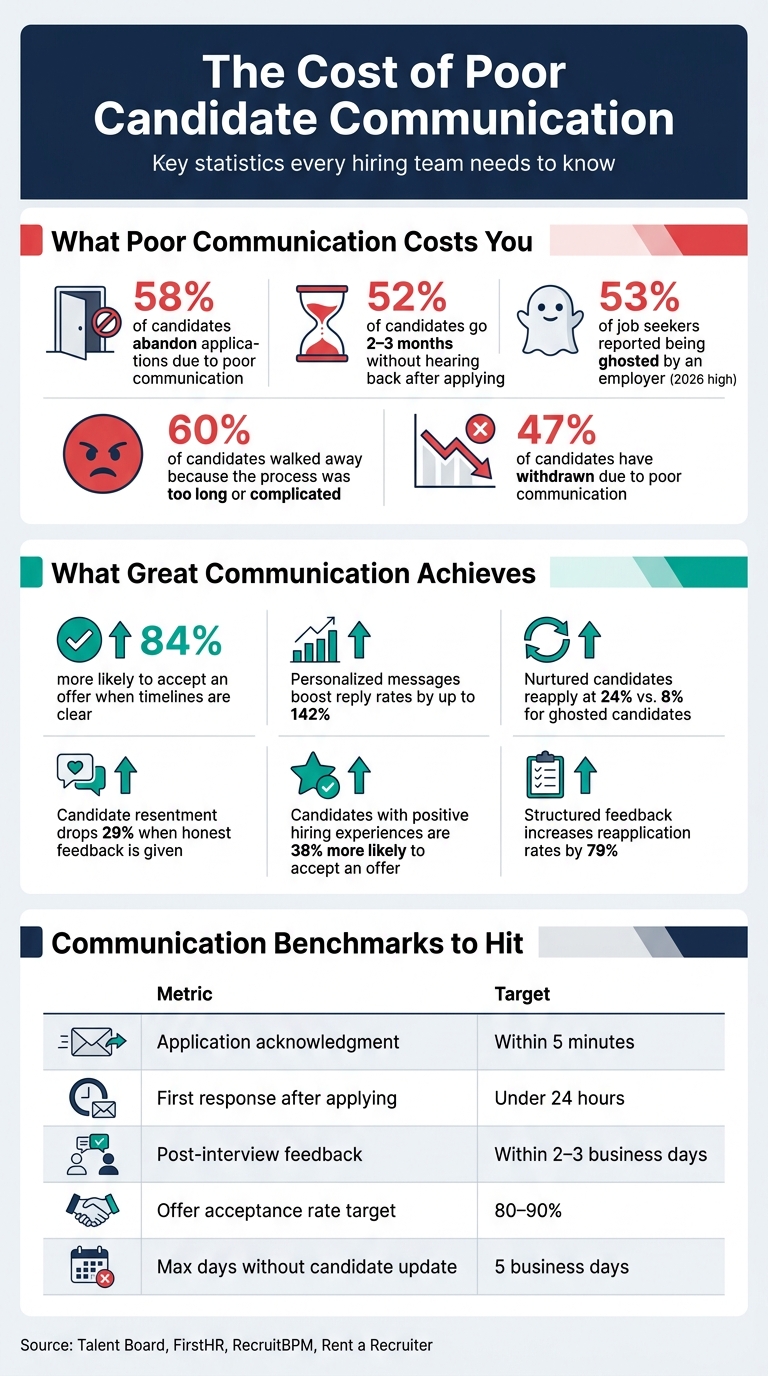
Candidate Communication: Key Stats Every Hiring Team Must Know
REPLAY: Messaging Best Practices for the Candidate Experience
sbb-itb-a23bd6a
1. Set Communication Standards for Every Stage
When communication with candidates lacks structure, it becomes reactive, often leaving applicants in the dark and driving them toward competitors. The solution? Establish clear standards for every step of the process – what needs to happen, when it needs to happen, and who is responsible. Start by identifying the key points where communication is essential to ensure consistency and build trust.
Map Key Communication Stages
Candidates expect updates at specific points in the recruitment process. These moments can either build trust or create frustration. The most important touchpoints include:
- Acknowledging applications: Confirm receipt promptly.
- Providing status updates: Keep candidates informed during the review process.
- Scheduling interviews: Communicate details and preparation steps clearly.
- Post-interview follow-up: Share feedback quickly.
- Final decision: Whether it’s an offer or rejection, communicate promptly and professionally.
- Pre-boarding: Maintain engagement after the offer is signed. Research indicates that 10–15% of accepted offers fall through before the start date when there’s no structured communication during this phase [6].
Set Response-Time Targets
Timely communication is critical. A staggering 52% of candidates report going two to three months without hearing back after applying [5]. This silence often leads them to pursue other opportunities. By setting clear response-time targets, you eliminate uncertainty and ensure your team stays on track.
| Stage | Response-Time Target | Recommended Channel |
|---|---|---|
| Application Submission | Within 24 hours | Automated email / ATS |
| Initial Screening Result | 3–5 business days | |
| Post-Interview Feedback | 1–2 business days | Email or phone call |
| Final Hiring Decision | 2–3 business days post-final interview | Phone (offer) / Email (rejection) |
| General Inquiries | Within 24 hours | Email or SMS |
It’s crucial to never let more than five business days pass without updating a candidate – even if the update is as simple as, "We’re still reviewing and will get back to you by [date]" [6].
Assign Ownership
Clear timelines only work when someone is accountable for each step. Communication often breaks down because no one takes ownership, and candidates slip through the cracks. To prevent this, create a simple workflow that assigns responsibility for every stage.
"To ensure a great candidate experience, we focus on clear communication, quick feedback, and a transparent selection process." – Denise Loschek, Head of HR, RSM Austria [2]
In smaller teams, a recruiter or embedded recruitment service typically handles most communication. In larger organizations, responsibilities can be divided between recruiters (for sourcing, screening, and rejections) and hiring managers (for interviews, offers, and pre-boarding). An ATS can further streamline this process by assigning tasks, sending reminders, and tracking every interaction – ensuring nothing is overlooked, no matter the team size [1][2].
2. Personalize Candidate Outreach
In today’s hiring landscape, generic outreach is becoming less effective. Cold recruiting emails now see an average reply rate of just 5–7% [11]. Candidates can easily spot mass messages and tend to ignore them. The solution? True personalization. But that means more than just adding a first name to a standard template.
Customize Templates
Show candidates you’ve done your homework by referencing specific details about them. Highlight a recent project, a unique skill they possess, or a career milestone. Research shows that messages with multiple personalized elements can boost reply rates by up to 142% compared to generic ones [11].
"Personalized messages can increase candidate engagement rates by more than 50%. That’s because personalization demonstrates effort and sincerity." – recruitRyte Admin [8]
Keep your outreach concise – under 100 words – and end with a clear, actionable question like, "Would you be open to a quick 15-minute call?" [9]. This respects the candidate’s time and makes it easy for them to respond. Also, ensure the email comes from a real person’s name rather than a generic inbox. Candidates are more likely to reply when they feel they’re communicating with an actual human [10]. To take it a step further, be transparent about how you found them. You can also rate your recruitment process to identify other areas for improvement.
Reference How You Found Them
Mentioning where you discovered the candidate adds a personal touch and shows your outreach is intentional. Whether it’s a LinkedIn post, a GitHub project, a conference talk, or a referral, naming the source makes your message stand out from automated database emails [13].
"Generic cold outreach signals you found them in a database. Strong personalization at this stage means referencing candidate-specific achievements in outreach…" – RecruitBPM [13]
For example, an impactful message might say: "I saw you led the migration from monolith to microservices at Acme – we’re tackling a similar challenge and looking for someone with your experience. Would you be open to a 15-minute call?" [9].
3. Be Transparent About the Process and Timelines
Uncertainty drives candidates away. A staggering 60% of candidates have walked away from a hiring process because it was too long or complicated [14]. And when hiring stretches beyond 40 days, candidate drop-off increases by 12% [3]. Clear communication about timelines and steps isn’t just courteous – it keeps candidates engaged and reduces dropouts. Here’s how to make transparency your advantage.
Outline the Full Process Upfront
Clarity builds trust. From the very first interaction, spell out the entire hiring process: how many interview stages there will be, the format of each (phone, video, or in-person), any assessments required, and a realistic timeline from application to decision. Avoid vague statements like "we’ll get back to you soon." Instead, set clear, actionable expectations. For example, including a "What to Expect" section in your initial outreach can ease candidate concerns. If delays occur, a quick update can make all the difference – 83% of candidates appreciate being informed promptly when they’re no longer in the running [2].
Share Interview Details in Advance
Once you’ve outlined the overall process, take it a step further by providing specific details before each interview. A comprehensive briefing email sent 3–5 days ahead can make a world of difference. Include the date, time (with timezone), duration, location or video link, and any technical requirements for virtual interviews. Go beyond logistics by sharing interviewer names, job titles, and a brief overview of their roles. When candidates know who they’ll meet and what to expect, they feel more prepared and confident. Research shows that candidates who understand the process perceive it as fairer [15], and interviewer experience accounts for 16% of their overall satisfaction with the hiring process [15].
| Information to Share | When to Send It |
|---|---|
| Number of rounds, format, and timeline overview | At application confirmation |
| Salary range and work model (remote, hybrid, on-site) | During first phone screen |
| Interviewer names, titles, and focus areas | 3–5 days before the interview |
| Logistics confirmation (link, time, tech requirements) | 48 hours before the interview |
| Post-interview decision timeline | Within 24–48 hours after the interview |
These small but impactful steps can significantly improve the candidate experience and streamline your hiring efforts. At Rent a Recruiter, we believe in making every step of the process transparent and efficient.
4. Confirm Every Application and Stage Update
Silence during the hiring process can destroy trust. Nearly half (47%) of job seekers say poor communication would make them pull out of a hiring process [19], and two-thirds of candidates have experienced being "ghosted" by an employer during their search [7]. To keep candidates engaged, confirm every application and provide updates at every stage.
Automate Application Acknowledgment
Set up your ATS or use AI-powered recruitment tools to send an automated confirmation email within 5 minutes of receiving an application [18].
"Silence after applying is the number one reason candidates disengage." – FirstHR [6]
Make these emails count by including key details: the role applied for, the expected timeline, and the next steps. Emails that use at least four personalization fields – like the candidate’s name, role, stage, and timeline – see a 41% boost in satisfaction scores compared to generic templates [18].
Standardize Stage Progression Updates
Keep candidates informed at every stage of the hiring process. Aim for 100% communication coverage across your pipeline [18]. Here’s a simple guide to match key events with timely updates:
| Trigger Event | Automation Action | Recommended Timing |
|---|---|---|
| Application submitted | Acknowledgment email with timeline | Within 5 minutes [18] |
| Moved to screening | Status update + next steps | Within 24 hours [18] |
| Interview scheduled | Prep guide & confirmation | Immediately [18] |
| Time-in-stage threshold exceeded | Decision delay notification | Immediately on threshold [18] |
| Candidate disqualified | Stage-appropriate rejection notice | Same business day [18] |
When delays occur, send decision delay notifications. This simple step can prevent 73% of candidates from abandoning the process mid-way [18].
To streamline this, build a library of ATS templates using merge fields for personal details and next steps. This ensures consistency, saves time, and reduces compliance risks under EEOC guidelines [18].
5. Use Multiple Communication Channels Effectively
Choosing the right communication channel is key to delivering messages efficiently and respectfully to candidates. Each channel has its strengths, and using them strategically can improve the candidate experience.
Match the Channel to the Message
Different messages call for different channels. For formal updates like interview prep materials, offer letters, or detailed process overviews, email is ideal. It provides candidates with a clear, tangible reference they can revisit. For urgent updates or same-day reminders, SMS is highly effective, thanks to its impressive 98% open rate [4]. High-stakes moments, such as extending an offer or delivering final-round feedback, are best handled through phone or video calls, which add a personal touch that automated messages simply can’t replicate.
Here’s a quick guide to matching channels with recruitment stages:
| Channel | Best Use Case | Recruitment Stage |
|---|---|---|
| Formal updates, interview prep, offer letters | Application, Post-Interview, Offer | |
| SMS | Reminders, urgent updates, schedule changes | Interview Scheduling, Day-of Reminders |
| Phone/Video | Offers, complex feedback, relationship building | Screening, Interviews, Offer Extension |
| Sourcing, initial outreach to passive candidates | Awareness, Sourcing |
When using SMS, keep messages concise and action-oriented. For example, a simple "Reminder: Your interview is scheduled for tomorrow at 10 AM. Reply YES to confirm or contact us for changes" works well. It’s clear, actionable, and respects the candidate’s time.
Ask Candidates How They Prefer to Communicate
Candidate preferences for communication channels can vary widely, often influenced by factors like age or personal comfort. For instance, 67% of candidates under 35 prefer text updates, while 72% of those over 45 lean towards email [20]. Ignoring these preferences can create unnecessary friction before the hiring process even begins.
To address this, include a simple preference question in your application form, such as: "How would you prefer to receive updates? (Email, SMS, or Phone)". Once you know their preference, stick to it throughout the process. This small step shows respect for the candidate’s choices and sets a positive tone from the outset.
"The single biggest predictor of candidate experience quality is not the interview itself – it is whether the candidate felt informed throughout the process." – Talent Board [20]
If your ATS supports it, take it a step further by automating stage-triggered notifications based on candidate preferences. This ensures timely updates in their preferred format without requiring manual intervention. By aligning these strategies with your communication standards, you create a seamless and engaging experience that candidates will appreciate.
6. Prepare Candidates Thoroughly Before Interviews
Thorough preparation is key to ensuring candidates shine during interviews. When candidates are well-prepared, they not only perform better but also leave with a positive impression of your company. This step is critical, especially considering that about 25% of candidates drop out during the interview stage due to unclear or disorganized processes [21].
Include Full Interview Details in Confirmations
Send interview confirmation emails 48–72 hours in advance, giving candidates enough time to prepare. These emails should cover all the essentials to help candidates feel confident and ready. Include the interviewers’ names, job titles, and LinkedIn profiles so candidates can research who they’ll be meeting. For virtual interviews, provide the platform name, a direct meeting link, expectations for camera usage, and a troubleshooting tip. For in-person interviews, share the exact address, parking details, building access codes, and check-in instructions.
Make the subject line clear and specific, like "Interview Confirmation – [Job Title] at [Company Name]", to ensure the email stands out. Always include a direct contact number for any last-minute issues.
"A single delayed or generic email can push a strong candidate toward a competitor." – RecruitBPM
Beyond logistics, offering guidance on how to prepare can significantly boost candidates’ confidence and performance.
Share What Candidates Should Prepare
Be explicit about what candidates need to bring or prepare for the interview. If a portfolio, code sample, or case study presentation is required, make this clear in advance. Even small details, like mentioning the dress code ("we’re business casual"), can help eliminate uncertainty.
For virtual interviews, suggest tools like noise-canceling headphones, a reliable microphone, and note-taking materials. If the interview involves multiple rounds, schedule 15-minute breaks between sessions to show respect for the candidate’s time. These thoughtful touches contribute to a smoother and more professional hiring experience.
| Detail Category | In-Person | Virtual |
|---|---|---|
| Location | Full address, parking details, entry codes | Meeting link, platform name, account setup details |
| Tech | Photo ID, printed resumes, portfolio | Screen-sharing readiness, digital work samples |
| Arrival/Setup | Check-in instructions, front desk contact | Camera-on policy, audio/video test reminder |
| Emergency Contact | Front desk or recruiter phone number | Direct phone number for interviewer or coordinator |
7. Give Timely and Useful Feedback
After thorough interview preparation, the next critical step is delivering feedback quickly and effectively. This keeps top candidates engaged and reinforces your company’s reputation. 53% of job seekers reported being ghosted by an employer in 2026, marking a three-year high [12]. With top candidates often securing roles within just 10 days [17], delayed feedback can cost you the talent you need.
Set a Feedback Timeline
Establish a clear standard for providing feedback. No active candidate should wait more than 2–3 business days after an interview. For final-round candidates, aim to respond within 24–48 hours, and always deliver the news by phone when possible. A phone call shows respect for their time and effort and leaves a better impression than an impersonal email.
If a decision is delayed, send a quick update to keep the candidate informed. Silence can be damaging – 34% of candidates assume they’ve been ghosted after just one week of no communication [12]. A simple check-in helps maintain trust and keeps candidates engaged.
| Interview Stage | Feedback Window | Recommended Method |
|---|---|---|
| Phone Screen | Within 48 hours to 3 days | Personal email [14][12] |
| First/Technical Interview | Within 2–3 business days | Personal email with feedback [6] |
| Final Round Decision | Within 24–48 hours | Phone call + follow-up email [12] |
| Status Update (no decision yet) | Every 5 business days | Email or text [6][17] |
Timely communication at every stage builds on the strong candidate experience established earlier in the process.
Implement Structured Feedback
Consistency matters when delivering feedback. Without structure, feedback quality can vary, leading to confusion or even legal risks. Using structured templates ensures feedback stays focused on objective, job-related criteria rather than personal opinions.
Follow a simple two-sentence framework: First, acknowledge the decision. Second, provide one specific, role-related reason. For example: "We decided to move forward with a candidate who had more experience managing enterprise sales cycles." This approach is clear, actionable, and professional [6][22].
"Candidate resentment drops 29% when employers provide honest feedback on qualifications and job fit." – Talent Board CandE Research [12]
Providing constructive, structured feedback doesn’t just improve candidate perceptions. It also increases reapplication rates by 79% [22]. By focusing on clear, consistent communication, you can strengthen trust and enhance your hiring process as candidates move through the pipeline.
8. Close the Loop with Every Candidate
Providing timely feedback is just one piece of the puzzle. The other, equally crucial part is ensuring every candidate – whether they’re hired or not – gets a clear and definitive outcome. The stakes are high: 52% of candidates wait over three months for a response or never hear back at all [14], and 72% will share a negative hiring experience with others or online [14]. Following through with candidates doesn’t just show respect; it actively safeguards your employer brand.
Send Respectful Rejection Messages
Rejections don’t have to feel impersonal. A tiered approach works best: automate responses for early-stage candidates, but for those who’ve invested more time – especially those who’ve made it past one interview – a personal touch matters. Sending a generic form letter to a final-round candidate can leave them feeling undervalued.
For these final-round candidates, consider a short, personalized note or even a brief phone call. Use honest, specific language to provide genuine closure. Avoid vague phrases like "you weren’t the right fit." Instead, try something like: "We decided to move forward with a candidate whose experience better aligns with our immediate needs." This approach respects their effort and provides clarity without being dismissive.
"Even if someone wasn’t your top choice, give them closure… That’s all it takes to preserve a relationship with someone you might want to hire later." – The Wilner Group [16]
The numbers back this up: candidates with positive hiring experiences are 38% more likely to accept a job offer [17]. Treating rejected candidates with care also keeps the door open for future opportunities. Once closure is provided, there’s an opportunity to turn these interactions into a long-term advantage.
Add Strong Candidates to Your Talent Pool
Respectful rejections can be the foundation of a stronger recruitment strategy. Those "silver medalist" candidates – the ones who reached the final stages but weren’t selected – are some of the most valuable connections you can maintain. Candidates who receive a personalized rejection with feedback are three times more likely to reapply compared to those who are ghosted [20]. Additionally, nurtured candidates reapply at a rate of 24%, compared to just 8% for those who don’t hear back [20].
To keep these candidates engaged, consider a simple three-step nurture process:
- Day 0: Send a personalized rejection with specific feedback.
- Day 14: Invite them to join your talent community or network.
- Ongoing: Reach out personally when a new role aligns with their profile.
Segmenting these candidates in your ATS by skills or priority level allows for quick and targeted re-engagement when the right opportunity arises. A little effort here can turn a rejection into a future hiring win.
9. Use Tools and Templates to Scale Communication
Scaling candidate communication requires more than just automated outreach – it’s about creating a system that feels personal while being efficient. Tools and templates play a crucial role in making this happen, ensuring consistent engagement without overloading recruiters with manual tasks.
Use ATS Automation
Your Applicant Tracking System (ATS) is the backbone of scalable communication. By setting up automated messages for every pipeline stage – like application received, interview scheduled, or decision pending – you can eliminate communication gaps. Teams with structured ATS setups achieve full communication coverage in just three weeks, while manual processes often take 8–12 weeks to reach the same level [18].
Here’s how to optimize your ATS:
- Configure it to send application confirmations within 5 minutes and post-interview updates within 2 hours.
- Use the recruiter’s name in the "From" field instead of a generic "HR Team" to increase open rates by up to 18% [18].
- Set alerts for candidates stuck in a stage too long. Proactive follow-ups can reduce mid-process drop-offs by 73% [18].
"The difference between candidate experience automation that delivers 52-point NPS improvements and automation that delivers 15-point improvements is not technology – it is implementation discipline." – Garrett Mullins, Workflow Specialist, US Tech Automations [18]
When your ATS is running smoothly, the next step is to build a strong library of templates to complement it.
Build a Centralized Template Library
A well-maintained template library ensures consistency across your team and keeps communication polished, no matter who’s handling the hiring. Templates that include at least four personalization fields – such as the candidate’s name, role title, current stage, expected timeline, and recruiter’s name – can boost satisfaction scores by 41% compared to generic messages [18].
AI tools can make this process even smoother by pulling details from resumes or interview notes directly into your templates, helping automated messages feel more tailored and less robotic. To keep things current, review and update your templates quarterly. You can find more recruitment resources to help refine your strategy. Processes evolve, and what worked six months ago might no longer match your tone or approach.
10. Track Results and Improve Over Time
Once you’ve established structured communication practices, the next step is to measure their impact. Regular performance tracking sharpens your approach, helping you identify what’s working and where adjustments are needed. This kind of evaluation doesn’t just keep candidates engaged – it strengthens your hiring process at every stage.
Monitor Key Metrics
Certain metrics can give you a clear picture of how effective your communication is. For instance, average response time shows how quickly candidates hear back from you. A strong benchmark is responding within 24 hours, but the gold standard is under 4 hours [6]. Another important metric is the offer acceptance rate. If this dips below 80%, it could mean candidates are disengaging during the final stages [6]. Lastly, the candidate Net Promoter Score (cNPS), measured through short post-process surveys, offers direct feedback on their experience.
| Metric | What It Tells You | SMB Benchmark |
|---|---|---|
| Average Response Time | Speed of first contact after application | Under 24 hours [6] |
| Offer Acceptance Rate | Engagement quality in final stages | 80–90% [6] |
| Application Completion Rate | Friction in the application process | 70–80% [6] |
| Time-to-Fill | Overall hiring cycle efficiency | 30–45 days [6] |
"When candidates aren’t sure what to expect regarding salary or next steps, they’re more likely to abandon the process." – Yulia Bondar, Recruiter [2]
By keeping an eye on these metrics, you can spot trends and make data-driven adjustments to improve the candidate experience.
Run Quarterly Communication Reviews
Set aside time every quarter to review your communication metrics. This helps you identify patterns and areas that need attention. For example, if your application completion rate drops below 70% for a couple of months, it might be time to streamline your application form or optimize it for mobile users [6]. Similarly, if your cNPS declines after a busy hiring period, dig into survey feedback to understand what might have gone wrong. Don’t stop at internal data – check external feedback, like Glassdoor reviews, to uncover recurring issues. Use these insights to refine your templates, workflows, and targets for the next quarter.
Conclusion: Building a Communication Process That Scales
Clear candidate communication isn’t just a nice-to-have – it directly impacts hiring outcomes. The practices outlined here, from setting clear standards to tracking key metrics, create a system that works at every stage. It’s about building a process that’s consistent and repeatable, not relying on one-off fixes.
Consider this: 47% of candidates have withdrawn from a process due to poor communication, and 72% have shared negative experiences as a result [13][23]. For high-growth SMEs competing with larger players, every missed email or delayed update doesn’t just cost you a hire – it can damage your reputation.
"Your communication strategy, or the lack of one, is your brand." – RecruitBPM [23]
This quote says it all. Clear communication isn’t just about keeping candidates in the loop; it’s about protecting your employer brand and running an efficient hiring process. The good news? It doesn’t require a massive budget. What it does demand is discipline – a challenge when your team is already stretched thin during growth.
If your team is feeling the strain, Rent a Recruiter can step in to help. Their embedded recruiters integrate seamlessly with your team, taking ownership of communication workflows, ensuring consistency in every candidate interaction, and safeguarding your employer brand. The result? Savings on both costs and internal hiring time.
Every stage of your hiring process benefits from strong communication. When candidates feel informed, respected, and valued, it pays off in better offer acceptance rates, a stronger talent pipeline, and a positive reputation that draws in top talent before you even reach out. Audit your recruitment process today, and watch it grow into a long-term advantage.
FAQs
What’s the minimum cadence for candidate updates?
While there’s no one-size-fits-all approach to response times, having a defined timeline is crucial. Aim to acknowledge applications within 24 hours and share post-interview feedback within 24-48 hours. If there are delays in decision-making, a quick update can go a long way in easing candidate concerns.
Rent a Recruiter works with companies to create structured and consistent communication processes. This ensures every interaction is managed smoothly, helping your business maintain momentum and support growth.
How do we personalize outreach without adding workload?
To make outreach more efficient and tailored, consider a three-layer system that blends automation with personal effort. Start by segmenting candidates based on factors like their industry or key motivations to craft messages that resonate.
Here’s how it works:
- Use automated templates for broad, general outreach to save time.
- Leverage AI tools for mid-level candidates, adding a layer of personalization without heavy manual input.
- Reserve manual research and customization for high-priority, top-tier prospects.
This balanced approach – 20% manual effort, 40% AI-assisted, and 40% automated – strikes the right balance between quality communication and reduced workload. It ensures you engage candidates effectively without overextending your resources.
What hiring metrics best reflect communication quality?
The most impactful hiring metrics for evaluating communication quality include candidate Net Promoter Score (cNPS), offer acceptance rate, and candidate drop-off rate. These numbers shed light on how candidates view your hiring process, while also reflecting the responsiveness and engagement of your recruitment team.