Recruitment is one of the biggest investments for scaling companies, yet most SMEs waste budget on sourcing channels that don’t deliver results. Did you know only 33% of organizations track source of hire, despite it being critical for reducing costs, improving retention, and hiring faster?
Here’s what you’ll learn:
- Why tracking source of hire beats focusing on application sources.
- How referrals outperform job boards with 18.5x higher efficiency.
- Metrics like cost per hire**, time to fill, and **retention rates to guide smarter sourcing decisions.
- How embedded recruitment can cut hiring costs by up to 70% and save 80+ hours per month in admin.
Bottom line: If you’re scaling and still guessing where to invest your hiring budget, it’s time to get data-driven. Clean, reliable source tracking and smarter channel management can transform recruitment from a cost center into a growth driver. Let’s break it down.
Key Metrics to Measure Recruitment Source Effectiveness
Core Metrics for Tracking Source Performance
For fast-growing SMEs, every metric plays a role in managing costs and optimising your recruitment process. Start by focusing on source of hire (SoH) data to gain accurate insights. Unlike source of application (SoA), SoH helps avoid wasting budgets on channels that generate traffic but fail to convert.
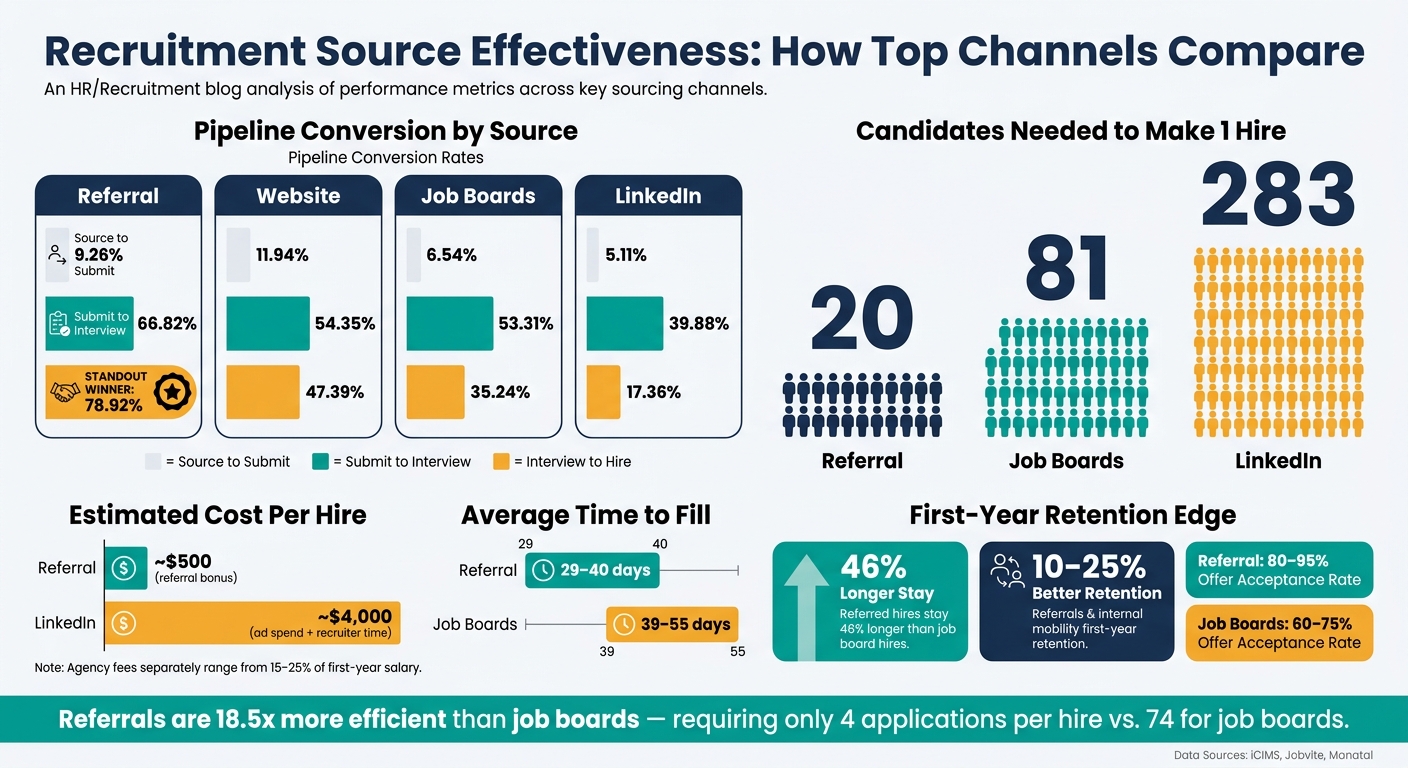
Once you’ve nailed down clean source data, turn your attention to pipeline conversion rates. These rates illustrate how candidates progress through your hiring funnel: Applied → Screen → Interview → Offer → Accept. Breaking this down by source uncovers valuable patterns. For example, referrals boast a 78.92% interview-to-hire rate, compared to just 17.36% for LinkedIn candidates [5]. This gives you far more actionable data than simply tracking application numbers.
"The source of applicants measures traffic. Source of hire measures conversion." – Manatal [8]
Another critical metric is time to fill, which highlights how quickly roles are closed depending on the channel. Referrals typically wrap up in 29–40 days, while job boards take 39–55 days [8]. For SMEs, those extra weeks can mean lost productivity and delayed growth.
Finally, measure financial efficiency by comparing costs across channels.
Cost and Efficiency Metrics
Cost per hire (CPH) is the go-to metric for evaluating the financial efficiency of different sourcing channels.
Source CPH = Total Channel Spend ÷ Hires from That Channel [6][8]
To calculate this, include all expenses tied to a specific source – ad fees, software costs, recruiter hours, and referral bonuses. Divide the total by the number of hires that channel delivered, and you’ll see the real cost per hire.
The differences between channels can be striking. For example, referrals may cost a $500 bonus per hire, while LinkedIn sourcing can climb to $4,000 per hire when factoring in ad spend and recruiter time [8]. Screening efficiency also varies: job boards typically require 81 candidates per hire, while referrals need just 20 [5]. That’s a huge time saver for your team.
Quality and Retention Metrics
Cost alone doesn’t tell the full story. It’s just as important to evaluate how well hires perform and how long they stay. Quick hires that leave within six months can drive up costs over time. That’s why quality of hire and retention metrics are essential.
Since quality can be tricky to measure, many SMEs rely on proxies like first-year retention rates, 90-day attrition, performance reviews, and ramp-up time. Tracking early attrition, particularly hires who leave within 90 days, helps identify channels producing poor matches [1][8]. For instance, referred hires tend to stay 46% longer than those sourced through job boards. Referrals and internal mobility also deliver 10%–25% better first-year retention rates compared to other sources [1][8].
Another key indicator is the offer acceptance rate (OAR). A high OAR suggests strong alignment between candidate expectations and what your company offers. Referrals typically lead, with OARs between 80% and 95%, while job boards average 60%–75% [1]. If a channel consistently produces candidates who decline offers, it’s a red flag to address before investing further in that source.
sbb-itb-a23bd6a
Building a Data-Driven Recruitment Tracking System
Setting Up Source Tracking in Your ATS
To make recruitment metrics meaningful, your Applicant Tracking System (ATS) must reliably capture source data. This system becomes the backbone for all your sourcing insights.
Start by standardizing how candidate sources are recorded. Use UTM parameters on external links to automatically feed traffic data into your ATS, avoiding the chaos of inconsistent, manual entries. Many modern ATS platforms, like Manatal and Breezy HR, streamline this process. For example, Manatal enables small and medium-sized businesses to post jobs to over 2,500 free and premium boards while enriching candidate profiles with data from 20+ social media platforms [9]. Breezy HR, on the other hand, offers a user-friendly visual pipeline starting at $157/month (billed annually), making it ideal for teams new to structured tracking [9].
The right ATS for you depends on your hiring volume and the number of channels you manage. However, one thing is non-negotiable: source data must flow into your system automatically to ensure accuracy from the start.
Once the ATS is set up to capture consistent data, the next step is ensuring that data remains clean and actionable.
Keeping Your Recruitment Data Clean and Accurate
A standardized tracking system is only as good as the consistency of its data entry. For your source metrics to hold strategic value, you need discipline in how data is logged. Here’s a key benchmark: if 30% or more of your hires are tagged as "unknown" or "other," your source-of-hire data has lost its reliability [6]. At that point, you’re basing decisions on incomplete or inaccurate information.
To avoid this, make source fields mandatory during the application process and require recruiters to verify the original source during their first interaction with candidates. Assign someone from Talent Acquisition Operations to oversee monthly data audits, correct mis-tagged entries, and enforce naming conventions across the team.
"Source of hire is only as good as its attribution data." – KPI Tree [6]
A consistent review schedule – monthly data checks and quarterly reporting – helps keep your data accurate and ensures your channel analysis remains actionable.
Tracking Multi-Touch and Assisted Sources
Once you’ve nailed down accurate source tracking, you can move toward multi-touch attribution, which credits all candidate interactions leading up to a hire. This approach captures the full journey. For instance, a candidate might first see your company on LinkedIn, discuss it with a colleague who refers them, and then apply directly via your careers page. If you only record the careers page, you risk undervaluing LinkedIn and referrals.
Multi-touch attribution builds on clean source data to provide a more complete picture of how candidates interact with your brand.
"Source of hire is not always the same thing as source of application. If the wrong source gets credit, teams can end up investing more heavily in channels that aren’t actually driving strong hiring outcomes." – Metaview [3]
To start, track three key data points for each hire: first touch, last touch, and any assisted touchpoints. You don’t need a complex system to get started; even adding a simple "original discovery source" field in your ATS can make a big difference. Over time, this data will reveal which channels are quietly influencing hires, helping you direct your budget to where it has the most impact rather than relying on surface-level application numbers.
Recruitment Metrics
To see how your current strategy compares, you can rate your recruitment health and identify areas for improvement.
Analyzing and Optimizing Your Source Mix
Recruitment Source Effectiveness: Referrals vs Job Boards vs LinkedIn
Identifying High-Performing and Underperforming Sources
Once you’ve got clean, reliable data, it’s time to dig in and refine your recruitment channel mix. The goal here is to figure out which channels are genuinely delivering results. Don’t just look at application volume; focus on how well those applications convert into hires.
A useful way to visualise this is by using a 2×2 grid that compares time-to-hire with quality. Channels that perform well on both metrics should get more of your attention and budget, while those consistently falling short might need to be scaled back or even cut. For example, referrals often stand out in this analysis. They’re known for their high quality and retention rates, especially when compared to LinkedIn. Just consider this: it takes an average of 283 candidates on LinkedIn to make one hire, whereas referrals only require about 20 candidates [5].
"The goal isn’t to find one magic channel. It’s to understand your specific mix… and to keep refining that understanding as conditions change." – Jen Dewar, JobScore [4]
Here’s a breakdown of how major sources perform across the funnel, from submission to hire:
| Source | Source to Submit | Submit to Interview | Interview to Hire |
|---|---|---|---|
| Referral | 9.26% | 66.82% | 78.92% |
| Website | 11.94% | 54.35% | 47.39% |
| Job Boards | 6.54% | 53.31% | 35.24% |
| 5.11% | 39.88% | 17.36% |
This kind of data gives you a clear roadmap for reallocating budgets to channels that consistently deliver better results.
Shifting Budget and Focus Based on Data
Armed with performance metrics, you can start making smarter decisions about where to direct your recruitment budget. A good habit is to conduct a formal ROI review every quarter and shift 10–20% of your budget based on what’s working [1][4]. This ensures your strategy evolves with real-time data rather than outdated assumptions.
For instance, instead of pouring money into broad job boards, consider investing more in referrals or leveraging your existing talent database. Research shows that 71% of placements at some firms come from candidates already in their CRM before the job is even posted [5]. If you’re spending heavily on external ads while sitting on a goldmine of pre-vetted candidates, it’s time to rethink your approach. Similarly, if agency fees are consuming a large chunk of your budget, limit their use to niche or senior roles where internal sourcing hasn’t worked. After all, agency fees can range from 15–25% of a hire’s first-year salary [7], which adds up quickly.
If your referral program isn’t delivering, the issue often lies in the incentive structure. Adjustments like tiered bonuses or faster payouts can significantly boost participation without compromising quality [1].
Testing New Sources and Retiring Old Ones
Before writing off an underperforming channel, take a closer look at how it’s being used. Sometimes the issue isn’t the platform itself but poor execution – weak job ads or generic outreach messages can tank results. A channel that seems ineffective might just need better strategy and effort.
When trying out a new channel, start small. Set a fixed budget, limit the test to 90 days, and define clear success metrics upfront. Whether you’re aiming for a specific number of qualified applicants, a target cost-per-hire, or a conversion rate, having clear goals makes it easier to measure success and compare against your existing channels. As with any data-driven approach, consistency in how you evaluate channels ensures the results are meaningful.
"Data-driven hiring does not eliminate uncertainty. It reduces it systematically, by replacing subjective impressions with structured data at every stage." – Treegarden Team [10]
When it’s time to retire a source, use the same logic. If a channel consistently underperforms on quality and cost metrics over two or three quarters, the data is sending you a clear message. Holding onto it out of habit or nostalgia is a quick way to waste your budget. Let the numbers guide your decisions and keep your strategy sharp.
Using Embedded Recruitment to Improve Source Effectiveness
How Embedded Recruiters Build Scalable Hiring Systems
Embedded recruiters bring a fresh approach to hiring by working directly within your team. They don’t just identify the best-performing channels – they build a system that continuously improves how those channels are used. This isn’t about handing off a shortlist; it’s about creating a hiring engine that evolves with your business.
By integrating with your team’s tools, like your ATS, and actively collaborating with hiring managers, embedded recruiters close the feedback loop. They see which candidates progress through interviews and why. This real-time insight allows them to fine-tune sourcing strategies, adjust outreach, and recalibrate targeting as they go [12].
"Embedded sourcing gives you a system that learns. When sourcers integrate into your workflow, they accumulate context that improves targeting, sharpens outreach, and builds pipeline that actually converts." – Salem Mansuri [12]
The results speak for themselves. Sourced hires are typically placed in 29 days, compared to an average of 44 days overall. That’s a reduction of 15 days per hire. With each unfilled role costing an estimated $98 per day in lost output [13], this time saved directly impacts your bottom line.
Cutting Hiring Costs and Reducing Admin Work
The financial case for embedded recruitment is compelling. Traditional agencies often charge a hefty 25–33% of a candidate’s first-year salary, which can amount to $39,600 for a $120,000 role. In contrast, embedded recruitment operates on a flat monthly retainer, typically ranging from $10,000 to $20,000 [13][16]. For companies hiring 10 to 24 roles annually, the savings quickly add up, making the retainer model a smarter choice.
Businesses working with Rent a Recruiter have reported cutting hiring costs by up to 70% compared to commission-based agencies. On top of that, they save over 80 hours per month on internal hiring tasks and admin. As one client put it:
"The subscription model removes commissions, reduces downtime on open roles, and creates clearer forecasting for talent and finance teams." – Rent a Recruiter [11]
Take MasterTech as an example. Over 27 months, they embedded a dedicated Talent Partner from Rent a Recruiter. This partnership resulted in 29 placements, outreach to over 3,000 passive candidates, and $123,000 in cost savings compared to traditional agency fees – all while maintaining a strong 4:1 CV-to-interview ratio [15]. This shows how embedded recruitment not only streamlines costs but also delivers measurable hiring outcomes. For more industry insights, visit our recruitment blog.
Continuous Sourcing Improvement with a Recruitment Partner
Recruitment isn’t a “set it and forget it” process. Markets shift, channels evolve, and yesterday’s strategy might not work tomorrow. Embedded recruiters address this by constantly refining sourcing methods, rather than relying on periodic reviews.
With weekly check-ins as part of your hiring routine, embedded recruiters ensure sourcing strategies stay aligned with current market conditions. Real-time data analysis allows for mid-search adjustments when trends shift [11].
"We greatly valued the data and insights they provided, which drove key strategic decisions." – Neil Spellman, Senior Recruiter, Nitro [11]
Another advantage? The knowledge embedded recruiters gain stays within your organization. Because they use your systems and tools, everything they learn – whether it’s about high-performing channels, ideal candidate profiles, or hiring manager preferences – remains accessible to your team. This ensures continuity and avoids the knowledge drain that often happens with external agencies [17].
Conclusion: Taking Control of Recruitment Source Effectiveness
Key Metrics and Steps to Improve
To enhance the effectiveness of your recruitment sources, track the entire candidate journey – from their first interaction to their final application [3]. Pay attention to conversion rates at each stage of the hiring funnel, from application to screening to hiring, to pinpoint where specific channels may be falling short [1][5]. Quality matters too: a poor hire can cost around 30% of that employee’s first-year salary [2].
On the efficiency front, employee referrals stand out. They only require 4 applications per hire, compared to 74 for job boards, making them 18.5 times more effective [14]. Before spending on external ads, tap into your existing CRM – 71% of placements at leading firms come from candidates already in the database before a job order even opens [5]. Regularly review your quarterly recruitment spend and consider reallocating 10–20% of your budget to channels with proven performance [1].
Action Plan for Scaling SMEs
Start with a clear audit of your current sourcing channels. Determine which ones consistently deliver hires who align with your needs and which ones only generate volume without long-term value.
"The goal of source-of-hire analysis isn’t just to identify where candidates came from. It’s to understand which sourcing channels consistently produce the best results." – Metaview [3]
If your data is incomplete or your applicant tracking system isn’t set up to accurately capture source information, make sure to standardize your process. Require source fields at the point of entry and implement a clear tagging system so candidates are tracked in real time [5]. This will allow you to base decisions on solid evidence rather than guesswork. Reliable data forms the backbone of a sourcing strategy that delivers results.
For fast-growing SMEs, it’s also worth evaluating whether your internal team has the bandwidth to manage sourcing improvements while handling active hiring demands. This is where embedded recruitment can make a difference, offering both the structure and analysis required to refine your sourcing approach as your business scales.
By taking these steps, you can shift your recruitment strategy into a more efficient, data-driven gear.
Ready to Optimize Your Recruitment Strategy?
If you’re dealing with high agency fees or struggling to fill roles in under 44 days [14], it’s time to focus on accurate data and a more targeted sourcing plan. Rent a Recruiter embeds skilled recruiters directly into your team, helping you build a reliable and cost-effective hiring process. Book a call today and take control of your recruitment sources.
FAQs
How do I track source of hire correctly in my ATS?
To get a clear picture of where your best hires are coming from, start with a standardized system for sourcing channels. Stick to defined categories like Referrals, Job Boards, and LinkedIn, and avoid letting users input free-text entries that can muddy the data.
For consistency, use tools like UTM parameters to tag links and track candidate sources. Combine this with directly asking candidates how they discovered the role to cross-check your data.
Take it a step further by using an attribution model, such as first-touch, to credit the initial source that brought a candidate into your pipeline. Regularly auditing your data ensures accuracy and keeps your insights reliable.
Finally, connect your ATS (Applicant Tracking System) with your HRIS (Human Resources Information System) to go beyond volume metrics. This allows you to pinpoint which channels are delivering quality hires – not just a flood of applications.
What’s the best way to fairly compare referrals vs job boards?
To make informed hiring decisions, it’s essential to evaluate referrals and job boards using consistent, end-to-end metrics for each role. Focus on these key performance indicators:
- Applicant-to-submit: How many applicants make it through the initial screening.
- Submit-to-interview: The percentage of submitted candidates who are shortlisted for interviews.
- Interview-to-hire: The success rate of converting interviews into hires.
- Offer acceptance rate: How often candidates accept your job offers.
- Time to hire: The total time it takes to fill a role.
- Cost per hire: The expenses associated with each successful hire.
- Retention and quality proxies: Indicators for how well hires perform and stay in the role.
Referrals typically deliver higher quality candidates and better conversion rates across the funnel, but they often generate fewer applicants. On the other hand, job boards excel at providing volume, though their conversion rates are generally lower.
To ensure a fair comparison, use consistent ATS source tagging to track where candidates are coming from and how they perform. Regularly conduct quarterly ROI reviews to assess the costs and outcomes of each source, helping you identify the best strategy for your hiring needs.
When should I switch budget away from a recruiting source?
Keep a close eye on your recruitment performance data. If a hiring source isn’t delivering results – whether that’s slow time-to-fill, low offer acceptance rates, or poor submit-to-interview ratios – it might be time to rethink where you’re spending.
Underperforming sources not only waste budget but can also create extra manual work for your team. The solution? Redirect those resources into channels that consistently deliver stronger outcomes.
With Rent a Recruiter, you gain the reporting and structure needed to pinpoint where your investment is driving results, so you can make smarter, data-backed decisions.