
Hiring mistakes cost SMEs time and money. With top candidates off the market in 10–14 days, outdated hiring methods can’t keep up. Data-driven talent sourcing offers a faster, more precise approach, cutting time-to-hire by up to 30% and improving recruitment efficiency by 20%.
Here’s how it works:
- Set clear goals. Start with measurable outcomes like time-to-source or 90-day retention rates.
- Track the right metrics. Focus on source-to-interview ratio, offer acceptance rate, and retention by source.
- Use your tools effectively. Leverage ATS, CRM, and talent intelligence platforms to identify trends and refine sourcing.
- Prioritize quality over volume. Channels like referrals and past applicants consistently outperform job boards.
The result? Faster hiring, lower costs, and better long-term retention. Scaling companies are already moving away from traditional methods to adopt smarter, data-backed strategies.
Need help building a data-driven recruitment process? Rent a Recruiter provides embedded recruitment solutions that save time, reduce costs, and deliver results.
Data-Driven Recruiting: How do you strategically utilize and leverage it
sbb-itb-a23bd6a
Setting Sourcing Goals and Success Metrics
To make the most of data-driven sourcing, you need clear goals and measurable outcomes. Define what success looks like before you start sourcing. While 82% of companies state that data is critical for talent acquisition decisions [6], many SMEs still focus on tracking activities rather than meaningful results. This difference highlights the gap between measuring effort and measuring outcomes. A practical way to start is by reverse-engineering your hiring funnel: begin with the number of hires required and work backward to figure out how many candidates need to be contacted, screened, and interviewed [5]. This method ties your strategic hiring goals directly to day-to-day recruitment actions.
"Business speaks the language of data. For recruiting not to speak that language is a major credibility gap." – Kyle Lagunas, Talent Strategist, Kyle & Co [7]
Key Metrics to Track in Talent Sourcing
Focus on metrics that drive decisions and improve outcomes. A strong sourcing team often achieves a 15–20% resume-to-interview ratio [1]. This serves as a benchmark to assess whether your targeting aligns with your hiring goals.
| Metric | What It Measures | Why It Matters for SMEs |
|---|---|---|
| Source-to-Interview Rate | % of sourced candidates who reach the interview stage | Indicates the effectiveness of your targeting and Ideal Candidate Profile [1] |
| Submittal Acceptance Rate | % of submitted candidates the hiring manager agrees to meet | Reflects alignment between recruiter efforts and business needs [5] |
| Source-to-Offer Rate | % of interviewed candidates who receive an offer | Shows sourcing precision and helps reduce hiring manager fatigue [9] |
| Offer Acceptance Rate | % of extended offers that are accepted | Highlights the competitiveness of your compensation and employer brand [2] |
| 90-Day Retention by Source | % of hires from a specific channel who stay at least 3 months | Links sourcing quality to long-term business impact [8] |
One standout metric is 90-day retention by source. With 20% of new hires leaving within the first 45 days [8], knowing which channels produce hires that stay is far more valuable than simply tracking high applicant volume.
Aligning Metrics with Business Goals
Your metrics should reflect your company’s immediate priorities. For instance, if you’re scaling after a funding round, time-to-source is crucial – every day a key role remains unfilled costs the business. On the other hand, if early attrition is a problem, 90-day retention by source becomes the focus. Pinpoint the outcome your business values most – whether it’s speed, quality, cost, or retention – and let that shape your metrics [6].
It’s also important to differentiate between leading and lagging indicators. Lagging indicators, like total hires, show what has already happened. Leading indicators, such as submittal acceptance rate or outreach response rate, are predictive and allow you to adjust before delays impact hiring [5][12]. For SMEs using fractional recruitment services or smaller internal teams, this real-time insight can be a game-changer. Review tactical data weekly, assess channel performance monthly, and evaluate strategic alignment quarterly to ensure your sourcing strategy stays in step with evolving business needs [10][11].
Standardizing Role Requirements and Candidate Criteria
Clear metrics and measurable outcomes are the backbone of effective, data-driven sourcing. To maintain consistency, every search must begin with well-defined role requirements. Without a standard approach to role profiles and evaluation criteria, sourcing data becomes fragmented – different recruiters focusing on varying aspects for the same role leads to unreliable comparisons and missed insights.
The solution? Develop an Ideal Candidate Profile (ICP). This framework outlines essential role responsibilities, key success traits, and disqualifying factors, such as candidates with repeated short tenures or experience limited to overly large companies [11]. By narrowing the search in this way, you can reduce the pool from thousands of profiles to a manageable list of genuinely qualified leads [11].
Companies that integrate skills-based sourcing into their ICPs see a 12% higher likelihood of making quality hires [11]. However, for this approach to work, standardizing skills taxonomy is critical. For instance, inconsistent tags like "JS" versus "JavaScript" in your ATS can cause AI filters and keyword searches to overlook strong candidates entirely [13]. A unified system not only enhances sourcing but also sets the stage for more productive intake meetings.
How Structured Intake Meetings Improve Sourcing
Structured intake meetings are the starting point for effective sourcing. These sessions help reverse-engineer success by consulting hiring managers and top performers [16].
Focus on limiting must-have skills to 3–5 critical requirements. For each skill, ask, "If a candidate didn’t have this, would we still consider them?" If the answer is yes, reclassify it as "nice-to-have" to avoid creating an overly restrictive profile [16]. Replace vague qualifications like "5+ years of experience" with measurable outcomes, such as "closed $100,000+ deals in a mid-market SaaS environment" [16].
Sharing market insights and funnel metrics during these meetings builds a sense of shared responsibility between recruiters and hiring managers. This collaboration reduces friction later in the process and ensures alignment on role expectations [15].
Skills-Based Sourcing for Hard-to-Fill Roles
For roles that are particularly challenging to fill, shifting the focus from credentials to skills can unlock hidden talent pools. This approach is especially effective given that 70% of the global workforce is passive, meaning they’re not actively searching job boards [4]. It’s also timely – 28% of organizations now require entirely new skills for existing roles [4].
Skills-based hiring has proven to be 5x more predictive of job performance than education and 2x more predictive than prior work experience [16]. This is crucial when the cost of a bad hire can reach 30% of the employee’s first-year salary [15].
Internal databases are a goldmine for skills-based sourcing. With 46% of sourced hires now originating from ATS or CRM systems – up from 26% in 2021 [11] – revisiting past candidates, often referred to as "silver medalists", can yield faster results than starting a search from scratch. By applying a skills-focused lens, you can identify strong candidates who might have been overlooked in earlier rounds.
Using ATS and Talent Intelligence Data Effectively
Your ATS, CRM, and talent intelligence platforms each provide unique insights that can transform your sourcing strategy. The key is understanding the strengths of each tool and how they complement one another.
Which Data Sources Deliver the Most Value?
Each platform serves a distinct purpose in your hiring process, offering a different perspective on your recruitment data. Instead of viewing them as interchangeable, think of them as layers of insight:
| Platform | Contribution | Key Metrics |
|---|---|---|
| ATS | Tracks operational efficiency and pipeline flow | Time-to-fill, stage conversion rates, cost-per-hire |
| CRM / Talent Pool | Focuses on re-engaging past candidates and tracking relationships | Reactivation rates, email response rates, silver-medalist tracking |
| Talent Intelligence | Provides predictive insights and external market benchmarks | Candidate fit scores, skills-gap analysis, market supply vs. demand |
Your ATS acts as the operational core, showing what’s happening within your hiring funnel. For example, with the average cost-per-hire reaching $4,700 in 2025 [14][18], understanding where candidates drop off in the process is essential. Talent intelligence platforms take it further by offering predictive insights, helping you identify potential bottlenecks before they happen. IBM’s use of its Watson Recruitment platform, for instance, led to a 40% reduction in time-to-fill and a 20% improvement in quality of hire by leveraging predictive data [14][18].
Despite its importance, quality of hire often flies under the radar. Only 20% of organizations track it effectively [18], even though 89% of talent acquisition professionals anticipate its growing relevance [18]. High-performing teams typically achieve a resume-to-interview ratio of 15–20%, while a ratio below 10% signals a potential targeting issue rather than a pipeline problem [1].
To make the most of these insights, maintaining clean and reliable data is non-negotiable.
How to Avoid Unreliable Sourcing Data
Bad data can derail your hiring strategy, misguide your budget, and undermine analytics. Common culprits include inconsistent recruiter data entry, undefined pipeline stages, and scattered data stored in disconnected systems [14][2].
To ensure data accuracy:
- Standardize pipeline definitions: Clearly outline what each stage of the hiring process means for every role and recruiter. Without consistency, conversion metrics become unreliable.
- Perform regular ATS audits: Merge duplicate records, standardize tags, and clean up outdated entries.
- Focus on actionable metrics: Prioritize data like source-to-hire conversion rates, resume-to-interview ratios, and 90-day retention rates [1][14].
One practical step is implementing structured feedback templates for rejected candidates. When hiring managers provide specific reasons for rejections – like "insufficient domain experience" – this sharpens future searches and improves targeting. Every rejection becomes a learning opportunity to refine your sourcing efforts.
Measuring Sourcing Channel Performance by Quality, Not Volume
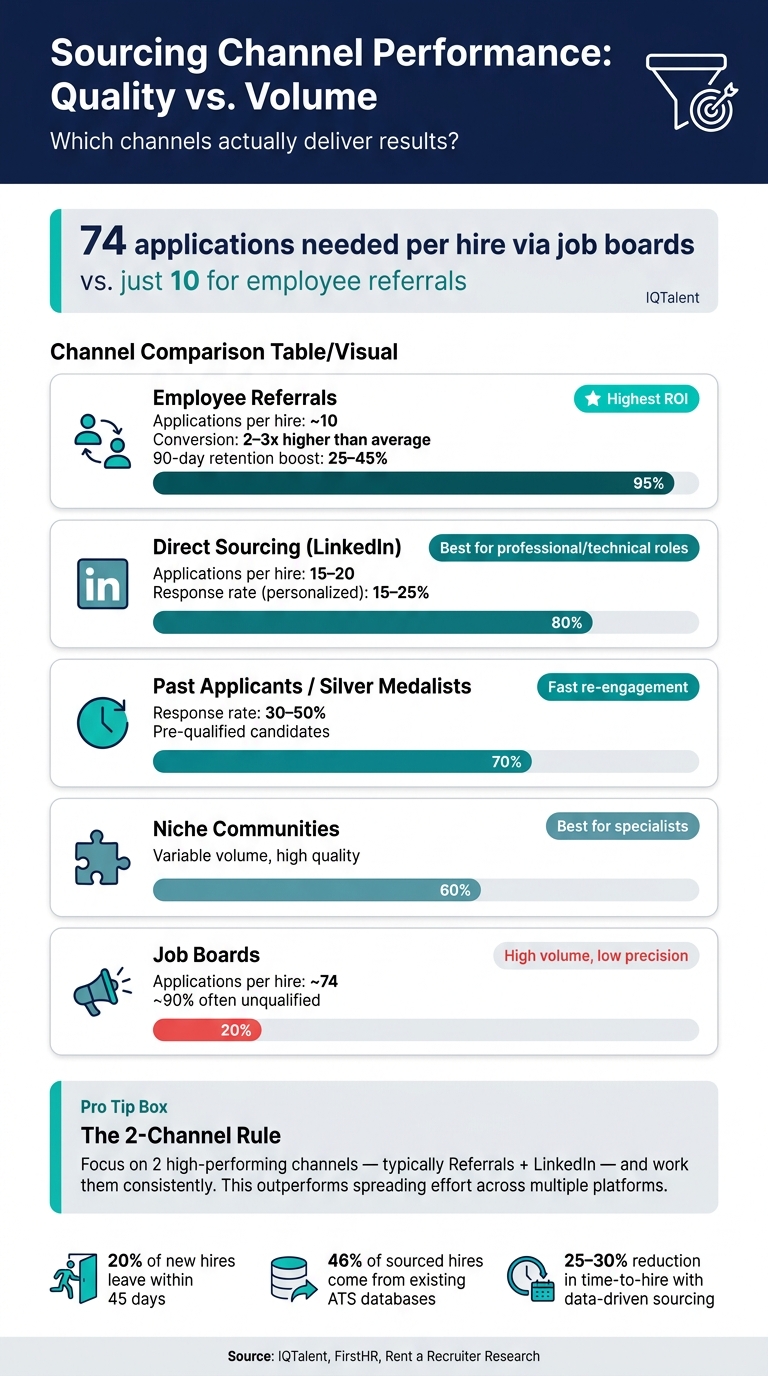
Sourcing Channel Performance: Quality vs. Volume Comparison
Once you’ve set clear goals and defined roles, the next step is to evaluate sourcing channels based on quality, not just quantity.
It’s tempting to focus on sheer numbers, but the real value lies in the results. A channel producing 200 applicants but only one hire is far less effective than one yielding 20 applicants and five hires. The key question isn’t "how many?" – it’s "how effective?"
"Job boards, everyone’s default, are the worst-performing channel. You need 74 applications to make one hire. That means 73 rejections and excessive screening." – IQTalent [21]
This highlights the issue with prioritizing volume over quality. Yet, many companies still funnel most of their sourcing budgets into job boards because the activity looks productive on paper.
Metrics for Measuring Channel Performance
The most reliable way to assess channel quality is by focusing on post-funnel metrics – what happens after candidates enter the hiring pipeline. These metrics include:
- Screen pass rates: How many candidates make it through the initial screening?
- Interview quality scores: Do candidates meet or exceed expectations during interviews?
- Offer acceptance rates: Are candidates excited to join your company?
- 90-day retention: Do new hires stick around, and are they thriving?
Retention is especially telling. With 20% of new hires leaving within the first 45 days [8], ignoring post-hire retention means missing out on vital feedback about sourcing effectiveness.
Another key metric is time to competency, which measures how quickly a new hire becomes productive. A candidate who ramps up in 30 days brings more value than someone who takes 90 days, even if both accepted the offer [9].
"The ROI of sourcing depends entirely on what happens after the offer." – FirstHR [8]
By combining these metrics with earlier KPIs, you get a clearer picture of which channels truly deliver.
Comparing Sourcing Channels Side by Side
To make informed decisions, compare sourcing channels using quality-focused metrics.
| Channel | Applications Per Hire | Strengths | Limitations | Best For |
|---|---|---|---|---|
| Employee Referrals | ~10 [21] | 2–3x higher conversion; better retention (25–45%) [8] | May limit diversity if unmanaged | Every role; offers highest ROI |
| Direct Sourcing (LinkedIn) | 15–20 [21] | Precise targeting; 15–25% response rate (personalized) [8] | High competition; InMail fatigue | Professional and technical roles |
| Niche Communities | Varies | High-quality candidates for specialized roles | Low volume; requires trust [8] | Developers, designers, specialists |
| Past Applicants | N/A | 30–50% response rate; pre-qualified [8] | Limited to previous pool size | Roles similar to past openings |
| Job Boards | ~74 [21] | High volume of active seekers | 90% often unqualified [21] | Entry-level and high-volume roles |
Channels like employee referrals and direct sourcing consistently deliver better results, making them ideal for businesses looking to maximize hiring efficiency.
For smaller teams with limited resources, the 2-Channel Rule is a smart strategy: focus on two high-performing channels – typically referrals and LinkedIn – and work them consistently. This targeted approach almost always outperforms spreading efforts thinly across multiple platforms [8].
Finally, when evaluating channels, remember that candidates rarely come from a single source. For example, someone might see a LinkedIn post, visit your careers page, and apply after hearing about the role from a friend. A U-shaped attribution model – which credits both the first and last touchpoints – provides a more accurate view of which channels drive quality hires [19].
Building a Repeatable Data-Driven Sourcing Process
Creating a repeatable, data-driven sourcing process can turn scattered insights into a scalable recruitment strategy that drives growth for SMEs. Start by centralizing your talent data. This eliminates silos and uncovers hiring trends you might otherwise miss. Why does this matter? Because 46% of sourced hires now come from candidates already sitting in a company’s database, a significant jump from 26% in 2021 [11]. But this only works if your data is clean, searchable, and consistently updated.
Next, establish a consistent taxonomy to anchor your process. For example, always use "JavaScript" instead of "JS" to ensure AI tools can filter accurately [1]. Standardized tagging makes your sourcing process reliable and scalable.
Using Sourcing Dashboards to Spot and Fix Bottlenecks
A sourcing dashboard is your best tool for identifying where candidates drop out of the process. It should track key metrics like funnel stage attrition, time between stages, and whether delays are caused by recruiters or hiring managers.
One critical metric to monitor is the resume-to-interview ratio. High-performing teams typically achieve 15–20%. If your team is below 10%, it’s a sign that your Ideal Candidate Profile (ICP) isn’t aligned with the candidates you’re targeting [1]. Similarly, if screening completion rates fall below 60%, the problem often lies upstream – either the role description is unclear, or the screening process is overly complex [22].
Different stakeholders will need tailored views of the dashboard:
| Role | What the Dashboard Shows | Why It Matters |
|---|---|---|
| Recruiters | Open roles, pending feedback, and scheduled interviews | Helps prioritize daily tasks [1] |
| Hiring Managers | Interview updates, pending approvals, and feedback status | Streamlines collaboration and reduces delays [1] |
| HR/TA Leaders | Funnel attrition, source ROI, and requisition velocity | Aids in strategic planning and oversight [1] |
To keep the process moving, implement a 24-hour SLA for hiring manager reviews. By tracking the time between a recruiter advancing a candidate and the manager providing feedback, you can prevent top candidates from losing interest while waiting [22].
Pair these insights with strong data governance to ensure your process remains consistent and effective.
Maintaining Data Quality and Governance
Clean data is the backbone of any reliable sourcing process, and maintaining it requires discipline. Data entry must be a core part of your recruiting workflow.
"The accuracy of every metric, dashboard, and predictive insight depends entirely on the quality and consistency of the data entered." – Ann Schumann, Content Writer and Former Recruiter, Manatal [14]
Conduct quarterly data audits to merge duplicate records, correct inconsistent tags, and remove outdated entries. These audits are also an opportunity to review rejection reasons. Structured feedback – like "weak communication" or "lacking domain expertise" – becomes searchable data that can refine your ICP for future hiring cycles [1].
Governance also includes compliance. Document your sourcing criteria for every role to ensure you’re audit-ready under EEOC requirements. Track DEI metrics, such as the diversity share of sourced candidates and their passthrough rates, to maintain an equitable process [20][17]. With 28% of recruiters admitting they still rely on gut instinct for hiring decisions [17], a data-backed, auditable process doesn’t just protect your company – it gives you a competitive edge.
Conclusion: Getting Results with Data-Driven Sourcing
Mastering data-driven sourcing creates a ripple effect of benefits. For SMEs that commit to maintaining clean data, tracking consistent metrics, and following structured processes, the results are undeniable: companies that focus on top-performing sourcing channels report cutting their average time-to-hire by 25–30% [1]. Additionally, businesses adopting data-driven strategies see a 30% improvement in time-to-hire [2].
Key Takeaways for Scaling SMEs
For SMEs looking to scale, shifting from intuition-based hiring to evidence-backed recruiting is game-changing. A few key principles can make all the difference:
- Prioritize outcomes over activity: A strong resume-to-interview ratio (15–20%) is far more valuable than chasing volume.
- Focus on high-performing channels: Rather than spreading resources thin, concentrate on two proven channels, such as employee referrals and LinkedIn [8].
- Leverage your ATS: Your existing database often holds a goldmine of pre-qualified candidates that are frequently overlooked [1].
Finally, remember that sourcing success doesn’t end with hiring. Weak onboarding can undermine even the best hiring efforts. Ensure a seamless transition by integrating sourcing data – like interview feedback and role criteria – into your 30-60-90 day onboarding plans.
Next Steps: Partnering with Rent a Recruiter
Aligning metrics, data, and processes is essential to building a scalable sourcing strategy. But for many SMEs, creating this framework from scratch isn’t feasible – especially when scaling rapidly after funding or managing a surge in hiring demand. That’s where Rent a Recruiter comes in.
With experienced recruiters embedded into your team within 5 days, Rent a Recruiter delivers the structure, discipline, and results discussed in this article – without the overhead of building an internal TA team [3]. Clients typically cut hiring costs by up to 70% and save over 80 hours per month compared to traditional agency models.
Ready to see the impact of data-driven sourcing? Book a call with Rent a Recruiter or try their free Recruitment Health Check to assess your current hiring process today.
FAQs
What are the best sourcing metrics to start with?
To build a strong sourcing strategy grounded in data, prioritize outcome-focused metrics rather than just tracking activities. Here are the key areas to measure:
- Source-of-hire: Pinpoint which channels are consistently delivering top candidates so you can allocate your budget more effectively.
- Time-to-source: Monitor how quickly you’re able to generate a shortlist of qualified candidates.
- Application completion rate and channel conversion rate: Evaluate the effectiveness of your sourcing channels and the quality of incoming leads.
- Pipeline attrition: Identify where candidates are dropping off in the process so you can address bottlenecks and avoid delays in hiring.
By focusing on these metrics, you can fine-tune your sourcing efforts to deliver better results.
How do I build an Ideal Candidate Profile (ICP) fast?
To streamline the creation of an Ideal Candidate Profile (ICP), start by analyzing your last 20 hires for the role. Look for recurring themes in their experience, skills, and backgrounds. Collaborate with hiring managers and high-performing employees to pinpoint what success looks like in the first 90 days. Focus on identifying the core skills and key behaviors that drive results. Once you’ve gathered this information, compile it into a structured profile and cross-check it with past sourcing data to ensure accuracy before beginning outreach.
How can I tell which sourcing channels drive retention?
To determine which sourcing channels lead to better employee retention, link your recruitment source data with metrics on employee performance and retention. This approach allows you to identify the channels that consistently deliver high-performing, long-term hires. Go beyond just measuring upfront hiring costs – consider the ROI by analyzing long-term outcomes from each channel. Rent a Recruiter helps scaling companies by placing experienced recruiters directly within their teams to simplify hiring and implement strategies focused on retention. Learn more about embedded recruitment here.