
Hiring costs can make or break your recruitment strategy. For small and mid-sized businesses (SMEs), understanding cost per hire (CPH) is critical to managing budgets and improving hiring efficiency. The average U.S. CPH is $4,750, but SMEs often face higher costs – $5,346 for companies under 500 employees and up to $7,500 for micro-SMEs with fewer than 50 employees.
Key Insights:
- What is CPH? It’s the total internal and external recruitment costs divided by the number of hires.
- Benchmarks: Entry-level roles cost $1,500–$3,000; mid-level roles $4,000–$7,000; executive hires $20,000+.
- Hidden Costs: Interview time and internal resources can inflate CPH by 30–40%.
- High-Cost Industries: Tech and fintech roles often exceed $9,000 per hire.
- Cost Reduction Strategies: Employee referrals, process automation, and embedded recruitment can cut costs by up to 70%.
Bottom line? Tracking your CPH helps you identify inefficiencies, justify budgets, and improve hiring outcomes. Learn how embedded recruitment can save both time and money for scaling businesses.
How to Calculate Cost Per Hire
The Cost Per Hire Formula
The formula is straightforward: (Total Internal Recruiting Costs + Total External Recruiting Costs) / Number of Hires [3][2]. This standard, outlined by SHRM/ANSI, provides a clear per-hire average for any timeframe you choose.
Let’s look at an example. Apex Dynamics, a mid-sized company, made 15 hires in Q1 2025. Their internal costs – covering recruiter salaries, HR admin, ATS subscriptions, hiring manager time, and referral bonuses – came to $29,240. External costs, including LinkedIn and Indeed ads, background checks, assessments, and agency fees, amounted to $25,950. Their total spend was $55,190. Divide that by 15 hires, and their cost per hire was $3,679 [6].
For technical roles, the numbers climb higher. An AI startup hired 8 engineers in Q1 2026, with internal costs hitting $44,000. This included $20,000 for 200 hours of engineering interview time, calculated at $100 per hour. External costs, such as agency fees, marketplace success fees, ads, and assessments, added up to $33,720. Their total spend was $77,720, resulting in a cost per hire of $9,715 [4].
Quarterly calculations are ideal. Monthly data can be too erratic, and annual data often comes too late to address inefficiencies. Quarterly reporting strikes the right balance, giving small and mid-sized businesses (SMEs) enough time to identify and correct issues without overreacting to short-term fluctuations [3][1].
Now, let’s break down the internal and external costs that feed into this formula.
Internal Costs vs. External Costs
One frequent oversight is failing to account for the cost of interview time. For example, a mid-level manager with a $90,000 annual salary costs around $43 per hour. If they spend 10 hours interviewing candidates, that’s an additional $430 added to your internal recruiting costs [6]. For senior engineers earning $100 or more per hour, the costs can escalate quickly. Many SMEs underestimate their cost per hire by 40–60% because they ignore these factors [2][6].
External costs, on the other hand, are easier to track. These include payments for job board ads, agency commissions, and candidate assessments [4][5][2]. Since these are direct vendor payments, they’re more straightforward to document compared to internal expenses.
It’s also important to exclude post-hire costs. Expenses like onboarding, equipment setup, or the new hire’s salary and benefits do not belong in your cost per hire calculation. Focus solely on recruitment-related spending [2].
sbb-itb-a23bd6a
A Deep Dive into Recruitment Analytics: What is Cost Per Hire? Why is it important to HR Teams?
Cost Per Hire Benchmarks for SMEs
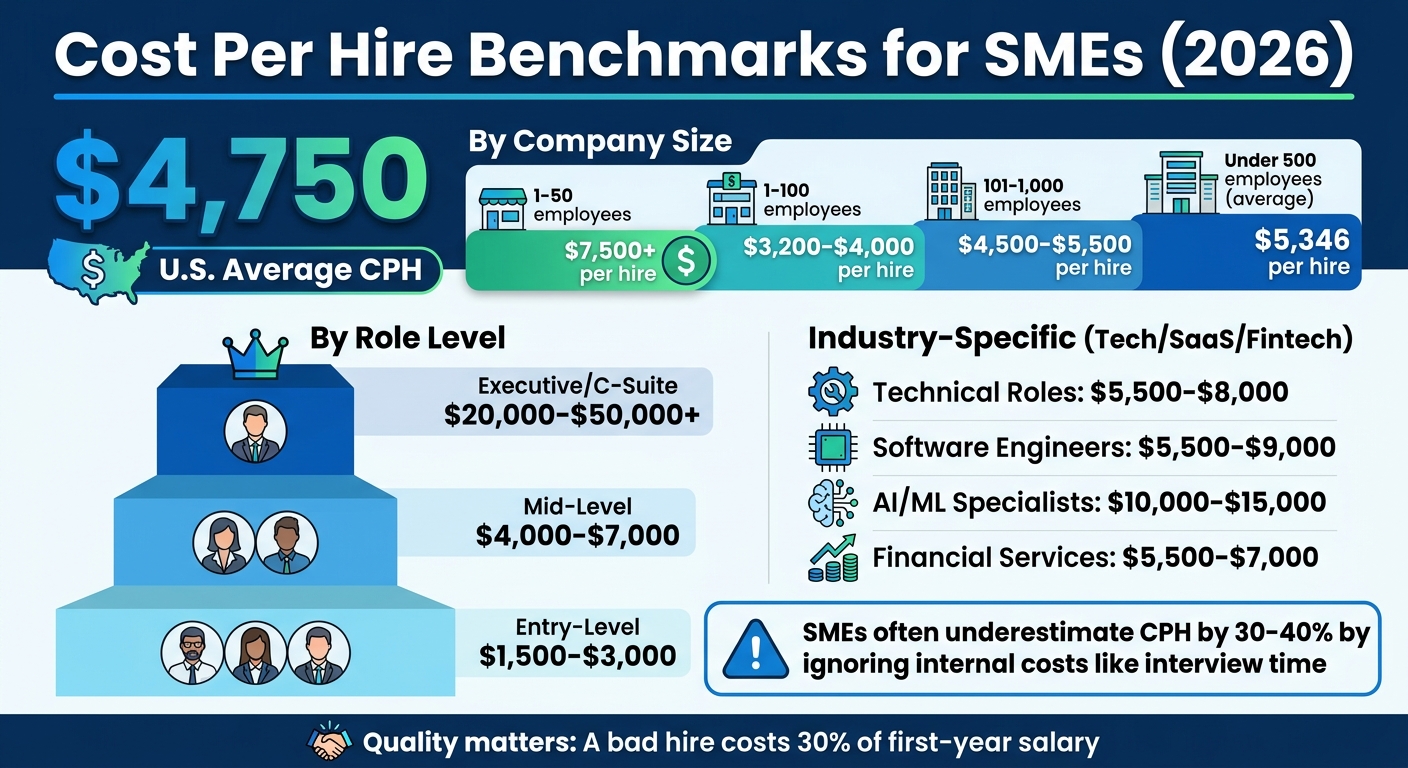
Cost Per Hire Benchmarks for SMEs by Company Size and Role Level
U.S. SME Benchmarks by Percentile and Role
As of 2026, the average cost per hire (CPH) across the U.S. stands at approximately $4,750 [7]. However, for small and mid-sized enterprises (SMEs), this figure can vary widely depending on company size and the roles being filled.
For small businesses with 1–100 employees, hiring costs typically range from $3,200 to $4,000 per hire [7]. Early-stage companies with fewer than 50 employees often face much higher costs, sometimes exceeding $7,500 per hire [5]. Mid-sized firms, with 101–1,000 employees, usually see costs fall between $4,500 and $5,500 [7].
The type of role being filled also plays a major role in determining costs. Entry-level positions tend to cost between $1,500 and $3,000 to fill, while mid-level professionals range from $4,000 to $7,000 [7]. Executive and C-suite hires, however, can cost anywhere from $20,000 to $50,000 or more [2].
"The goal is not the lowest CPH, but the smartest investment. A higher CPH for a critical role can be a strategic win if it results in a higher quality of hire." – Vicky Liu [1]
Simply chasing the lowest hiring cost can backfire. A poor hire can cost a company around 30% of the employee’s first-year salary, making it critical to weigh cost against factors like quality of hire and retention rates within the first 90 days [6].
By understanding these benchmarks, SMEs can better align their recruitment strategies to balance efficiency and quality. It’s worth noting that these averages can shift significantly in niche industries or for specialised roles.
Tech, SaaS, and Fintech Industry Averages
In industries like tech, SaaS, and fintech, hiring costs tend to be higher. Technical roles generally cost between $5,500 and $8,000 to fill [7], while hiring software engineers can range from $5,500 to $9,000 [4]. For AI and machine learning specialists, where competition for talent is fierce, costs can climb to $10,000–$15,000 [4].
Internal recruiting processes also add to these expenses. In tech, for instance, the time engineers spend interviewing candidates often accounts for 50–70% of the total CPH [4]. For example, if a senior engineer earning $100 an hour spends 20 hours on interviews, that adds $2,000 in additional internal costs.
Financial services companies face similar challenges, with CPH averaging between $5,500 and $7,000 [7]. In highly regulated industries, the cost of leaving a role vacant can be substantial. For instance, a senior sales position left unfilled for 45 days could result in lost revenue of up to $112,500 [6].
One way SMEs can manage these costs is by adopting an embedded recruitment model. By embedding experienced recruiters – such as those from Rent a Recruiter – companies can reduce hiring expenses by up to 70% compared to traditional agencies that charge 15–25% of a candidate’s first-year salary. This approach also saves over 80 hours of administrative work per month. For SMEs with ongoing hiring needs, especially in technical or specialised roles, this model offers a practical and cost-efficient solution to recruitment challenges.
How to Reduce Cost Per Hire
Improve Your Recruitment Process
Streamlining your recruitment process is essential for cutting costs and improving efficiency. One major area where companies often lose money is hidden internal costs. Many SMEs underestimate their true cost per hire by 30–40% because they overlook the time hiring managers and team members spend on interviews and debriefs [5]. To get a clear picture, start tracking interview hours and follow-up meetings.
Another way to reduce costly mistakes is by standardizing interviews. Using digital scorecards can double the predictive accuracy compared to informal conversations [4][5]. Additionally, setting a 48-hour deadline for interviewer feedback ensures you don’t lose top candidates who might drop out due to delays [4].
Employee referrals are another smart way to reduce costs. Referred candidates are 50% cheaper to hire, start 10 days sooner, and have a 46% retention rate after one year, compared to only 33% for hires from job boards [5]. Before spending on job board postings, review your applicant tracking system for potential candidates already in your database [5][6].
Automation is a game-changer for cutting hiring expenses. AI tools can reduce resume screening time by up to 80% and save 3–5 hours per hire on scheduling tasks [3][5][6]. Companies using AI-driven platforms have reported 30–50% lower overall hiring costs [5]. By automating repetitive tasks like resume parsing and calendar management, your team can focus on engaging with candidates directly.
These steps not only reduce costs but also lay the groundwork for adopting more efficient hiring models that can further drive savings.
Use Embedded Recruitment Models
Switching to embedded recruitment is another effective way to reduce costs. Traditional recruitment agencies often charge 15–30% of a candidate’s first-year salary [4][6]. For a $100,000 hire, that’s a steep fee of $15,000 to $30,000. In contrast, embedded recruitment offers a more budget-friendly option. Instead of paying per placement, you bring experienced recruiters into your team on a fixed monthly fee.
With Rent a Recruiter, you get embedded recruitment tailored to high-growth industries like technology, SaaS, fintech, and professional services. This approach can cut hiring costs by up to 70% (you can estimate your potential savings with an embedded recruitment ROI calculator) while saving over 80 administrative hours every month. It’s particularly useful for SMEs with ongoing hiring needs or those facing sudden hiring spikes after funding rounds or product launches.
Summary and Next Steps
Key Takeaways
Understanding your true cost-per-hire (CPH) is critical for streamlining your recruitment process. While the U.S. average is $4,750, smaller businesses often face higher costs – $5,346 for companies with fewer than 500 employees and over $7,500 for micro-SMEs with 1–50 employees[2][7]. These figures reflect challenges like limited economies of scale and weaker employer branding compared to larger organizations.
Failing to account for internal costs can result in underestimating your CPH by as much as 30–40%[5]. It’s important to track these hidden expenses to get a full picture of your recruitment budget. But remember, the goal isn’t just cutting costs. As Vicky Liu from Juicebox wisely points out:
"The goal isn’t simply to spend less; it’s to invest smarter. A rock-bottom CPH might mean you’re cutting corners on sourcing."[1]
Quality matters just as much as cost. A bad hire can cost up to 30% of their first-year salary[5], making it crucial to balance efficiency with finding the right candidates.
Focus on strategies that work. Employee referrals, for example, can cut costs by 50% and improve first-year retention rates to 46%[5]. Standardizing your interview process is another way to avoid expensive rehires. And for a more cost-effective approach, consider embedded recruitment, which can lower hiring costs by up to 70% compared to traditional commission-based methods.
Now, let’s dive into actionable steps to better evaluate and manage your recruitment costs.
Evaluate Your Recruitment Costs
To get a handle on your recruitment spending, start by breaking down costs by department and role. Use the SHRM formula to calculate your CPH: (Internal Costs + External Costs) / Total Hires[5]. Track key metrics like CPH, time-to-fill, and 90-day retention on a quarterly basis to gain clear insights into your hiring efficiency[2].
If your recruitment costs are above industry averages or if managing hiring is pulling you away from growing your business, it may be time to consider more effective solutions. Rent a Recruiter offers an embedded recruitment model, placing experienced recruiters directly within your team. This approach can cut hiring costs by up to 70% while saving over 80 hours per month in administrative tasks. Whether you’re scaling after funding or managing a hiring surge, this model provides the capacity you need – without the hefty fees of traditional agencies. Book a call to discuss your hiring goals, or see your potential savings with our cost calculator.
FAQs
What costs should I include in cost per hire?
Including all relevant costs is key to understanding your true cost per hire.
Internal expenses cover elements like recruiter and hiring manager time, software subscriptions, employee referral bonuses, and any internal mobility programs. These are often overlooked but can add up quickly.
On the other hand, external costs might include agency fees, job board postings, background checks, and other recruitment-related services.
When you combine these, you get a full picture of what each hire is actually costing your business. This clarity is essential for managing budgets and improving hiring efficiency.
How do I estimate the cost of interview time accurately?
To get a clear picture of interview costs, you need to account for both direct and indirect expenses. Start by calculating the total hours hiring managers and interviewers spend on tasks like preparation, conducting interviews, and follow-ups. Then, multiply those hours by their hourly wage or salary equivalent.
But don’t stop there. Think about the opportunity cost – the value of the work they could have been doing instead. By including this in your calculations, you’ll have a more accurate estimate, helping you create a recruitment budget that reflects the true cost of hiring.
What should I do if my cost per hire is above benchmarks?
If your cost per hire (CPH) is higher than industry benchmarks, it’s time to dig into the details. Start by pinpointing where your expenses are climbing above average. Are you overspending on job boards or agency fees? Are manual processes slowing you down?
Consider these steps to bring costs under control:
- Optimize your recruitment channels: Focus on the platforms delivering the best results and cut back on underperforming ones.
- Automate repetitive tasks: Tools for screening and scheduling can save both time and money.
- Tap into employee referrals: These often lead to faster, more cost-effective hires.
It’s also worth reevaluating your internal processes. Are inefficiencies or an over-reliance on external agencies driving up costs? Bringing in an embedded recruiter could be the game-changer you need. They work directly within your team, helping streamline the hiring process while cutting down on expensive agency fees. This approach can quickly align your CPH with industry standards.