If your hiring plan is not tied to revenue, delivery capacity, and cash, you are guessing, and bad guesses get expensive fast.
I see the clearest path like this: SMEs need short planning cycles, tight headcount control, and hiring capacity they can turn up or down without adding fixed cost. Large firms can carry longer planning cycles and bigger people teams, but most scaling companies cannot. For you, the goal is simple, make better hiring calls, cut wasted spend, and save leadership time.
Here is the short version:
- SMEs usually plan 6 to 18 months out, not 3 to 5 years
- Internal data is often patchy, so a small set of hiring metrics matters more than a big system rollout
- Comparing different recruitment models shows how embedded support can close capacity gaps when hiring demand jumps
- Companies using Rent a Recruiter report up to 70% lower hiring costs versus agency fees and 80+ hours saved per month in hiring admin
- One embedded recruiter can often cover 15 to 30 active roles, depending on role type and process load
Data-Driven Workforce Planning | Ensuring Talent Alignment with Business Goals
sbb-itb-a23bd6a
Quick Comparison
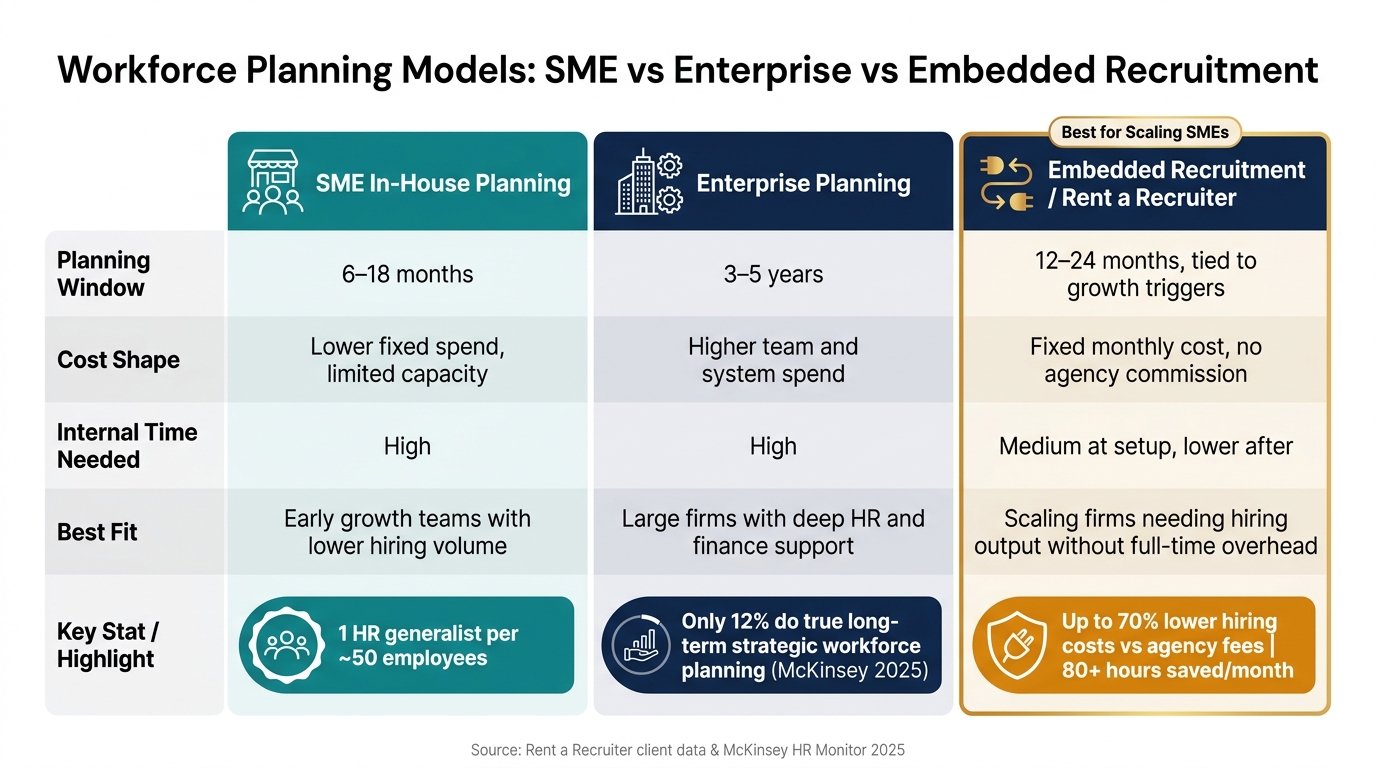
SME vs Enterprise vs Embedded Recruitment: Workforce Planning Comparison
| Model | Planning window | Cost shape | Internal time needed | Best fit |
|---|---|---|---|---|
| SME in-house planning | 6 to 18 months | Lower fixed spend, but limited capacity | High | Early growth teams with lower hiring volume |
| Enterprise planning | 3 to 5 years | Higher team and system spend | High | Large firms with deep HR and finance support |
| Embedded recruitment | 12 to 24 months, tied to growth triggers | Fixed monthly cost, no agency commission | Medium at setup, lower after | Scaling firms that need hiring output without full-time overhead |
If you are scaling in SaaS, tech, fintech, engineering, security, insurance, or professional services, the right model is usually the lightest one that still gives you control, data, and hiring output. The rest of this article breaks that down in plain terms.
1. Rent a Recruiter
For SMEs, the issue is not whether hiring should be data-led. It’s how to build that muscle without adding fixed overhead.
Rent a Recruiter is an embedded recruitment model built for the hiring pressure high-growth SMEs face. You add recruiting capacity without growing permanent headcount. An experienced recruiter joins your team directly, often within five days, and manages hiring from sourcing through offer. [1]
Planning Horizon
This model suits a near-term planning horizon.
It works well around milestones like a funding close, product launch, or market entry. If plans change, the engagement can grow or wind down to match.
Scalability Model
The embedded model scales up or down month to month based on actual hiring demand, not forecast demand.
That matters when hiring plans move fast. In one case, an embedded recruiter handled 291 interviews, 17 offers, and 10 hires in a few months. [1] That kind of output needs recruiting capacity that can flex without adding long-term cost.
Resource Intensity
This model gives leadership time back for commercial work.
Clients report saving over 80 hours per month in internal hiring and admin time. They also cut hiring costs by up to 70% compared with commission-based models. [1] For CEOs, CFOs, and HR leaders, that means less time tied up in process and more time spent on growth.
Data Maturity
Many SMEs do not have steady hiring data.
The embedded model deals with that from day one by bringing structure and visibility to hiring, with tracking for metrics such as CV-to-interview ratios and offer acceptance rates. In a 27-month partnership with MasterTech, Rent a Recruiter achieved 29 placements and kept a 4:1 CV-to-interview ratio. [1]
That mix of flexibility, visibility, and lower overhead makes the model useful in SME workforce planning.
2. High-growth SMEs
High-growth SMEs plan on shorter cycles because hiring demand can change fast after funding, product launches, or big sales wins. Compared with enterprise planning, SME workforce planning uses fewer inputs, shorter cycles, and faster resets. It has to move faster and stay lighter if you want it to keep up with that level of change.
Planning Horizon
High-growth SMEs usually work on a shorter, rolling horizon of about 6 to 18 months [2][4][5]. The usual pattern is an annual plan with quarterly reviews, so leadership can reshuffle role priorities as sales, cash flow, or product plans shift.
Many teams also split planning into two layers. They keep a near-term hiring plan for business-critical roles, then use a lighter long-range forecast for team growth. That rhythm helps you match hiring to live demand instead of locking yourself into a static annual plan.
Scalability Model
Instead of building a large internal planning team, high-growth SMEs usually scale workforce planning around role priority and business impact. The model often starts with a small group of repeat hires, then becomes more structured as hiring volume climbs.
A simple pressure test helps here: what breaks if a hire is delayed by three months? That question keeps the focus on roles that protect revenue or delivery capacity, rather than adding headcount too soon.
Flexible staffing arrangements, especially contract and fractional support, also give SMEs room to handle uneven hiring swings without adding fixed overhead. For scaling companies, that can mean:
- lower fixed hiring cost
- more room to react to demand changes
- less pressure to build an internal team too early
Resource Intensity
That shorter cycle only works if the process stays simple. Most high-growth SMEs run with a lean People function, often one HR generalist. So workforce planning becomes cross-functional by default, with finance, operations, and senior leaders directly involved.
There is rarely budget or team capacity for heavy systems. That means the process has to stay lightweight and easy to update.
The most useful setup is usually a short list of high-value metrics, such as vacancy rate, time-to-fill, offer acceptance rate, and hiring pipeline health. That gives you enough visibility to make decisions without trying to copy enterprise-level workforce analytics.
Data Maturity
Data maturity in high-growth SMEs is usually low to medium. Workforce data often sits across spreadsheets, payroll systems, and manager updates, with no single clean view of headcount.
The practical path is step by step:
- start with basic headcount visibility
- move into role-level forecasting
- add scenario planning as hiring volume grows and data quality improves
Start by standardising job titles, tracking headcount changes, and linking hiring data to a small set of business KPIs. Usable data is enough. You do not need perfect systems to make better calls on role priority, hiring timing, and hiring volume.
3. Large enterprises
Large enterprises operate on a very different rhythm. They often plan 3 to 5 years out, but the plan on paper and the plan in motion are not always the same thing. McKinsey‘s HR Monitor 2025 found that 73% of organizations do operational workforce planning, but only 12% do true long-term strategic workforce planning. Of that 12%, only 30% integrate skills data into the process [7].
Planning Horizon
Enterprise workforce planning usually combines a 3 to 5 year view with an annual budget cycle. From there, each business unit turns headcount targets into quarterly hiring plans.
That long view helps with succession planning and future team design. But it can also slow you down. If the market shifts in six months, a plan built for the next five years can start to feel heavy.
Scalability Model
Most large enterprises scale workforce planning through a centralised model. A central HR team or Workforce Planning Center of Excellence sets the frameworks, tools, and headcount targets. Local teams then execute inside that structure.
This model works because it creates consistency at scale. Standardised job families and shared analytics make it easier to roll planning across regions without rebuilding the process every time.
Resource Intensity
The resource load is high. Enterprise workforce planning often pulls in HR business partners, talent acquisition, finance, people analytics teams, and business unit leaders, all working across dedicated platforms.
In a 2012 ConAgra integration, the company centralised fragmented cost data and moved from annual headcount planning to continuous, cost-driven planning [6]. The result was real-time visibility into total workforce costs and a more strategic role for HR.
For leadership teams, that matters. Better visibility means tighter budget control, stronger hiring decisions, and less guesswork around workforce spend.
Data Maturity
Data maturity is usually stronger at enterprise level. Teams pull data from HRIS, ATS, finance systems, and labour market sources. That gives leaders the ability to model future hiring needs, forecast attrition risk, spot internal mobility options, and find skills gaps before they start affecting delivery.
The trade-off is complexity. Siloed systems, fragmented data governance, and the overhead of maintaining multiple integrated platforms are still common issues, even at this scale [6][7].
That gap helps explain why many scaling companies need more hiring capacity first before they try to build enterprise-level planning infrastructure.
4. Embedded and outsourced hiring support in workforce planning
After enterprise-scale planning, the SME question is simpler: how do you add hiring capacity without adding fixed overhead?
For SMEs, embedded hiring support gives you a flexible way to match recruiter capacity to demand. How you use it comes down to four things: your planning horizon, how fast you need to scale, how much internal time your team can spare, and how solid your hiring data is.
Planning Horizon
Large enterprises may plan 3 to 5 years ahead. SMEs usually plan hiring support across 12 to 24 months, tied to clear triggers like a funding round, a product launch, or a revenue milestone [1].
That shorter window fits how most scaling businesses operate. Funding changes. Product timelines move. Revenue targets shift.
A company scaling after a Series A, for example, might need to fill 15 to 20 roles in 9 months. That is a defined hiring push with a clear end point, and embedded support can be shaped around it.
Scalability Model
The main upside of embedded support is simple: it turns hiring volume into something you can plan for and control.
Most SMEs are choosing between building internal capacity or using flexible embedded recruitment. Building in-house is a long-term cost. It takes time to hire, time to ramp, and it is not easy to scale back if demand drops.
Embedded models are different. They can be up and running within days, slot into your team, and flex with demand instead of locking you into fixed cost.
One embedded recruiter can usually manage 15 to 30 active requisitions, depending on role complexity [1]. That gives you a clear planning number you can use in quarterly headcount discussions.
Resource Intensity
There is a trade-off here.
Embedded support needs some upfront onboarding. Recruiters need to learn your culture, systems, and process. That takes time from your team at the start.
But that effort tends to pay back. You get better process consistency, cleaner hiring data, and less drag on internal leaders over time. Rent a Recruiter clients typically reduce hiring costs by up to 70% compared to commission-based agency models [1].
For CFOs and HR leaders, that matters. You are not just adding recruiting help. You are reducing wasted spend and giving hiring managers time back.
Data Maturity
Embedded support also affects data quality, and this part often gets missed.
When recruiters sit inside your team and run hiring end-to-end, the data becomes more consistent across roles and time periods. That includes time-to-fill, pipeline conversion rates, source-of-hire, and quality-of-hire. Without that consistency, workforce forecasting is mostly guesswork.
SMEs with low data maturity often get the biggest lift from embedded support because it puts structure in place early. Businesses with stronger processes can use embedded recruiters more like a capacity lever, using past data to estimate recruiter workload and decide when to add or reduce support.
Track a small set of metrics each quarter:
- Cost-per-hire
- Time-to-fill by role type
- Pipeline conversion
- Hours saved
Those numbers tell you whether embedded hiring support is taking pressure off your team, or just moving the workload somewhere else.
Resource Constraints, Hiring Capacity, and Practical Trade-Offs
Workforce planning looks different in SMEs for one simple reason: they don’t just have smaller budgets, they have less capacity to plan.
That changes everything.
In many U.S. companies with 51 to 200 employees, one HR person supports about 50 employees [8]. At that ratio, workforce planning has to fight for time with payroll issues, manager requests, onboarding, and day-to-day people admin. In plain terms, planning often loses to urgent work.
Large enterprises have more room to divide the load. HR, Finance, and analytics teams can each own part of the process, and they usually have the tools to support it. That makes it easier to run annual planning cycles and then recalibrate each quarter [9].
Data is another sticking point.
SMEs often don’t have a single source of truth. Headcount data sits in one system, hiring plans sit in spreadsheets, and budget assumptions live somewhere else. That makes forecasting harder and slows decision-making. Large enterprises can put data stewards and governance teams on those gaps. Most SMEs can’t.
When commercial pressure builds, hiring tends to turn reactive. Product launches, funding rounds, and urgent delivery targets push planning down the queue, right when better planning would save the most time and money.
The contrast is easier to see side by side.
| Dimension | SMEs | Large Enterprises |
|---|---|---|
| Budget demands | Tight budgets; planning spend has to be incremental and show quick ROI | Larger, more flexible budgets; can fund multi-year programmes and specialised tools |
| Internal staffing | Generalists, founders, or a small HR team handle planning; limited analytics capacity | Dedicated HR, workforce planning, and analytics teams with clear roles |
| Implementation effort | Must stay lightweight and practical | Higher effort is justified by scale; deeper integration and governance are feasible |
| Execution risks | Overstretched teams, poor data quality, and inconsistent follow-through | Siloed systems, slow cross-functional decisions, and data reconciliation gaps |
For hiring leaders, this is the trade-off. SMEs need planning that fits the time and headcount they have, not a heavy process built for enterprise teams. Large companies can absorb more process because the scale makes that effort pay off.
These limits shape the pros and cons of each model and how hiring changes as you scale.
Pros and Cons
The trade-off is simple. SMEs get speed. Large enterprises get depth. Embedded hiring support adds capacity when SME teams are stretched. Look at it that way, and each model is solving a different business problem.
SMEs usually move fast. Decision chains are shorter, and leadership tends to sit much closer to hiring. That makes it easier to change course when plans shift. The catch is data confidence is often weak [3], so workforce planning can stay reactive. In practice, that means SME planning is less about precision and more about moving fast, learning fast, and correcting fast.
Large enterprises tend to have the data, tools, and in-house teams to support more advanced workforce planning. On paper, that sounds ideal. In practice, those same strengths can slow delivery. Complex governance, siloed systems, and multi-stakeholder sign-off make it harder to react when hiring needs change. HR analytics can improve alignment and cut labor costs by about 20% [10], but that only works when the right systems, people, and coordination are in place. For many SMEs, that gap explains why extra hiring capacity often matters more than building a full planning stack from scratch.
Embedded recruitment adds capacity rather than replacing internal planning. Rent a Recruiter, for example, places experienced recruiters into your team within days, giving you end-to-end hiring support and clearer visibility into demand and delivery. That matters when you need results without adding full-time overhead or waiting months to build internal capability.
These trade-offs show up clearly below.
| Subject | Pros | Cons |
|---|---|---|
| SMEs | Fast decisions; close leadership-hiring alignment; easy to pivot | Limited analytics; fragmented data; greater risk of hiring errors |
| Large enterprises | Strong HRIS; dedicated analytics teams; formal planning processes | Slower to adapt; complex governance; siloed data and uneven local execution |
| Embedded recruitment (e.g., Rent a Recruiter) | Rapid integration; scalable on demand; cost-efficient | Requires clear goals and internal coordination |
The real choice comes down to how much planning depth, data maturity, and hiring capacity your business can support right now.
Conclusion
This comes down to fit. Data-led workforce planning does not need enterprise-level complexity to work. For U.S. SMEs, clear decision-making and steady execution matter more than copying big-company hiring processes.
For SMEs, workforce planning should be a steady leadership habit, not a once-a-year spreadsheet task. Short planning cycles tend to work better. So do hiring decisions tied closely to revenue, team capacity, and near-term growth.
When internal hiring capacity becomes the bottleneck, embedded recruitment support can start within days, adding structure without adding fixed overhead.[1]
A simple way to think about it:
- Early-stage SMEs need lean internal planning
- Growth-stage SMEs often need fractional recruitment services
- Larger organizations can justify deeper internal analytics
The right model is the one that fits your current scale, budget, and hiring pace. To see how your current strategy stacks up, you can rate your recruitment with our free health check.
FAQs
How do I connect hiring plans to revenue and cash?
Use a data-led rolling forecast instead of static headcount planning.
Tie headcount to the numbers that run the business, such as revenue per employee, sales pipeline volume, and customer success ratios. Then model hiring 2 to 4 quarters ahead based on revenue milestones and product launches.
This gives you a clearer view of when demand is likely to hit, and when hiring needs to start, not when the gap has already turned into a problem.
Build in a 60 to 90-day recruiting buffer and a 3 to 4-month ramp-up for each hire. That matters because headcount on paper is not the same as output in the business. If you wait until a team is stretched, you’ve already lost time.
Track the fully loaded cost of each role at 1.25x to 1.50x base salary. That should include more than pay alone. It helps you plan with a sharper commercial view, especially if you’re weighing hiring speed against margin pressure.
Prioritise revenue-protecting roles first. In most scaling companies, that means the hires tied most closely to sales delivery, customer retention, product delivery, or service capacity.
Review the plan monthly against actual performance. If revenue is ahead, pipeline is softening, or a launch shifts, your hiring plan should move with it. Static plans age fast. A rolling model gives you more control over cost, timing, and hiring outcomes.
When should an SME use embedded recruiting support?
An SME should use embedded recruiting support when internal hiring capacity can’t keep up with growth, especially during rapid scaling, post-funding expansion, or product launches.
It also makes sense when hiring demand is uneven, leadership is getting dragged into recruiting admin, hiring delays are slowing delivery, candidate quality is inconsistent, or the business needs a more structured, data-led process without building a permanent internal team.
Which hiring metrics matter most for small teams?
For small teams, the metrics that matter most are the Big Four: cost per hire, time to fill, offer acceptance rate, and 90-day retention.
These four give you a clear view of hiring performance without turning recruitment into a reporting exercise. They show how much you’re spending, how fast you’re hiring, whether candidates want to join, and whether new hires stick.
Time to fill shows how fast you get back to full capacity. For SMEs, a sensible target is 21 to 42 days. If roles stay open for longer, the cost adds up fast through lost output, team strain, and delayed growth.
Offer acceptance rate should sit between 85% and 95%. If you’re below that, it’s often a sign that pay, process, or role clarity needs work.
90-day retention helps confirm whether your hiring process is leading to the right hires, not just fast hires. It’s a simple way to check early quality and reduce the cost of replacing people who leave soon after joining.