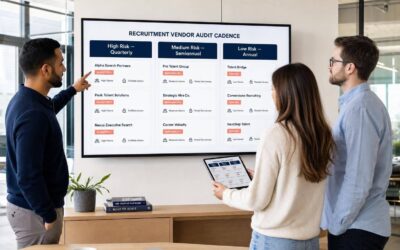
If you scale hiring without tight vendor checks, you can lose money, lose time, and lose control.
I’d boil this down to four things: set clear vendor rules, store proof in one place, review vendors on a fixed schedule, and act fast when something slips. That matters because vendor failure is not a small admin issue. In the source article, 45% of firms lost more than $1 million from vendor failures , as seen in our recruitment case studies, and the average cost of a third-party breach was about $4.45 million.
If you lead hiring in SaaS, IT, fintech, engineering, security, insurance, or professional services, the commercial point is simple. You still carry the risk, even when another firm handles sourcing, screening, or hiring support.
Here’s the short version:
- Turn policy into rules you can test
- Put those rules into contracts and SLAs
- Tier vendors by risk
- Track documents, incidents, and review dates
- Use a short scorecard with clear thresholds
- Fix issues fast, then tighten the process
This is the part many teams miss: weak vendor control slows hiring too. It leads to poor submissions, missing records, repeat checks, legal spend, and extra work for HR, finance, legal, and leadership.
So if I want a simple answer to “how do I monitor vendor compliance policies?”, it’s this: make every vendor duty clear, measurable, visible, and tied to action. That is how you cut avoidable cost, save team time, and keep hiring on track as the business grows.
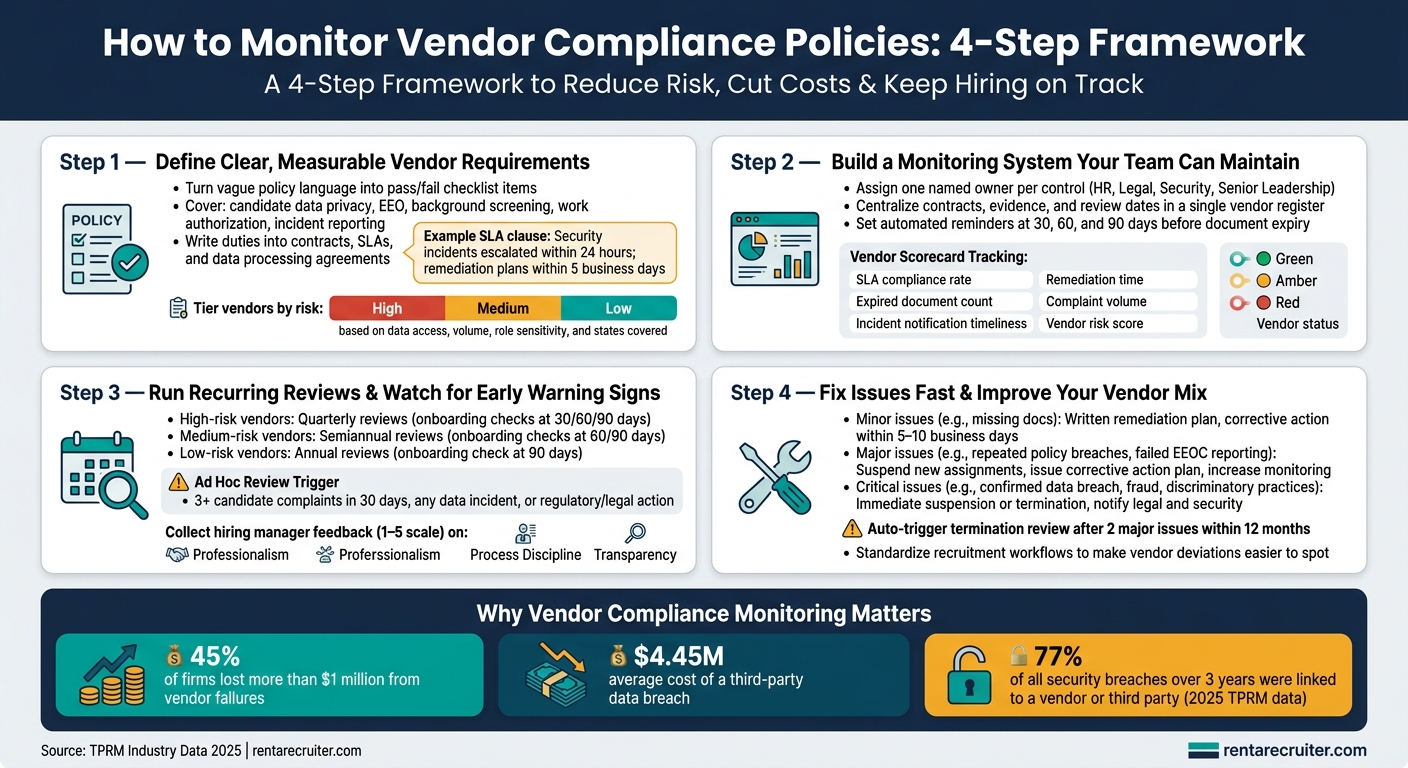
How to Monitor Vendor Compliance Policies: 4-Step Framework
How to Safeguard Compliance with your Vendors and their Contracts
sbb-itb-a23bd6a
1. Define vendor compliance requirements in clear, measurable terms
You can’t monitor what you haven’t defined. Broad policy language is too loose to audit. Phrases like "handle data responsibly" or "screen fairly" don’t give you something you can test.
Before you track vendor performance, turn those policies into specific, observable duties the vendor must meet.
If your policy says report issues promptly, your vendor terms should say: notify us of any suspected data incident within 24 hours.
Once those requirements are set, assign an owner for each one and decide what evidence proves it happened.
Turn internal policies into a vendor compliance checklist
Start by mapping your internal hiring policies to the parts of the process where vendors actually work. The top areas to cover are candidate data privacy, equal employment opportunity, background screening, work authorization, and incident reporting. Those are the areas with the most legal risk if a vendor gets them wrong.
For each area, write checklist items with a clear pass/fail test. A good example is: Does the vendor collect written candidate authorization before ordering a background report? The EEOC says employers must get written permission before obtaining a background report used in an employment decision, and that rule should sit directly in your vendor checklist.[1]
Your checklist should also cover:
- Document retention periods
- Training records
- Insurance certificates
- Required operating procedures for submissions and interviews
Each item should be written so a reviewer can mark it met or not met and attach evidence.
Write compliance duties into contracts, SLAs, and data agreements
A checklist on its own won’t protect you. The duties behind it need to be enforceable. That means putting them into your contracts, service level agreements, and data processing agreements.
Key clauses should cover audit rights, breach notification windows, documentation duties, subcontractor limits, and what happens if the vendor falls short. Be specific with SLA language. For example, a contract might require monthly compliance reports by the 5th business day of each month, security incidents escalated within 24 hours, and remediation plans submitted within 5 business days of a finding.
That level of detail matters. It turns compliance from a vague expectation into a contractual standard your team can check, chase, and enforce.
Data agreements should also spell out who owns I-9 and work authorization duties. USCIS says that in most staffing arrangements, the staffing agency, not the client, completes and retains Form I-9 for placed workers.[2][3] Put that in the contract so there is no confusion later.
Set risk tiers based on vendor activity and data access
Not every vendor carries the same risk. So they should not all get the same level of review.
Group vendors into risk tiers based on hiring volume, role sensitivity, how much candidate data they can access, which states or jurisdictions they work in, and how important they are to the business. This helps you spend more time where the downside is higher, instead of giving every vendor the same treatment.
| Risk factor | Higher risk | Lower risk |
|---|---|---|
| Role sensitivity | Senior finance, healthcare, engineering | Entry-level, low-sensitivity roles |
| Data access | PII, screening records, right-to-work docs | Limited candidate visibility |
| Hiring volume | High-volume, ongoing placements | Occasional or project-based |
| States covered | Multi-state with varying privacy laws | Single state |
Vendors in higher tiers should face tighter contract terms, more frequent reviews, and deeper evidence requests. Lower-tier vendors can sit on a lighter review cycle.
Use tiers to focus scrutiny where failure risk is highest.
These tiers set the review cadence in the next step.
2. Build a monitoring system your team can maintain
Monitoring only works when ownership is clear and evidence is easy to find.
As hiring volume grows, your process needs to stay simple enough for a small team to run without things slipping. If ownership is vague and records live in five different places, reviews get missed, documents expire, and issues sit there far too long.
Use the risk tiers from the previous step to decide how much oversight each vendor needs.
Assign owners across HR, talent, legal, and security
Every monitoring task needs one named owner and one backup. Shared ownership sounds fine on paper, but in practice it often means nobody acts.
Set one operational owner, usually Talent Operations or Talent Acquisition. Start by assigning one owner to each control. A RACI matrix helps keep this clean:
- HR or talent operations is responsible for collecting evidence and updating scorecards
- Legal is accountable for contract language and policy approval
- Security or IT is consulted on data access and incident response
- A senior leader approves vendor suspension or termination decisions
Document your escalation path before you need it. If a vendor misses an SLA, sends an expired insurance certificate, or fails to report an incident, your team should know who flags it, who contacts the vendor, and who can stop work if the issue is not fixed.
Centralize contracts, evidence, and review dates in one place
A shared vendor register should be the single source of truth for your monitoring system. That can be a spreadsheet, a procurement tool, or a GRC platform. The format matters less than consistency.
At a minimum, each vendor record should include the contract version, signed SLA, data processing agreement, insurance certificate, policy sign-offs, security review results, risk tier, incident history, primary contacts, and next review date.
Set automated reminders 30, 60, and 90 days before any document expires. Keep records searchable and up to date. If your team has to hunt for paperwork during a review, the system is already costing you time.
Use a vendor scorecard with compliance KPIs and KRIs
A scorecard makes vendor compliance visible and actionable. Track only the metrics that show compliance, rising risk, and what needs action next.
Keep it lean. A small team can maintain a short set of metrics per vendor on a steady basis. Each metric should have a clear definition, a data source, a named owner, a review frequency, and a threshold that triggers action.
| Metric | Definition | Target / Threshold | Owner | Review Frequency |
|---|---|---|---|---|
| SLA compliance rate | % of agreed service levels met in the period | Meets agreed service levels | Talent Operations | Monthly |
| Expired document count | Number of certifications, insurance, or DPAs past their expiry date | 0 | HR Operations | Monthly |
| Incident notification timeliness | % of incidents reported within the contractually required window, such as 24 hours | 100% | Compliance Lead | Per incident |
| Remediation completion time | Time from issue flagged to closure evidence received | Closed by deadline | Legal / HR | Per finding |
| Complaint volume | Number of candidate or hiring manager complaints logged in the period | Review trend; escalate on increase | Talent Operations | Quarterly |
| Vendor risk score | Composite score based on open issues, tier, and recent review results | Green / Amber / Red band | TPRM Lead | Quarterly |
Use simple color bands, green, amber, and red, so leaders can see which vendors need attention at a glance. That makes review meetings faster and makes it easier to act before a small issue turns into a hiring problem.
3. Run recurring reviews and watch for early warning signs
Once your scorecard is live, the next step is simple: review vendors on a fixed schedule. Without that rhythm, a scorecard and vendor register become paperwork, not control tools.
Review vendors on a fixed schedule based on risk tier
High-risk vendors need the closest oversight. At each review, check current attestations and training records, current insurance certificates with coverage limits, and the status of security certifications such as SOC 2 or ISO 27001. You should also confirm whether data-handling practices have changed.
Then do a sample check on process discipline. For example, confirm that background-check consent was properly documented. It sounds basic, but this is often where small gaps turn into bigger problems.
Use the table below as your review cadence.
| Risk Tier | Onboarding Checks | Ongoing Cadence | Key Monitoring Activities | Escalation Path |
|---|---|---|---|---|
| High | 30, 60, and 90 days | Quarterly | Policy updates, training records, current insurance certificates with coverage limits, SOC 2/ISO 27001 status, process sample checks, hiring manager feedback | HR, legal, and security review; senior leadership for material issues |
| Medium | 60 and 90 days | Semiannual | Policy confirmations, current insurance certificates, sample process checks, hiring manager survey | Talent operations and legal review as needed |
| Low | 90 days | Annual | Annual attestation, policy confirmation, insurance confirmation | HR operations and talent operations |
Track incidents, complaints, and legal actions
Scheduled reviews help, but they only show you issues after the fact. Real-time alerts help you catch problems sooner.
Set up your ATS and helpdesk tools to flag vendor-related issues as they happen. That includes candidate complaints about data handling, unusual account activity from vendor accounts, or missed process steps such as skipped consent forms.
Clear thresholds matter here. If three or more substantiated candidate complaints come in within 30 days, that should trigger an ad hoc review. Any vendor-related data incident should notify your information security and legal teams straight away. If a vendor is involved in a legal action or regulatory inquiry, such as an EEOC charge or a state-level privacy complaint, escalate it to senior leadership at once, no matter where that vendor sits in the review calendar.
Gather hiring manager feedback and add it to the scorecard
Hiring manager feedback belongs in the scorecard because numbers alone don’t tell the full story. Managers often spot qualitative compliance risks before they appear in a report.
A vendor that pressures them to skip steps, misrepresents candidate qualifications, or is vague about sourcing practices.
Those patterns can damage hiring quality, slow decision-making, and create legal risk if left unchecked.
After each hiring cycle or major requisition, ask managers to rate vendor behavior on three areas:
- Professionalism
- Process discipline
- Transparency
Use a simple 1 to 5 scale and include an open text field for examples. Ask direct questions, like whether the vendor followed your interview and feedback timelines, or whether candidates were given the required information upfront.
That feedback should feed straight into the vendor scorecard. If you only track operational metrics, you’ll miss the warning signs that people on the ground can see first.
4. Fix issues quickly and improve your vendor mix over time
Once a review flags an issue, the next move should be clear. Act fast. When monitoring shows a gap, your team needs a set path for remediation, suspension, or termination.
Set triggers for remediation, suspension, or termination
Not every issue calls for the same response. Set three response levels in advance so your team knows what happens when something slips.
| Severity | Example Issues | Response |
|---|---|---|
| Minor | Missing documentation, unsigned data processing addendum | Written remediation plan, corrective action within 5 to 10 business days |
| Major | Repeated policy breaches, audit findings, failed EEOC reporting, mishandled background checks | Suspend new assignments, issue a corrective action plan, increase monitoring |
| Critical | Confirmed data breach, fraud, discriminatory hiring practices, regulatory enforcement action | Immediate suspension or termination, notify legal and security, execute incident response |
Document the thresholds ahead of time. For example, you might set an automatic termination review after two major issues within 12 months. Link these triggers straight to scorecard findings, so a red-band vendor rating leads to a set next step, not a debate in the moment.
Once the response level is clear, track every fix until the issue is fully closed.
Track corrective actions to closure and update controls
A remediation plan needs one owner. Assign one internal owner, one vendor owner, a deadline, and proof of completion, such as updated policies, training records, or corrected documentation.
Track each action as open, in progress, or complete. Do not close anything until Legal, Security, or Talent Acquisition checks and signs off on the fix.
When the same issue shows up again, the problem usually is not the plan on paper. It is the control around it. If the same documentation gap keeps coming back quarter after quarter, tighten the process. Update contract language, shorten the vendor’s review cycle, or add a mandatory pre-engagement audit for new recruiters at that vendor.
Patterns across vendors matter too. If several vendors struggle with data retention practices, revise your standard data processing agreement and SLA metrics for everyone. That saves time, cuts repeat admin, and gives you tighter control across the full vendor mix.
Standardize recruitment workflows to reduce compliance gaps
Standardize your internal recruitment steps to cut vendor compliance gaps. When job intake, candidate submission, documentation, and offer approval follow the same workflow every time, vendor deviations are easier to spot and faster to fix.
That gives you cleaner evidence trails, fewer process exceptions, and simpler oversight across your vendor base. It also helps protect hiring speed, because your team spends less time chasing missing paperwork or fixing avoidable errors.
If you need more recruitment capacity to keep that consistency in place as hiring grows, Rent a Recruiter embeds experienced recruiters directly into your team to manage hiring end-to-end. That gives you the structure and day-to-day oversight needed to keep vendor compliance visible and under control.
Conclusion: Build a repeatable vendor compliance process that supports faster growth
Vendor compliance monitoring is not a one-off task. It needs to run in the background as your company grows, because hiring risk does not stand still.
With the right monitoring framework in place, the aim is simple: consistency.
Define vendor duties clearly. Put them into contracts. Keep evidence in one place. Review vendors based on risk level. Act on issues fast. A policy only works when you rate your recruitment process to measure it, back it up in the contract, and review it on a set schedule.
That matters because the business impact is direct:
- Clearer oversight
- Less admin
- Fewer compliance surprises
- A steadier hiring pipeline
The risk for recruitment vendors inside hiring operations is hard to ignore. In one 2025 TPRM snapshot, 77% of all security breaches over the prior three years were linked to a vendor or other third party.[5][4] That is exactly why a risk-tiered, centralised process makes sense. It helps you focus limited oversight where exposure is highest, instead of treating every vendor the same.
If your team needs more capacity to keep this process running day to day, Rent a Recruiter can help. They embed experienced recruiters directly into your team to manage hiring end-to-end, while keeping vendor compliance visible and manageable as you scale.
FAQs
What evidence should I collect from each vendor?
Collect hard, checkable evidence instead of taking self-reported claims at face value. If you’re trusting a recruitment partner with hiring activity, data access, and brand risk, you need proof you can verify.
That usually includes:
- Legal and financial documents: tax forms, business licenses, incorporation documents, and insurance certificates
- Data privacy and security records: DPAs, NDAs, SOC 2 Type II reports, security policies, and incident response plans
- Operational, compliance, and ethics records: placement data, ATS logs, worker classification protocols, background check logs, and data ownership, storage, and deletion procedures
This matters for one simple reason: claims don’t protect your business, records do. A provider might say they follow a tight process, handle data with care, or meet your compliance bar. The paperwork shows whether that’s true.
For CEOs, CFOs, HR leaders, and Talent Leaders, this kind of review cuts through sales talk fast. It helps you spot legal exposure, data risk, and process gaps before they turn into hiring delays, audit issues, or extra cost.
How often should I review high-risk vendors?
Review timing should match the level of risk.
For high-risk findings, like compliance gaps in background checks, run a follow-up review within 30 to 60 days. That gives you a short window to check whether the issue was fixed before it turns into a bigger cost or compliance problem.
For critical vendors, look at overall performance and financial stability every month. If warning signs show up, reassess straight away. That includes things like declining candidate quality or unexpected cost increases.
In plain terms, the higher the risk, the shorter the review cycle. That helps you protect hiring outcomes, control spend, and avoid surprises.
What should trigger vendor suspension or termination?
Suspend or terminate a vendor when performance gaps continue after corrective action, the vendor no longer fits your business needs, or complacency keeps showing up in delivery.
Terminate at once for serious issues such as data security breaches, gross negligence, critical SLA failures, repeated SLA breaches, candidate NPS below 50, or an ongoing lack of transparency in data practices.
Before you make that call, check that the problem did not come from your side as well. Then follow the contract notice period and termination terms closely. In plain terms, protect the business first, then execute the exit properly.