Fast hiring without controls gets expensive later. If you are hiring as you scale across the US, one weak hiring process can lead to worker classification mistakes, pay errors, poor interview records, and missed onboarding steps that surface months later as back pay, fines, legal cost, and lost leadership time.
I see the pattern clearly in scaling SaaS, fintech, engineering, IT, security, insurance, and professional services firms. The fix is not more policy documents. It is putting checks inside the hiring workflow so managers do not make pay, interview, or onboarding decisions ad hoc. That gives you better cost control, less rework, and fewer hiring delays as headcount grows.
At a glance, the article comes down to four points:
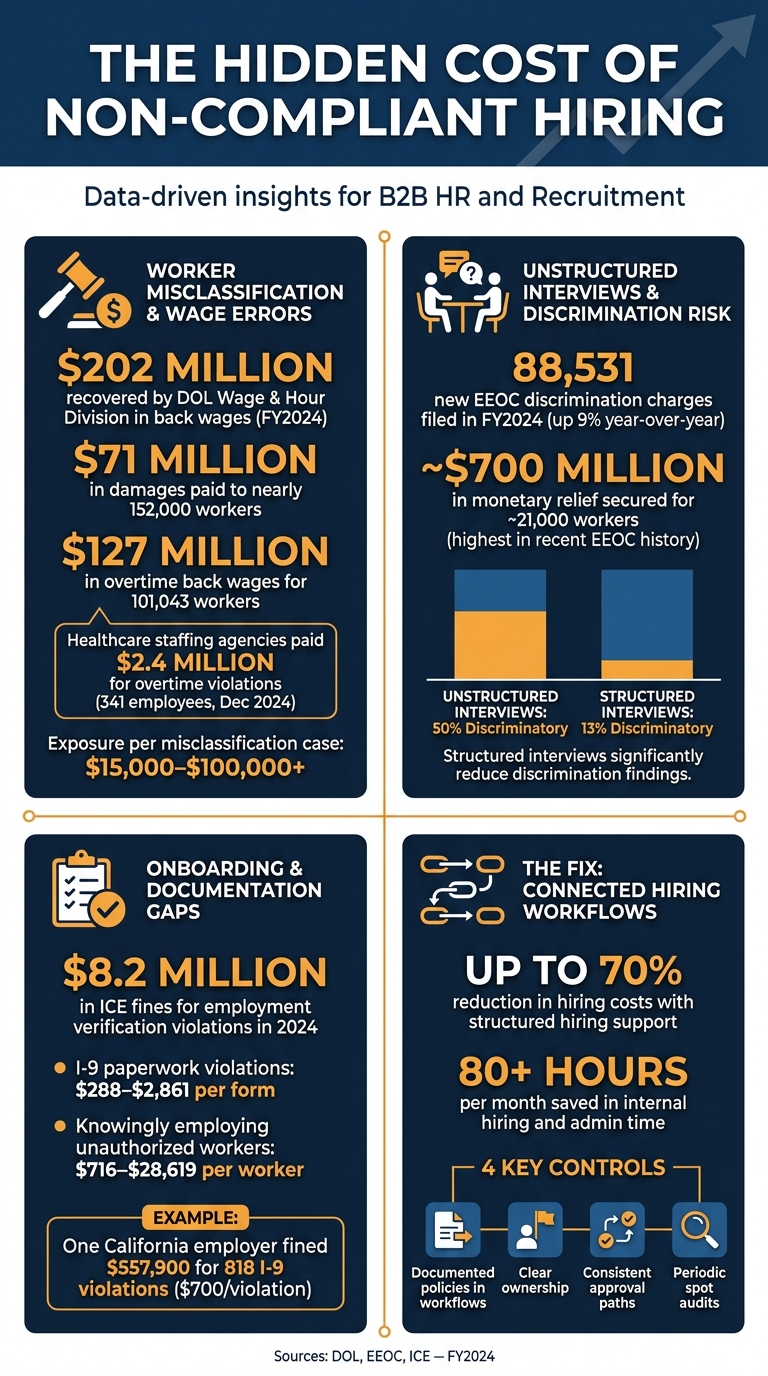
- Worker classification and pay errors can create exposure of $15,000 to $100,000+ per case.
- Loose interviews increase discrimination risk and leave you with weak records if a complaint lands.
- Onboarding gaps often lead to missed I-9s, tax forms, and state notices, with fines that add up fast.
- Connected hiring workflows help you protect margin, save time, and keep hiring moving.
If you want growth without messy clean-up later, this is the part of hiring to fix first.
Compliance Risks in High-Growth Hiring: Key Fines, Penalties & Stats
HR Compliance Is Too Reactive. Carla Tells Us How to Get Ahead | SHRM ’26
sbb-itb-a23bd6a
Problem 1: Worker misclassification and wage errors during fast hiring
When hiring speeds up, classification calls often happen on the fly. A manager needs someone to start next week, so they bring them in as a contractor to skip admin. A role gets marked exempt because the title sounds senior. That might feel like a small shortcut in the moment. It can turn into legal and financial exposure very fast.
Where fast-growing teams get classification and pay decisions wrong
Fast-growing teams often get two things wrong first: worker classification and pay setup.
In SaaS and fintech, long-term contractors doing core product or customer work are sometimes treated as independent contractors, even when they meet IRS and Department of Labor tests for employee status. Engineering firms can make the same mistake with field technicians or project coordinators, classifying them as exempt even though the work is hands-on and not managerial. The key point is simple: worker status depends on what the person actually does, not what the contract says.[3]
Pay errors usually follow the same pattern. Someone copies a previous offer and doesn’t check whether it meets the minimum wage or salary threshold in the new hire’s location. A remote employee in Colorado or New York gets an offer based on the company’s home-state rules, not the rules where they work.
That is where small process gaps become expensive. In fiscal year 2024, the DOL’s Wage and Hour Division recovered $202 million in back wages and $71 million in damages for nearly 152,000 workers. Overtime violations alone accounted for $127 million in back wages for 101,043 workers.[1]
And the cost is not abstract. In December 2024, healthcare staffing agencies in Massachusetts and Pennsylvania paid more than $2.4 million for overtime violations affecting 341 employees, including workers misclassified as independent contractors.[2]
For hiring leaders, this is the business issue: a rushed hiring process can create back pay claims, tax exposure, penalties, and avoidable cost per hire inflation later.
How to add pay and classification checks to the hiring workflow
The fix is not running a legal review every time you open a role. It is much simpler than that. You need a few checks built into the workflow, so the right questions are answered before a requisition is approved or an offer goes out.
| Compliance Issue | Business Risk | Process Control |
|---|---|---|
| Contractor vs. employee misclassification | Back pay, payroll tax liability, penalties | Classification review before requisition is opened |
| Exempt vs. non-exempt errors under FLSA | Overtime back pay, class actions | Duties test applied to every new role, not just title or salary |
| Inconsistent offer terms across locations | Internal pay inequity, discrimination claims | Centralized offer templates with location-specific pay validation |
| Weak time tracking for non-exempt staff | Overtime disputes, missed break violations | Integrated timekeeping tied to payroll, manager sign-off required |
These checks should be a hard gate before requisition approval or offer release. If the process lives in your ATS, even better. That gives you one review path, one record, and one sign-off standard for every hire.
Done well, this saves more than legal pain. It cuts rework, reduces offer delays, and gives finance and HR more control over hiring cost.
Even when pay is fixed, unstructured interviews create the next compliance risk.
Problem 2: Unstructured interviews increase discrimination risk
Once pay and worker classification are under control, interviews are often the next weak spot. A lot of scaling teams still let hiring managers wing it, with no shared questions, no scorecard, and no note-taking standard. That inconsistency can turn into legal exposure.
High-risk interview practices in multi-manager and multi-state hiring
The risk comes down to what gets asked and what gets written down. Questions about age, pregnancy or childcare, religion, disability, or national origin can all be used as evidence of discriminatory intent, even if the interviewer had no bad intent.[5][6][7][8][9][10][11][12][14]
This gets worse when hiring involves multiple managers or multiple states. Without a structured framework, interviewers end up assessing different things, using different standards, and recording feedback in different ways.
One manager focuses on job-related skills. Another spends half the interview talking about a candidate’s personal background. If a rejected candidate files a complaint, you may have no clear record showing the hiring decision was tied to the role and applied the same way across the process. That leaves you with no solid defence on paper.
In FY 2024, the EEOC received 88,531 new discrimination charges, up more than 9% from the prior year, and secured almost $700 million in monetary relief for about 21,000 workers, the highest recovery in its recent history.[15][16][17][18] For scaling SMEs with loose interview processes, that is a direct business risk.
How structured interviews reduce legal risk and improve hiring consistency
The fix is simple: define the competencies the role needs, build a standard set of questions around them, and score every candidate using the same method. Structured interviews were found discriminatory in 13% of cases, versus 50% for unstructured interviews.[4] They also do a better job of predicting performance on the job.[13]
In practice, that means moving away from free-flowing, manager-led interviews and using:
- Competency-based interview guides
- Anchored scorecards
- Written rationales stored in your ATS
- Clear interviewer ownership for each assessment area
Each interviewer should assess a set area, score on their own, and document what they observed in concrete, job-related language. "Did not demonstrate experience managing a regulated onboarding process" is defensible. "Not a culture fit" is not.
The table below shows where common interview questions create risk and what safer alternatives look like:
| High-Risk Question | Compliance Risk | Compliant Alternative |
|---|---|---|
| Do you have kids? or Are you planning to get pregnant? | Sex/pregnancy discrimination under Title VII | Are you able to meet the schedule requirements for this role, including occasional overtime? |
| How old are you? | Age discrimination under the ADEA | Ask only if a minimum age requirement is legally required for the role |
| Where were you born? | National origin discrimination under Title VII | Are you legally authorized to work in the United States? |
| Do you have any health conditions? | Disability discrimination under the ADA | Are you able to perform the essential functions of this role, with or without reasonable accommodation? |
| What church do you attend? | Religious discrimination under Title VII | Are you available to work the required schedule? We can discuss any accommodation needs if an offer is extended. |
Train interviewers before they meet candidates. That training should cover prohibited questions, note-taking, scorecards, and how to handle accommodation requests.
Standardized interviews only work when the hiring record carries cleanly into onboarding.
Problem 3: Documentation and onboarding gaps cause avoidable compliance failures
Even strong interviews can fall apart if the handoff into onboarding is loose.
Once an offer is accepted, a split between recruitment and onboarding often leads to missed compliance steps and avoidable risk. Most onboarding compliance failures happen after offer acceptance. When hiring is moving fast, those misses can turn into direct financial exposure.
The most common breakdowns in fast-moving onboarding
The main issue is unclear ownership. Recruiters stop at offer acceptance. HR waits on managers. Managers wait on HR. And no one clearly owns Form I-9 completion, so the three-business-day deadline slips by.[30][31]
ICE levied $8.2 million in fines against employers for employment verification violations in 2024 alone.[21] Paperwork violations can cost between $288 and $2,861 per form, while knowingly employing unauthorized workers can lead to fines of $716 to $28,619 per worker, with higher penalties for repeat offences.[19][20][22][23] One California employer was fined $557,900 at $700 per violation after 818 I-9 violations were found.[24]
It does not stop with I-9s. Teams also miss W-4s, state withholding forms, and required notices. Remote hiring adds another layer, because state-by-state withholding, reporting, and notice rules are easy to miss when you rely on a generic onboarding pack.[32]
How connected recruitment and onboarding controls prevent missed steps
The fix is simple in principle: make onboarding part of the hiring workflow, not a separate admin task.
Trigger onboarding at offer acceptance, not day one. When your ATS or HRIS creates an employee record as soon as an offer is accepted, it can generate a checklist straight away, assign owners, and set hard deadlines before responsibility gets blurred.[25][26][28][29]
This is where gating controls help. In high-volume hiring, your system should block start date confirmation, payroll setup, and IT access until I-9 completion, W-4 submission, and required state notices are marked complete.[26][27][28][29] That cuts manual chasing and makes missed steps much less likely.
The table below shows how ownership and documentation should line up across onboarding:
| Stage | Required Documentation | Process Owner |
|---|---|---|
| Offer & Acceptance | Signed offer letter, background check consent | Recruiter + HR review |
| Pre-Start Compliance | I-9 Section 1 scheduled, W-4 sent, state withholding forms sent | HR |
| Day One | I-9 Sections 1 & 2 completed, E-Verify initiated (if applicable), handbook acknowledgment | HR + Hiring Manager |
| First Week | Benefits enrollment forms, IT/security agreements, state-specific notices | HR + IT |
| Ongoing Compliance | Training completions, updated acknowledgments, performance documentation | Manager + HR |
Storage matters too. I-9s should be kept separately from general personnel files and retained for three years after the hire date or one year after termination, whichever is later.[33] W-4 and payroll records must be kept for at least four years under IRS guidelines.[33]
If those records live in inboxes or shared folders, you are asking for trouble. Store them in a role-based-access HRIS instead. That keeps documents easier to find during an audit and lowers deletion and access risk.
Solution: Build a scalable hiring model with built-in compliance controls
The fix is not more policy documents sitting in a folder. It is fewer manual decisions inside the hiring process.
Most of these issues show up when policy sits outside the workflow. Classification checks, structured interviews, and onboarding gates work best when they are built into one controlled system.
In other words, governance should live inside hiring, not beside it.
What good governance looks like in a scaling hiring function
Good hiring governance comes down to four controls.
Documented policies tied to real workflows. Put rules for classification, pay, EEO, background checks, and data privacy directly into your ATS, offer templates, and onboarding checklists. If the rule is not in the workflow, people will miss it.
Clear ownership at every stage. Give each step one owner, whether that is the recruiter, hiring manager, HR, or finance. Shared ownership sounds fine on paper, but in practice it often means delays, gaps, and finger-pointing.
Consistent approval paths. Every offer should move through one standard approval workflow. HR confirms the job level. Finance confirms the budget. The system should block the offer letter until both approvals are done.
You should also set escalation rules for exceptions, such as pay exceptions, contractors, or remote workers in new states. Those cases need senior review before anything is signed off. One approval path, with system blocks for exceptions, keeps control tight without adding extra admin.
Periodic spot audits. Review recent hires for scorecard use, pay-band approval, and complete onboarding. This is how you catch small issues before they turn into bigger cost or legal problems.
Conclusion: Cut compliance risk without slowing growth
Fragmented hiring creates gaps. Connected workflows close them.
When workflows are standardised, approvals are enforced by the system, and role ownership is clear, you cut the back-and-forth, rework, and legal exposure that drain time and money.
If you need this structure fast, outside support can help without slowing hiring. Rent a Recruiter places experienced recruiters into your team within days, managing hiring end to end while bringing structure, visibility, and consistency to the process. Clients typically reduce hiring costs by up to 70% and save over 80 hours per month in internal hiring and admin time.
FAQs
What hiring checks should we add first?
Start with worker classification, background screening, and compensation controls.
Before hiring picks up, check each role against Department of Labor and IRS guidelines. That helps you cut the risk of misclassification penalties, back pay claims, and tax issues that can drain time and budget.
For screening, build a process that covers:
- Identity and SSN verification
- Criminal history checks
- Employment and education verification
- Reference checks
Just as important, make sure the process follows the FCRA. Use standalone disclosures, get candidate consent, and remove salary-history questions from applications and interview scripts.
This is basic hiring control, but it has a direct business impact. Clean compliance steps early on save expensive fixes later.
How can we standardize interviews quickly?
Move from ad hoc, subjective hiring chats to a structured evaluation framework.
Before the role goes live, define 4 to 6 job-related competencies. Then build a fixed set of interview questions that map directly to those criteria. This gives every interviewer the same lens, which means better hiring decisions and less time lost in vague debriefs.
Give each interviewer a shared interview guide and a 1 to 5 scorecard with clear behavioural indicators. That way, scoring is based on what the candidate actually said and did, not gut feel or who spoke last in the room.
Just as important, have interviewers submit their scores independently before any group debrief. This helps cut groupthink and keeps evaluations fair and consistent. For hiring leaders, that means a process you can trust, cleaner decision-making, and fewer costly mis-hires.
Who should own hiring compliance?
Hiring compliance needs clear owners for each task. That’s how you get accountability, clean records, and fewer gaps when hiring picks up.
This should sit with leadership as a business issue, not just an admin task. But day-to-day ownership needs to be shared across the people closest to the work.
- HR managers: oversight and final file control
- Hiring managers: role definitions and interview records
- Leadership: business alignment and offer approvals