
Bad interviews cost money, slow hiring, and lead to weak hiring calls. Structured interview templates fix that with the same questions, the same scoring, and clearer decisions across every interviewer.
If you are hiring across SaaS, technology, IT, fintech, engineering, security, insurance, or professional services, this is the simple takeaway: set 12 month role outcomes, score against fixed competencies, separate notes from ratings, and run one debrief process for every hire. Structured interviews are also far more predictive than unplanned interviews, with validity often cited at r = 0.42 to 0.51, versus about r = 0.20 for unstructured interviews.
In this guide, I cover the full hiring setup you need:
- One core structured interview framework
- Role templates for sales, software engineering, product, customer success, and People Ops
- One shared scorecard
- One panel debrief format
- A simple way to use the same process across departments without adding extra admin
If your hiring team is moving fast after growth, funding, or headcount pressure, this gives you a tighter way to compare candidates, cut wasted interview time, and make hiring decisions you can back up.
A lot of companies do not need more interviews. They need a better interview system.
What Every Structured Interview Template Should Include
These elements help small teams stay consistent without piling on HR admin. A structured interview template is not just a question list. It is a working system that keeps interviewers aligned, makes candidate assessment more consistent, and gives you a hiring decision you can stand over.
Use this structure as the base for every role template below: outcomes, competencies, core questions, scoring, notes, and recommendation.
Define the Role Outcomes for the First 12 Months
Start with success, not questions. Before you write anything for the interview, turn the job description into 3 to 5 measurable first-year outcomes. That could be tied to revenue, delivery, quality, or retention.
For a sales role, one outcome might be generating $750,000 in new annual recurring revenue by the end of the first 12 months.
Put these outcomes at the top of the template. They give the whole interview a clear point of reference. When interviewers know what the hire must deliver, they can judge whether the candidate has done something similar before. That makes interviews more useful, and it cuts down on vague debate later.
List the Competencies Being Assessed
Next, define 5 to 8 role-critical competencies, such as customer focus, analytical thinking, or technical skill.
Each one should have a one-sentence definition so every interviewer is judging against the same bar. For example, customer focus: demonstrates a consistent ability to understand customer needs, respond promptly, and prioritise long-term relationships over short-term gains.
This sounds simple, but it saves time and avoids confusion. Without clear definitions, two interviewers can sit through the same interview and leave with completely different views of the same person.
Use Standardized Behavioral and Situational Questions
Your template should include both behavioural and situational questions.
Behavioural questions ask candidates what they did in past situations. Situational questions ask what they would do in a hypothetical scenario linked to the role.
Document 4 to 6 core behavioural questions and 2 to 4 situational questions, all tied back to the same competencies. You can also include a few follow-up prompts, such as:
- What was the outcome?
- What would you do differently?
Those prompts help interviewers get better detail. But the core questions should stay fixed. That is what gives you a fairer comparison across candidates and a cleaner decision process.
Apply a 1-to-5 Rating Scale
Vague feedback like seemed solid tells you almost nothing when you are comparing five candidates interviewed on different days.
A 1-to-5 rating scale, applied separately to each competency, fixes that. Define each score in plain language:
- 1 = far below expectations
- 2 = below expectations
- 3 = meets expectations
- 4 = above expectations
- 5 = outstanding
Clear scoring anchors make ratings more comparable across interviewers. That matters if you want a hiring process that stands up to scrutiny, especially when several people are involved.
Structured interviews also show strong inter-rater reliability, around 0.82 to 0.92, compared with lower agreement in unstructured formats.[2][3]
With the scoring logic in place, the role-specific templates below show how to use it in practice.
Separate Notes from Judgments
Each competency in the template should have two separate fields: one for factual notes and one for the rating.
In the notes field, interviewers write what the candidate actually said. That means specific examples, metrics, and exact phrases where useful. In the rating field, they assign the 1 to 5 score and add a short reason.
This split matters. It pushes interviewers to record evidence before making a judgment, which helps reduce snap reactions and gut-feel hiring.
Add a Clear Hiring Recommendation
Close the template with a simple recommendation field: Strong Yes, Yes, No, Strong No.
Add a short justification box where the interviewer links that recommendation back to the competency scores. This keeps the decision tied to evidence, not general impressions. It also helps teams move faster when they need to review candidates across multi-stage hiring processes.
sbb-itb-a23bd6a
1. Rent a Recruiter Structured Interview Framework
Where It Fits Best
This framework works best for the SME roles high-growth teams hire most often: sales, engineering, product, customer success, and people ops.
The structure stays the same across roles. What changes is the competency lens for each one. That matters because consistency helps small teams move faster, while role-based scoring keeps hiring decisions tied to the job in front of you.
How It Adapts by Role
Each template swaps in role-based competencies and questions, so the format stays consistent while the evidence changes.
For example, a CSM template may test churn recovery and escalation handling. But those questions only work if the scoring anchors are just as specific. Otherwise, you end up with vague feedback, uneven scoring, and a debrief that takes longer than it should.
Role-Specific Scoring Anchors
Each score uses role-based anchors. For example, a 4 in sales means repeated quota attainment, while a 4 in engineering means ownership of production-critical systems and architectural decisions.
That gives interviewers a shared standard. In the debrief, they compare scores in a structured way so ratings stay grounded in evidence.[4] For scaling teams, that means cleaner decision-making, less bias, and fewer costly hiring mistakes.
Running It on a Small Team
For small teams, the framework should be simple to launch inside your existing tools, then tightened up after the first few interviews and debriefs.
You do not need to build a big hiring machine on day one. Start with a clear scorecard, use it in live interviews, and adjust where the process feels loose. That keeps the admin light while helping your team hire with more consistency.
2. Sales Interview Template for Account Executives and SDRs
Role Fit for SME Hiring
Once the base interview structure is in place, sales hiring needs to tie directly to revenue.
For SMEs, that matters even more. You are often hiring people who need to build pipeline and win business without a big support system around them. An AE or SDR may have to source their own prospect lists, sell a brand with lower market recognition, and work with light marketing support.
That is why the opening section of the template should define 3 to 5 measurable 12-month outcomes. Keep them role-specific and tied to business results, such as:
- time to first meeting booked for SDRs
- time to first closed-won deal for AEs
- quota attainment
- pipeline volume and quality
These metrics make the interview less about general sales polish and more about whether the person can deliver in your setup.[12][13]
Competency and Question Structure
After you define outcomes, assess the behaviours that lead to them.
For SDRs, focus on outbound prospecting discipline, resilience to rejection, coachability, communication clarity, and organisation. For AEs, focus on discovery and qualification, deal management, objection handling, stakeholder management, and closing execution.
Each competency should link to 2 to 3 behavioural and situational questions. That keeps the interview focused and gives you enough evidence to score with confidence.
For SDR prospecting, ask how the candidate would structure a day with 60+ outbound calls and emails while keeping quality and consistency high.[7] For AE deal execution, ask them to walk through a complex deal from first conversation to close, then explain how they kept momentum and secured stakeholder buy-in.[8][9]
The follow-up questions matter just as much as the main question. Push for numbers, steps, and outcomes. If someone says they managed a strong pipeline, ask how much pipeline, over what period, and what conversion rates they were working with. That is usually where you find out whether the answer is solid or just well rehearsed.
Scoring Rubric Clarity
Your scoring rubric should use sales-specific anchors on the 1-to-5 scale.
For prospecting, a 5 means the candidate can show multiple prospecting methods, clear metrics, and examples of process changes they made. A 3 means they can explain a structured prospecting approach, but results may be uneven. A 1 means they depended on inbound or marketing-sourced leads and cannot explain a clear outbound system.[6][11][12]
This kind of scoring helps small teams avoid vague feedback like “good energy” or “felt commercial”. Instead, you get something you can compare across candidates.
Require written evidence for any score of 4, 5, 2, or 1. That extra discipline makes it much easier to compare people fairly across interviews, especially when several interviewers are involved.[10]
Implementation Effort for Small Teams
Keep the process light. Use one master template per role across the phone screen, first interview, and panel.
Early screens should focus on quota history and comfort with outbound work. Later rounds should go deeper on behavioural and situational questions. Split ownership across the panel, with each interviewer covering 2 to 3 competencies, so nobody is trying to assess everything at once.
Before interviews begin, run a short 60- to 90-minute calibration session to align on what strong evidence looks like.[13] That small bit of prep can save a lot of back-and-forth later and helps your team make better hiring calls, faster.
Use the same scorecard logic for the next sales role. In most cases, the framework stays the same, only the competency mix changes.
3. Software Engineering Interview Template
Role Fit for SME Hiring
Engineering hiring in an SME looks different from hiring in a large enterprise.
In most cases, you are not hiring for a narrow specialist role. You are hiring someone who can own work end to end, move across the stack when needed, and work closely with product, sales, and customer success in a fast-moving, sometimes messy setup.
Use the same scorecard structure as the other templates, but judge engineers on delivery, reliability, and cross-functional execution.
Start with the base scorecard, then shape the 12-month outcomes around engineering delivery. For most SME engineering roles, that usually means:
- Shipping a set number of major features
- Improving system reliability or performance
- Putting practical testing and deployment habits in place
- Working well with other teams across the business
For SMEs, the aim is not specialist depth on its own. It is reliable ownership in a small-team setting.
Competency and Question Structure
Five core competencies cover most of what SMEs need from software engineers: technical depth and problem-solving, code quality and maintainability, ownership and execution, collaboration and communication, and learning speed.
Each competency should link to 2 to 3 standard behavioral or situational questions based on work the person has done before.
For ownership, ask the candidate to walk through a feature they took from idea to production, including testing, deployment, and monitoring after launch.
For collaboration, ask how they handled a case where a non-technical stakeholder asked for something that carried technical risk.
For learning speed, ask about a time they had to get up to speed with a new technology fast to hit a deadline on a small team.
Role-specific question banks help if you are hiring across different engineering profiles. Backend engineers should be asked about API design and debugging distributed systems. Frontend engineers should be asked about performance gains and working with incomplete design specs. Full-stack engineers should be asked about trade-offs between speed and technical strength across the stack.
Score against evidence, not just how polished someone sounds technically.
Scoring Rubric Clarity
Use the same 1-to-5 scale from the base framework, but tie it to engineering-specific behavior.
A score of 5 for ownership means the candidate can point to clear examples of leading incident resolution, running postmortems, and making changes that stopped the same issue from happening again.
A score of 3 means they deliver assigned work dependably with some guidance.
A score of 1 means they struggled to explain even one feature they owned without heavy support.[14]
This matters because vague scoring slows decisions and makes debriefs drift into opinion. Clear anchors help your team compare engineers on the same basis, which cuts wasted interview time and leads to better hiring calls.
Implementation Effort for Small Teams
Keep each interview round focused on 3 to 4 competencies so sessions stay within 45 to 60 minutes.
A simple split works well:
- Technical depth and ownership in one round
- Collaboration and learning speed in another
Before interviews begin, run a short calibration session where interviewers score a sample response or mock interview on their own, then compare ratings.
That one step can reduce scoring inconsistency and make the debrief much faster. Use the same structure across backend, frontend, and full-stack roles. Change only the technical prompts.
4. Product Manager Interview Template
Role Fit for SME Hiring
PM hiring in an SME is different from enterprise product roles.
In a larger business, product scope is often split across several people. In an SME, that usually isn’t the case. Your product manager often owns the full lifecycle: discovery, prioritisation, delivery coordination, and go-to-market collaboration. In practice, they need to handle discovery, prioritisation, delivery coordination, and go-to-market support with far less structure around them.
That changes what you need to test.
You need someone who can work through ambiguity, make calls with partial data, and handle cross-functional trade-offs without getting stuck. If they need perfect inputs, a large product ops function, or layers of sign-off, they’ll struggle.
In most SMEs, the PM works with a small engineering squad, uses light documentation, and reports into a founder or department head. Like the other templates in this article, this one keeps the same scorecard structure and only shifts the competency lens.
Competency and Question Structure
Build the template around five competencies: product sense, execution, analytics and metrics, communication and influence, and strategic thinking.
Each area should include both behavioural questions and situational prompts. That gives you two things: proof from past work, and a view of how the person thinks under pressure.
For prioritisation, ask the candidate to describe a time they faced conflicting demands from sales and engineering, and how they decided what shipped first.
For analytics, ask how they’ve made product decisions when data was partial or noisy. This matters in SMEs because many teams don’t have a large data function. You’re testing judgment, not dependence on extra support.
For execution, ask them to walk through a release they shipped under tight constraints. What trade-offs did they make? What happened after launch? Did the result meet the goal, or did they need to adjust?
Use one scenario to show how the candidate balances revenue, technical debt, and customer pressure. A strong SME prompt is:
"You have three features to consider – one with high revenue potential, one addressing technical debt, and one requested by a major customer. Engineering has capacity for one sprint. How do you prioritize?"
Good candidates won’t dodge the trade-off. They’ll map the options, name the framework they’re using, and explain how they’d communicate the decision to stakeholders. That’s a strong sign they can protect product focus without losing trust across the business.
Scoring Rubric Clarity
Use the same 1 to 5 scale, tied to PM-specific behaviour.
| Score | What It Looks Like |
|---|---|
| 5 | Drives measurable outcomes with light process and clear stakeholder alignment. |
| 3 | Solid examples with clear reasoning; can operate effectively in the role with some ramp-up. |
| 1 | Cannot give concrete examples or relies on support unavailable in an SME. |
Score each competency on its own, then give one hiring recommendation.
Pay close attention to weak scores in prioritisation, discovery, or cross-functional collaboration. Those gaps tend to hit SMEs hard. A PM can sound strong in strategy, but if they can’t make trade-offs or work across teams, delivery slows down and founder time gets pulled back into day-to-day product decisions.
Implementation Effort for Small Teams
Keep the interview loop practical.
A simple structure works well for lean teams:
- 30 to 45 minutes for the recruiter screen
- 60 minutes for the hiring manager deep dive
- 45 minutes for a cross-functional interview with an engineering lead or customer success rep
That keeps the process manageable while still giving you enough signal to make a sound call.
Before interviews begin, run a short calibration session. Have interviewers score a sample PM response on their own, then compare ratings. Use one sample PM answer to align scoring around prioritisation and trade-offs. This step helps cut inconsistent scoring, which matters when you have several interviewers looking at the same role from different angles.
If you’re working with embedded recruitment, the recruiter can set up the scorecard and interviewer training fast. The aim is simple: keep the loop short, consistent, and based on evidence.
5. Customer Success Manager Interview Template
Role Fit for SME Hiring
For SMEs, a CSM interview should test retention, expansion, and early risk detection.
In most cases, a CSM manages 20 to 60 accounts, based on ACV and account complexity. The role usually covers onboarding, health tracking, renewals, and expansion conversations.
Use the same scorecard structure as the other templates. The difference here is the competency focus.
In the first 12 months, the role should be shaped around onboarding ownership, retention and expansion, proactive risk management, process building, and cross-functional influence. A strong CSM helps cut churn and protect revenue. That matters fast, especially in a scaling business where one weak renewal cycle can hit growth targets.
You are not looking for someone who only keeps customers happy on calls. You need someone who owns outcomes. They should be able to run QBRs, spot at-risk accounts early, and find upsell openings without leaning on a big ops team in the background.
Competency and Question Structure
Use five competencies: relationship building, account ownership, value storytelling, expansion, and process building in lean teams.
Each one should include both a behavioural question and a situational question. For retention and churn management, ask: "Describe a specific at-risk customer you managed to retain. How did you diagnose the risk, and what did you do?" For expansion, try: "Share an example where you identified and drove an upsell with a customer who wasn’t actively asking for more." For process building, ask: "Tell me about a time you created or improved a CSM process – onboarding, renewals, QBRs."
"You have three at-risk accounts and only time for two deep dives this week. How do you decide where to focus?"
Strong candidates usually bring a framework to this. They might use health score, revenue at risk, or renewal timing. More importantly, they should explain the trade-off. That’s what you want to hear: structured thinking, not instinct on its own.
Scoring Rubric Clarity
Once the competencies are set, score each one against CSM-specific evidence.
| Score | What It Looks Like |
|---|---|
| 5 | Built a repeatable CSM process with measurable retention or expansion gains. |
| 4 | Strong examples with clear metrics and proactive ownership. |
| 3 | Meets expectations with solid ownership in existing processes. |
| 2 | Shallow examples, unclear impact, heavy guidance. |
| 1 | No relevant examples or weak SME fit. |
Score each competency on its own before writing your hiring recommendation. Pay close attention to account prioritisation and value realisation. Those two areas often tell you whether a candidate can protect revenue when time and headcount are tight.
Implementation Effort for Small Teams
Keep the process lean so small teams can run it the same way every time. Use a 2- to 3-interview loop, run a 30- to 45-minute calibration session, assign clear ownership, and review the template every 3 to 6 months.
If you’re hiring several go-to-market roles at once, an embedded recruiter like Rent a Recruiter can help design, roll out, and improve structured CSM interview templates while also handling day-to-day hiring.
6. HR and People Operations Interview Template
Role Fit for SME Hiring
In SMEs, strong People Ops hires need to be hands-on, level-headed, and comfortable working where process is still taking shape, documentation is light, and priorities move fast. The people who do well here connect HR decisions to retention, productivity, and growth.
In a small company, weak People Ops shows up quickly. You see hiring drag out, managers clash, and compliance issues build into expensive problems.
Use the same structure as the earlier templates, but put more weight on compliance, employee relations, and process design.
Set the interview in context from the start. Include the company stage, current HR maturity, reporting line, and the top three outcomes expected in year one. Examples include reducing average time-to-hire from 60 to 40 days, putting in place a basic performance review cadence, or improving eNPS. That keeps the interview tied to measurable business impact, not loose HR experience.
Competency and Question Structure
Keep it to 4 to 6 competencies. For SME People Ops hiring, a practical set includes:
- Employee relations and manager coaching
- Compliance and risk management
- Process design and improvement
- Change management and communication
- HR metrics and reporting
- Stakeholder management
For each competency, use one behavioral question and one situational question:
- Employee relations and manager coaching
- Behavioral: Share a situation where you helped a manager navigate a conflict within their team. How did you balance fairness, speed, and business pressure?
- Situational: A manager comes to you with a performance issue they’ve been avoiding for three months. How do you handle it?
- Compliance and risk management
- Behavioral: Describe a time you handled a sensitive HR issue with limited documentation. How did you manage the risk and what was the outcome?
- Situational: You discover a policy gap that creates legal exposure. What do you do first?
- Add one confidentiality question to this section.
- Process design and improvement
- Behavioral: Tell me about a process you built from scratch, onboarding, performance reviews, or a hiring workflow, in a growing organization. Why did you build it and what improved?
- Situational: You’re asked to build an onboarding process with no budget and no dedicated HR team. Where do you start?
- Change management and communication
- Behavioral: Describe a time you introduced a people process that met resistance. How did you get buy-in?
- Situational: Leadership wants to roll out a new performance framework in 30 days. How do you approach it?
- HR metrics and reporting
- Behavioral: How have you used turnover, time-to-hire, or absenteeism data to identify a problem and decide what to change?
- Situational: You notice a spike in 90-day attrition. What data do you pull and what do you do with it?
- Stakeholder management
- Behavioral: Tell me about a time you pushed back on a people decision made by a senior leader. What happened?
- Situational: Two department heads want conflicting things from HR this quarter. How do you prioritize?
Score each answer against the same outcomes and competencies, not against the interviewer’s style or how polished they sound.
Scoring Rubric Clarity
Use the same 1 to 5 scale, but anchor it to HR-specific behavior:
| Score | What It Looks Like |
|---|---|
| 5 | Built or transformed a People function in a small, growing company with measurable, data-driven impact. |
| 4 | Gives structured examples with clear outcomes; improved HR processes before issues grew and spotted risks early. |
| 3 | Solid, relevant experience; handles typical SME scenarios well. |
| 2 | Answers stay at the surface or vary too much; limited ownership of outcomes. |
| 1 | Minimal relevant experience; would need heavy support or may create compliance risk. |
Each competency should include two fields: a numeric score and a short evidence note that records what the candidate actually said. For example: Handled 15–20 open roles simultaneously; built a simple 30-60-90 plan for new managers. Avoid vague labels like organized, polished, or confident.
Implementation Effort for Small Teams
Keep the template short enough for a founder-led business or lean People team to use the same way every time. Spend 60 to 90 minutes upfront choosing 6 to 8 questions that test your first-12-month outcomes directly. Save that as a reusable HR interview pack.
Assign one owner for the template, a founder, COO, or fractional HR consultant. Then keep the process to three stages:
- recruiter screen
- structured competency interview
- founder or leadership conversation
That gives you a process small teams can actually run, without adding admin for the sake of it.
7. Structured Interview Scorecard Template
Role Fit for SME hiring
Use this as the master scorecard behind every role template in this article.
Start with the role title, interview stage, interviewer name, first-year outcomes, and core competencies. Everything else on the page should flow from those fields. That keeps each role template aligned, and it makes feedback easier to compare across interviewers.
Scoring Rubric Clarity
Keep evidence, score, and judgment as separate fields. [5]
That split matters. If one interviewer writes down evidence and another jumps straight to opinion, your hiring team ends up comparing gut feel instead of facts. A clean scorecard helps small teams make more consistent calls, with less back-and-forth.
Each rating should include a short behavioural anchor so two interviewers are more likely to score the same answer in the same way:
| Score | What It Means |
|---|---|
| 5 | Significantly exceeds expectations, repeated, high-impact results in similar contexts; evidence of leadership, system-level thinking, or scalable processes |
| 4 | Above expectations, strong, relevant experience; examples involve complexity similar to or above the SME’s environment; likely to ramp quickly |
| 3 | Meets expectations, solid, relevant experience; can operate with moderate guidance and structure |
| 2 | Below expectations, partial understanding or limited experience; examples are basic or lack relevant complexity |
| 1 | Strong concern, cannot demonstrate the basic behaviors or skills required; vague or irrelevant examples |
Implementation Effort for Small Teams
Cap each scorecard at 5 to 7 competencies per role. [4][16]
That keeps the process tight. Too many competencies slow interviews down, blur accountability, and make debriefs messy. For a small hiring team, that means more time spent discussing notes and less time moving the right people through the process.
For each new role, only change:
- Competency labels
- Competency definitions
- Mapped interview questions
Keep the rating scale, evidence fields, and recommendation section fixed across every hire. Only the competencies should change by role. The scorecard format should stay the same.
Finish with one standard recommendation label, Strong Yes, Yes, No, or Strong No, plus a one-line reason tied straight to the competency scores and first-year role outcomes. [17][15][18]
Then use the completed scorecard to run the panel debrief that follows.
8. Panel Interview Debrief Template
Role Fit for SME Hiring
Once individual interviews are scored, the panel debrief turns separate notes into one clear hiring decision.
For SMEs, the discussion should stay tied to role outcomes, team fit, and near-term business impact. Run the debrief within 24 to 48 hours of the final interview, after all scorecards are submitted. That timing helps you avoid fuzzy recall and cuts the risk of decisions drifting based on gut feel.
Use the debrief to compare scorecards, sort out disagreements, and land on one final call. Keep the panel small, 2 to 3 interviewers is enough. Each interviewer should own a different area in the interview process, so the debrief brings in separate points of view instead of duplicate feedback. Save this process for critical roles where a poor hire is expensive, such as senior sales, lead engineers, and product managers.[19][20][22] For those scaling SMEs, that matters. A slow or weak hire in one of these roles can cost time, revenue, and team momentum.
Debrief Structure
Keep the order simple: evidence first, then scores, then the decision.
That sequence matters more than it might seem. If you start with first impressions, people tend to defend their early view. If you start with evidence, the conversation stays closer to what the candidate actually said and did.
For each competency, record:
- The consensus score
- The strongest evidence behind that score
- Any material disagreement
Track the question that produced the evidence only if it helps explain why one prompt gave a clearer signal than another.
Implementation Effort for Small Teams
A short, standard debrief form keeps the meeting focused and easy to repeat.
Setup usually takes 4 to 8 hours. That includes defining outcomes, building competencies, writing rating anchors, and setting up the debrief form. After that, the admin load is light. Interviewers complete the scorecard after each interview, and the debrief itself should take 15 to 30 minutes per candidate.[20][24][26]
End with one decision: hire, no hire, or hold. Then add:
- 2 to 3 rationale bullets
- Any conditions, such as a reference check
- A named owner for next steps
This keeps future debriefs held to the same standard.[21][23][24][25][27] It also gives you a written record you can review later, which is a big help as hiring volume grows and more people get involved.
Panel interviews show higher interrater reliability than separate one-on-one interviews, which is the practical case for a structured debrief.[1][28]
That is why SMEs should compare scorecards together, not collect isolated opinions.
How to Use These Templates Across Sales, Tech, and Operations Hiring
Once your template is in place, the next job is consistency. If each interviewer uses it a bit differently, the process starts to drift. Scores get messy, feedback gets hard to compare, and hiring decisions take longer than they should.
Adjust Competencies Without Changing the Structure
Keep the main framework locked in: stages, question types, rating scale, notes fields, and hiring recommendation.
What changes is the focus. For a sales role, you may weight prospecting and quota ownership more heavily. For engineering, you may put more weight on problem-solving and code quality. The structure stays the same.
That matters because you can tailor the scorecard to the role without rebuilding the whole process every time. It saves time, cuts confusion, and makes interviewer feedback easier to compare.
Calibrate Interviewers Before Interviews Start
A 1 to 5 scale only works if everyone on the panel reads it the same way. If not, one interviewer’s meets expectations becomes another’s strong hire, and your scorecard data loses value fast.
Run a 30 to 45 minute calibration session before each hiring round. Score two sample responses on an individual basis, compare the ratings, and tighten the anchor language when interviewers differ by more than one point. The practical output is more consistent scoring across roles and interviewers.[5][29][30][31][32]
This is one of those small steps that saves a lot of pain later. Better alignment up front means cleaner debriefs, fewer reruns, and less time spent arguing over what a score was meant to say.
After the scoring standard is aligned, keep the interview loop short enough for SMEs to run well.
Keep the Interview Process Realistic for Small Teams
For most roles, keep the process to 2 to 3 stages: screen, structured interview, and final panel. Add one case or exercise only for senior or specialised roles.[33][34][35][36][37]
That kind of discipline matters for scaling teams. Too many stages slow hiring, drain interviewer time, and increase drop-off risk. A lean process is often the difference between moving fast and losing good people to delay.
Use the Same Scorecard Logic Across Departments
Use the same 1 to 5 scale, anchor language, and recommendation labels across departments. That makes it easier to compare hiring standards across sales, engineering, product, and operations.
Also, require evidence-based notes. A score on its own does not tell you much. A score backed by clear examples gives you something you can compare, defend, and use in a debrief without guesswork.
Apply Templates to In-Office, Hybrid, and Remote Hiring
The template should stay the same whether interviews happen in-office, hybrid, or remote. Use the same questions, the same scorecard, and the same debrief process in each setting.
Different logistics, same standard.
That consistency gives you cleaner data, fewer decision gaps between teams, and a hiring process that holds up as your company grows.
With the process standardised, the next step is comparing the templates side by side.
Structured Interview Template Comparison Snapshot
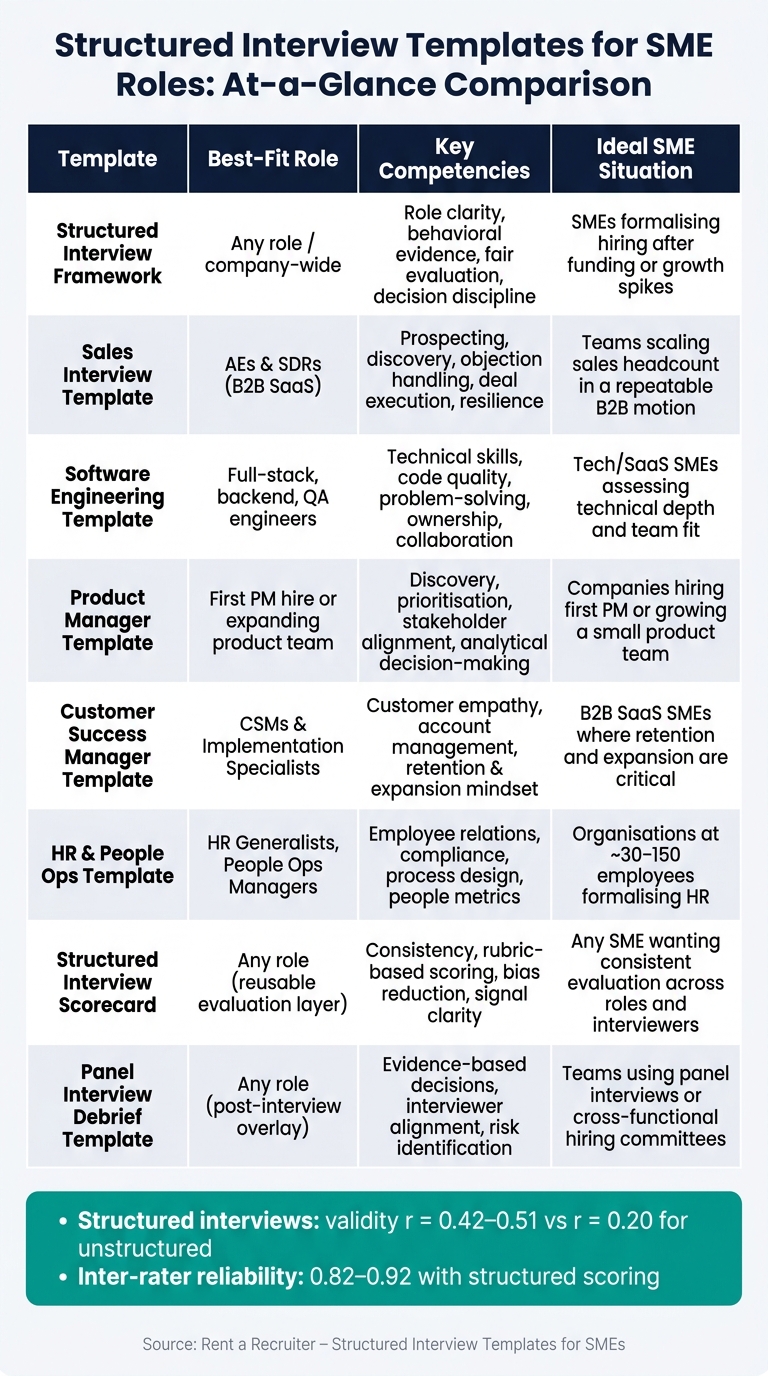
Structured Interview Templates for SME Roles: At-a-Glance Comparison
Use this snapshot to choose the template that fits the role and the hiring stage. It helps you pick the right starting point based on the bottleneck you need to fix first.
| Template | Best-Fit Role | Interview Stage(s) | Main Competencies | Ideal SME Situation |
|---|---|---|---|---|
| Rent a Recruiter Structured Interview Framework | Any role; company-wide structured interview framework | Used in every stage; sets structure and scoring | Role clarity, structured questioning, behavioral evidence gathering, fair evaluation, decision discipline | SMEs formalising hiring after funding or growth spikes |
| Sales Interview Template | Quota-owning revenue roles (AEs, SDRs) in B2B SaaS | First-round structured interview + role-play in second round | Prospecting and pipeline generation, discovery and qualification, objection handling, deal execution, resilience, coachability | Teams scaling sales headcount quickly in a repeatable B2B motion |
| Software Engineering Template | Software engineers (full-stack, backend, QA) for tech and product teams | Technical interview after initial screen and before final interview | Core technical skills, problem-solving, code quality and maintainability, collaboration, ownership | Tech and SaaS SMEs adding engineers who need consistent assessment of technical depth and team fit |
| Product Manager Template | Product Managers (first PM hire or expanding product team) | Hiring manager round or structured hiring-manager interview | Customer discovery, prioritisation and roadmap thinking, stakeholder alignment, analytical decision-making, execution | Companies hiring their first PM or growing a small product team |
| Customer Success Manager Template | CSMs and Implementation Specialists in recurring revenue models | First-round structured interview | Customer empathy, proactive account management, retention and expansion mindset, expectation management | B2B SaaS SMEs where retention and expansion are critical and CSM headcount is actively growing |
| HR and People Ops Template | HR Generalists, People Ops Managers, Talent Acquisition Partners | Hiring manager round | Employee relations, policy discipline and process consistency, stakeholder support, discretion, people metrics | Organisations at roughly 30 to 150 employees formalising HR and adding People Ops hires |
| Structured Interview Scorecard | Any role, reusable evaluation layer | Used in all stages where candidates are scored | Consistency across interviewers, rubric-based scoring, bias reduction, signal clarity | Any SME wanting consistent evaluation across roles and interviewers, especially where managers are new to hiring |
| Panel Interview Debrief Template | Any role, reusable post-interview overlay | Used immediately after the final interview or panel | Evidence-based decision-making, alignment across interviewers, risk identification, hiring decision clarity | Teams using panel interviews or cross-functional hiring committees to cut ambiguity in final decisions |
Role templates fix role-specific gaps. The scorecard and debrief bring consistency to evaluation.
If your problem sits at the top of the funnel, start with a role template. If your team already interviews well enough but scoring is messy or final decisions drag on, start with the scorecard and debrief.
That gives you a cleaner process, less back-and-forth, and better hiring decisions without rebuilding your entire interview system at once.
Conclusion
Across sales, tech, and operations, the pattern is clear. Structured interview templates give SMEs a repeatable hiring process you can trust, without leaning on one person’s gut feel.
They also tend to predict hiring success better than unstructured chats. For a small company, that matters. One bad hire can hit team culture, customer results, and burn rate all at once.
The good news is, you do not need to build a whole new hiring function to make this work.
Start small. Use the template for one or two priority roles first. Run the process once. See where it works, where it slows down, and tighten it up before using it more broadly.
What should stay the same is the evaluation structure:
- one scoring scale
- one scorecard format
- one debrief process across every team
Only the competencies should change from role to role.
If you want help putting this into practice, Rent a Recruiter can work inside your team and run the process with you.
Every structured hire is easier to assess, easier to onboard, and easier to defend.
FAQs
How do I create a structured interview template for a new role?
Start with an intake meeting to pin down the role’s core responsibilities, first-year outcomes, and 4 to 7 observable competencies that point to success. Focus on measurable skills. Then build a scorecard for each interview stage with a 1 to 5 rating scale and space for evidence-based notes.
Write 2 to 4 standardised behavioural and situational questions for each competency. Keep 70% to 80% of the interview consistent for every candidate, and train interviewers to score on their own using the same rubric.
Which competencies should I score for each role?
Start with a job analysis built around the outputs you need in the first six months. That keeps the role tied to business results, not a vague wish list.
From there, choose 4 to 6 observable, role-specific competencies that have a direct link to success in the job. Focus on what you can assess in a structured way, such as execution, stakeholder management, problem-solving, decision-making, or learning speed.
Skip broad ideas like culture fit. They’re hard to assess, easy to bias, and rarely help you make better hiring calls.
Instead, use measurable traits and then force-rank and weight them. Put the biggest weighting on the skills that matter most to performance. That way, the final hiring decision reflects what the role actually needs, not who interviewed well or left the best impression.
For hiring leaders, this does two things:
- Improves hiring accuracy
- Cuts wasted interview time on low-value criteria
It also gives your team a clear scoring model, which makes interview feedback easier to compare across stakeholders.
How can a small team roll this out quickly?
Start small instead of trying to standardise everything in one go.
Pick one job family or 1 to 2 priority roles first. Then spend 4 to 6 hours per role defining 3 to 5 competencies and building reusable scorecards. Run a 6-week pilot so you can test the process, show what works, and build internal buy-in before rolling it out more broadly.
Once that pilot is in motion, centralise your approved questions, rubrics, and scorecards in one place. Set one clear workflow with named owners and agreed timelines, so interviews don’t drift or stall. Train interviewers in 60 to 90 minutes, not over a long series of sessions that eat into the week. In the first 30 days, calibrate after every three evaluations to keep scoring aligned and reduce inconsistency early.