
Every unfilled role costs your business – lost productivity, missed revenue, stretched teams. If your hiring process relies on spreadsheets, scattered tools, or reactive decisions, you’re not just slowing growth – you’re blocking it.
The fix? Build a recruitment system that delivers results: faster hires, lower costs, and better talent. Here’s what matters:
- Pre-Recruitment Planning: Align hiring goals with business outcomes, prioritize critical roles, and map a clear timeline.
- Efficient Sourcing: Use clear job postings and scalable tools to attract the right candidates.
- Structured Screening & Interviews: Standardize criteria, reduce bias, and focus on skills that deliver results from day one.
- Data-Driven Decisions: Track metrics like time-to-hire, cost-per-hire, and quality-of-hire to continuously improve.
- Seamless Offers & Onboarding: Clear, competitive offers and strong onboarding reduce drop-offs and boost retention.
The result? A recruitment process that supports business growth instead of holding it back. Let’s break it down step by step or use our free tool to audit your current process.
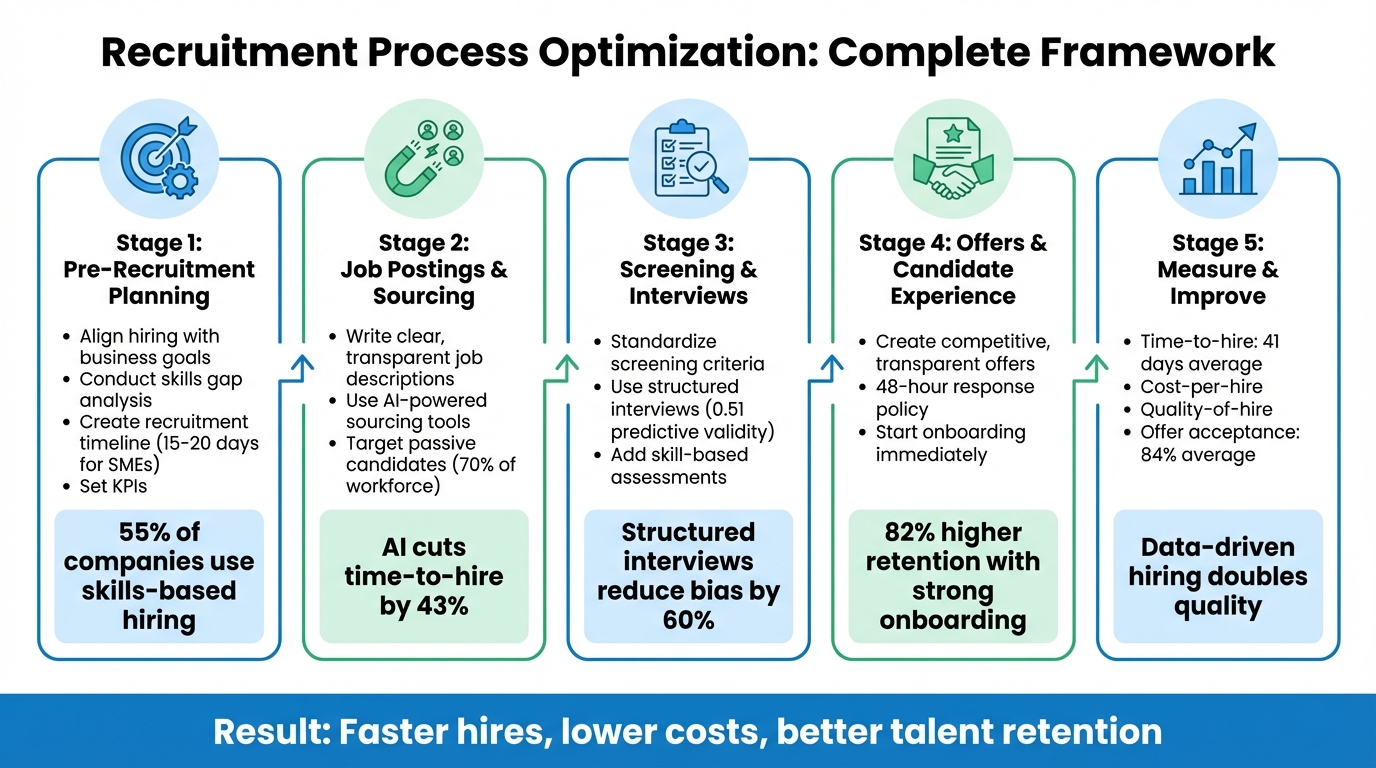
5-Stage Recruitment Process Optimization Framework for SMEs
How to Build a Structured Recruiting Process for Startups
sbb-itb-a23bd6a
Pre-Recruitment Planning: Set Your Foundation
Pre-recruitment planning shifts hiring from reactive problem-solving to a forward-thinking, strategic approach. For growing SMEs, this stage determines whether you’ll secure the right talent to fuel growth or spend months struggling with misaligned hires. The goal? Align every hire with business goals, confirm your resources, and set measurable benchmarks before diving into sourcing.
Define Your Hiring Goals and Priorities
Start by connecting your hiring goals to your business outcomes over the next 12–18 months, rather than simply filling vacancies [4]. Ask yourself: What critical process or revenue stream would suffer if this hire were delayed by three months? If the answer is "not much", it might not be a priority. Focus first on roles that directly impact revenue – positions that generate or protect income should come before those aimed at leadership layering or expansion [3].
Think capabilities, not just headcount. Instead of focusing on job titles, identify the exact skills your team needs. For example, AI literacy, DevSecOps expertise, or cloud cost optimization are increasingly valuable [6]. Over 55% of companies are already moving toward skills-based hiring to adapt to changing demands [4]. Conduct a skills gap analysis with team leads to decide whether gaps should be addressed through new hires, upskilling current employees, or outsourcing [6].
Secure budget approval, headcount authorization, and departmental sign-off early to avoid delays [1]. At the same time, define your Employer Value Proposition (EVP). What makes your SME a compelling place to work? Highlight perks like meaningful impact, flexibility, or growth opportunities. This is especially important given that 34% of small businesses report difficulty filling roles due to a lack of qualified candidates [5].
Create a Recruitment Timeline
A realistic timeline is essential. It should cover every stage of the hiring process – sourcing, interviewing, background checks, and onboarding. For small teams, aim for a total time-to-hire of 15–20 business days, much faster than the 30–45 days typical for larger enterprises [7]. Speed matters: candidates often favor companies that move quickly without compromising quality.
Plan roles by department and align hiring with specific quarters or months, prioritizing revenue-generating roles first [3]. Assess your team’s capacity to ensure hiring managers or recruiters aren’t overwhelmed – bottlenecks can significantly delay the process. Set benchmarks to maintain momentum, such as a 5-business-day turnaround from application to first interview [7]. Automating scheduling can save 5–10 hours per week by eliminating the back-and-forth of coordinating interviews.
Defining "must-haves" early helps avoid delays during evaluation and offer stages. Here’s a sample timeline for small teams:
| Hiring Stage | Target Timeline (Small Teams/SMEs) |
|---|---|
| Application to Initial Screening | 24–48 hours |
| Application to First Interview | 5 business days or less |
| First Interview to Offer | 7–10 business days |
| Total Time-to-Hire | 15–20 business days |
Instead of locking into a rigid annual plan, review your recruitment calendar quarterly. This allows you to adjust for market changes or shifting business needs [3]. Treat recruitment planning as an ongoing effort, not a one-time task.
Once your timeline is in place, establish measurable KPIs to track and improve your process.
Set Key Performance Indicators (KPIs)
To improve your hiring process, you need to measure it. Start with core metrics like time-to-hire, cost-per-hire, and quality-of-hire. These indicators will show if your process is efficient, cost-effective, and delivering the right results. Track additional metrics like response times, time to offer, and drop-off rates at each stage to identify bottlenecks.
Take it a step further by evaluating quality and impact. Measure which sourcing channels yield the best candidates, track interviewer effectiveness, and monitor long-term retention rates. For example, in 2025, Cinemark used Workday to streamline job requisitions and recruitment, increasing their applicant pool by 88% while cutting job promotion costs [4].
To ensure fairness and consistency, create objective scoring rubrics and define your selection criteria before posting jobs [1]. With KPIs in place, you’re ready to optimize job postings and candidate sourcing in the next phase.
Streamline Job Postings and Candidate Sourcing
Once your groundwork is in place, the next step is attracting the right candidates. This phase can either streamline your hiring process or bog it down with mismatched applications. The secret? Clear job postings, scalable sourcing tools, and smart, data-driven targeting.
Write Clear Job Descriptions
Think of your job postings as marketing tools – they’re often your first interaction with potential candidates. Use straightforward, searchable job titles and highlight key details like salary, work schedule, location, and benefits right at the top. Format the content with bullet points and concise paragraphs to make it easy to skim.
Adopt a conversational tone that helps candidates envision themselves in the role. For instance, instead of saying, "The successful candidate will execute tasks", try, "You’ll be the backbone of our operations, ensuring everything runs smoothly." Avoid generic phrases like "fast-paced environment" and instead provide specifics such as "weekly coaching from managers" or "teamwide recognition programs." Highlight opportunities for growth by explaining what skills the candidate will develop and how the role could evolve within your organization.
As Abbigail Fox, Marketing Professional at Talroo, puts it:
"Your job ad is not just a description of an open role. It’s a marketing asset, a brand moment, and often your first impression to potential candidates."
Transparency around pay is increasingly becoming a legal requirement in many states, but it’s also a way to build trust. Consider applying the 70-30 rule: hire candidates who meet 70% of the qualifications and plan to train them on the remaining 30%. Simplify your application process with options like quick apply or making resumes optional to reduce drop-offs during the process.
Once your job descriptions are polished, it’s time to focus on sourcing tools that expand your candidate reach.
Use Scalable Sourcing Solutions
To connect with passive talent – who make up about 70% of the global workforce[9] – use tools designed to actively engage this group. AI-powered sourcing platforms can streamline candidate searches using natural language queries, saving time and effort. Choose platforms that integrate seamlessly with your existing HR systems to avoid duplicating work.
For small and medium-sized enterprises (SMEs) with limited HR capacity, embedded recruitment services offer a practical solution. These services embed experienced recruiters into your team within days, providing immediate hiring support without the need for a full in-house recruiting function. For example, Rent a Recruiter can reduce hiring costs by up to 70% compared to traditional commission-based recruiters while also saving over 80 hours per month in administrative tasks.
Once you’ve established reliable sourcing tools, leverage data to refine your targeting efforts.
Target Candidates with Data
Data is your ally when it comes to identifying the most effective sourcing channels. Predictive analytics and AI can cut time-to-hire by up to 43%, helping you align your sourcing strategies with performance outcomes[1]. Companies that rely on structured, data-driven recruitment consistently outperform those that rely on guesswork.
Still, only 33% of HR professionals say their analytics deliver actionable insights, often due to disconnected systems – a challenge faced by 81% of HR teams[10]. As ClearCo notes:
"61% of orgs say useful people data is their top HR tech priority – but only 33% get actionable insights. Stop guessing and start hiring smarter with data-driven recruiting."[10]
Regularly review recruitment dashboards to track which sources work best and adjust your strategies accordingly. For example, consider implementing a "Silver Medalist" system to keep track of strong candidates who weren’t selected for previous roles, so you can reach out to them for future opportunities. Establish clear KPIs – like the effectiveness of sourcing channels or job offer acceptance rates – to ensure your recruitment aligns with your broader business goals.
Using standardized data points and AI-driven screening can also help eliminate biases and ensure consistent evaluations. Early automated reference checks and verification tools can save time by filtering out candidates who aren’t a good fit before you invest too many resources.
Improve Screening, Interviews, and Assessments
Once you’ve built a strong candidate pipeline, the next challenge is evaluating those candidates effectively. This is where many hiring processes stumble. Unclear criteria, disorganized interviews, and decisions based on instinct can lead to expensive mistakes. A bad hire can cost over 30% of that employee’s annual salary[11]. To avoid this, you need a structured, data-driven approach to screening, interviews, and assessments.
Standardize Your Screening Criteria
Before posting a job, hold an intake meeting with your team to define the role’s core competencies, must-have qualifications, and how much weight each skill should carry[11][12]. This ensures everyone is aligned and prevents shifting priorities mid-process.
Use structured scorecards with a consistent rating system – like a 1–5 scale – to evaluate candidates on specific attributes. Add 3–5 knockout questions to your application to screen for essentials like work authorization, certifications, or years of experience[13][14]. These tools help eliminate biases, such as the "halo effect", where one positive trait overshadows potential concerns. As Youbaldo Simenetti from InterviewIA explains:
Bias creeps in when you don’t know what you’re looking for. Structure keeps you focused.[13]
Since recruiters typically spend just 8–15 seconds reviewing resumes[13], these knockout questions allow you to quickly identify qualified candidates and move past mismatches.
Calibration sessions are also essential. Before making offers, compare scorecards across interviewers to address any inconsistencies in candidate ratings[11]. Rather than outright rejecting borderline candidates, consider stack-ranking them into tiers – Tier 1 for top matches and Tier 2 for promising talent – to ensure your pipeline remains strong[13].
Streamline Your Interview Process
Structured interviews – where each candidate is asked the same questions in the same order – are nearly twice as effective at predicting job performance as unstructured ones. Their predictive validity is .51 compared to .38 for casual conversations[16]. Laszlo Bock, former VP of People Operations at Google, highlights the issue with unstructured interviews:
Typical, unstructured job interviews were pretty bad at predicting how someone would perform once hired. They create a situation where an interview is spent trying to confirm what we think of someone, rather than truly assessing them.[15]
Incorporating asynchronous video interviews for initial screenings can save time and eliminate scheduling hurdles. This is important since 55% of candidates drop out if they can’t schedule their first interview within a week of applying[2][14][17].
To reduce bias and improve decision-making, use anchored scoring rubrics with clear behavioral indicators to evaluate responses on a 1–5 scale. This approach replaces subjective "gut feelings" with documented evidence and cuts bias by over 60% compared to freeform interviews[16]. Training your interview panels through calibration sessions ensures everyone knows what a strong answer looks like[16][17].
Panel interviews can also be a time-saver, offering diverse perspectives in fewer rounds[15][17]. Pre-made interview guides save up to 40 minutes per session[16], and recording virtual interviews allows team members to review and provide input without attending live sessions[17].
Add Skill-Based Assessments
Skill-based assessments are powerful tools – 56% of employers say they improve hiring quality, and 59% believe they lead to fairer decisions[18]. However, they must be concise. Only 21% of candidates are willing to spend more than 20 minutes on a test[18].
Choose the right type of assessment for the role. For technical positions, coding tests or software evaluations are ideal. Work simulations, like drafting a press release for a communications role or role-playing for customer success, provide insight into real-world skills. Situational judgment tests can reveal how candidates handle workplace challenges[18][19].
Pilot these assessments with your top-performing employees to ensure the questions are relevant and accurate[19]. To reduce bias, remove identifying information from results[20][14]. Additionally, offering feedback to candidates – even those not selected – can enhance their experience. In fact, 42% of candidates not chosen would appreciate feedback to help them improve their skills[18].
When designing assessments, focus on essential skills needed from Day 1. Identify which abilities are critical and which can be developed during onboarding[8][1]. This approach complements the structured screening and interview processes, ensuring you don’t over-filter and keeping your candidate pool strong.
Manage Offers and Improve Candidate Experience
Once you’ve identified top candidates, the next challenge is turning them into team members. The offer stage plays a pivotal role in securing their acceptance. For most employers, offer rejection rates fall between 1% and 10% [22]. However, delays, unclear communication, or a lack of personal touch can push these numbers higher. Additionally, 34% of new hires leave within six months when the job doesn’t align with what was promised during the offer stage [23].
Create Competitive and Clear Offers
Before presenting an offer, ensure your compensation package aligns with market standards. Research shows that 60% of employees feel underpaid when compensation details are ambiguous [23]. Transparency is key. Clearly outline the job title, reporting structure, base salary, bonuses, equity, benefits, location, start date, and any critical employment terms like probation periods or remote work policies.
Start with a personal touch – call the candidate to extend the offer verbally before sending the formal letter. This not only adds a human element but also allows you to address any immediate questions or concerns. Follow up with a detailed breakdown of total rewards, including health insurance, 401(k) matching, paid time off, wellness programs, and career development opportunities. Set a clear deadline for acceptance – three to five business days is standard [21] – and be ready to negotiate within a predefined salary range while offering flexibility on non-cash perks.
Improve Communication and Feedback
Strong communication is the backbone of a positive candidate experience. Adopt a 48-hour response policy to ensure no candidate waits more than two days for updates after the offer stage. Personalize your interactions by referencing specific moments from interviews. As TalentAlly puts it:
Communication is your employer brand [25].
For candidates who don’t make it to the final stage, provide at least one sentence of specific, constructive feedback. A staggering 94% of candidates want feedback after interviews [25], and those who receive it are four times more likely to reapply [24]. Consider Virgin Media’s experience: in 2014, poor candidate treatment cost them roughly $5.4 million annually, as 6% of their 123,000 rejected candidates canceled their subscriptions due to negative hiring experiences [26]. Ensuring clear, respectful communication during the offer phase not only boosts acceptance rates but also strengthens your employer brand and sets the tone for onboarding.
Prepare for Onboarding
Onboarding starts the moment an offer is accepted – not on the employee’s first day. With 20% of new hire turnover happening within the first 45 days [27], the pre-boarding phase is critical. Within 24 hours of acceptance, send a personalized welcome email, begin IT setup, and share pre-boarding materials.
Complete compliance tasks – such as I-9s, W-4s, direct deposit forms, and handbook acknowledgments – digitally before Day 1. This allows the first day to focus on building relationships [27][28]. IT provisioning should be completed at least seven days prior to the start date to ensure a smooth "laptop-on-desk" experience [27]. Assigning an onboarding buddy or mentor can also help new hires navigate company culture and daily operations. Companies with strong onboarding processes see 82% higher retention rates and over 70% increases in productivity [27]. As FirstHR aptly notes:
Hiring succeeds when you select the right candidate. Onboarding succeeds when that candidate is still at the company at 90 days and performing against their goals [27].
Measure Results and Make Improvements
Tracking the performance of your recruitment process is non-negotiable. Data-driven hiring doesn’t just improve outcomes – it doubles the quality of hires [29]. Yet, many small and medium-sized enterprises (SMEs) still lean on intuition rather than hard data. This reliance on guesswork can make the difference between a scalable hiring process and one that stalls your growth.
Track Your Recruitment Metrics
To truly understand how your recruitment efforts are performing, focus on six essential metrics. These numbers offer a clear picture of your process’s strengths and where it needs work:
- Time-to-Hire: Measures the period from the first candidate interaction to offer acceptance. In 2025, the average is 41 days, reflecting a shift in hiring trends [29].
- Time-to-Fill: Captures the total time from opening a job to successfully filling it.
- Cost-per-Hire: Accounts for internal expenses like recruiter salaries and training, alongside external costs such as job board fees and background checks. Don’t forget hidden costs, like time spent by hiring managers in interviews [29].
- Quality-of-Hire: The ultimate return on investment metric, assessed through first-year performance, manager feedback, and how well the hire integrates into your team.
- Sourcing Channel Effectiveness: Tracks which platforms – LinkedIn, Indeed, referrals – deliver the most qualified candidates, helping you allocate your budget wisely.
- Offer Acceptance Rate: Currently averaging 84% in 2025, this measures how compelling your offers are to candidates.
- Ramp-Up Time: Evaluates how quickly new hires become fully productive.
| Metric Category | Key KPI |
|---|---|
| Efficiency | Time-to-Hire: How quickly candidates move through your process |
| Financial | Cost-per-Hire: Total investment per role |
| Quality | Quality-of-Hire: Post-hire performance and team fit |
| Sourcing | Source Quality: Effectiveness of recruitment channels |
| Experience | Offer Acceptance Rate: Success in converting offers to hires |
| Onboarding | Ramp-Up Time: Time for new hires to reach full productivity |
Leverage your Applicant Tracking System (ATS) to create real-time dashboards that visualize these metrics. Use tools to monitor hiring velocity and pipeline health, and implement a 48-hour feedback rule to reduce candidate drop-offs. Identify bottlenecks by tracking where candidates exit your pipeline. As Dipti Shukla aptly puts it:
Hiring success isn’t defined by offer acceptance. It’s defined by who actually joins – and stays [8].
This data-driven approach ensures you’re not just hiring faster but hiring smarter.
Run Regular Recruitment Health Checks
Don’t wait for your hiring process to falter – proactively schedule audits. As Martina Di Gregorio warns:
If your hiring successes are lower than you need, you’ve left your audit too late [30].
Map out every step of the candidate journey, from job posting to onboarding, to uncover where delays or failures occur. Combine quantitative data with feedback from candidates, recent hires, and recruiters to get a complete picture [30].
For SMEs, the Rent a Recruiter Recruitment Health Check offers a free, customized report benchmarking your hiring practices against industry norms. It evaluates key areas like employer branding, diversity efforts, and workflow bottlenecks. This report can serve as your starting point for identifying what’s working and what needs attention.
Additionally, gather insights from all stakeholders – recruiters, hiring managers, and even candidates who declined offers. Pay attention to what your competitors are doing differently. With 90% of recruiters describing today’s labor market as candidate-driven [30], optimizing your process is crucial to staying competitive.
These audits and insights provide the foundation for immediate improvements.
Refine Your Process for Growth
Once you’ve analyzed your metrics and conducted health checks, it’s time to act. If your time-to-hire is creeping past 45 days, consider integrating automated screening tools. AI-driven systems can cut time-to-hire by up to 40% [29]. If certain sourcing channels aren’t delivering, reallocate your budget to focus on those that are.
Experiment with A/B testing for job ads, interview formats, and communication strategies to improve candidate conversion rates. Use standardized scoring rubrics to ensure quality-of-hire evaluations are consistent and objective [1]. Keep an eye on first-year retention rates – they’re a key indicator of both recruitment success and cultural alignment.
Recruitment teams today handle 42% more interviews per hire than they did just a few years ago, reflecting a more cautious and detailed selection process [29]. As your business grows, your hiring strategy must evolve too. With 97% of tech leaders planning to adopt automation tools to track metrics and reduce manual work [29], it’s clear that technology is no longer optional.
Create feedback loops at every stage of the hiring process and review your metrics monthly. Adjust your approach quarterly to ensure your recruitment efforts stay aligned with your company’s growth objectives.
Conclusion: Next Steps for Recruitment Optimization
Key Takeaways for High-Growth SMEs
Refining your recruitment process is a continuous effort that directly influences your ability to scale effectively. The essentials include pre-recruitment planning, efficient sourcing, structured interviews, and tracking key metrics. Research shows that structured recruitment not only improves candidate satisfaction by 67% but also cuts time-to-hire by 43% [1], giving fast-growing businesses a distinct edge.
As highlighted earlier, leveraging data-driven strategies can significantly enhance efficiency. Instead of sticking to rigid annual headcount forecasts, focus on flexible, adaptive planning. Evaluate roles based on their direct contribution to business outcomes. Prioritize positions tied to revenue generation or protection, and move beyond simply filling titles – develop capabilities like AI literacy and adaptability that align with long-term goals [3].
To fine-tune your recruitment approach, monitor stage-level conversion rates, collect feedback from candidates and hiring managers, and experiment with A/B testing for job postings and outreach methods [1]. Regular recruitment audits can help you pinpoint and resolve bottlenecks before they disrupt your hiring objectives. As Lars Schmidt, Founder of Amplify, puts it:
A recruitment audit is crucial for startups. It helps identify inefficiencies in your hiring process, ensuring you’re attracting and selecting the best talent while controlling costs [31].
Start Your Recruitment Optimization Today
With these insights in mind, take actionable steps to improve your recruitment strategy right away. Every unfilled position costs you in lost productivity, increased overtime, and missed opportunities [1]. You don’t need a complete overhaul – start small by conducting a free Recruitment Health Check. This tailored report evaluates areas like employer branding, diversity initiatives, and workflow challenges, giving you a clear path for immediate improvements.
If you’re scaling after funding, managing a hiring surge, or launching a new product, embedded recruitment could be the solution you need. Companies adopting this model often cut hiring expenses by up to 70% compared to traditional agencies and save over 80 hours monthly in internal admin time. An experienced recruiter can join your team within days, working alongside you to build the hiring capacity essential for growth. Schedule a consultation today to take the first step toward a more efficient and scalable recruitment process.
FAQs
What should I automate first in my hiring process?
Start by focusing on automating repetitive tasks like candidate screening and interview scheduling. These are often the biggest bottlenecks in the hiring process, slowing things down unnecessarily. But here’s the key: make sure your recruitment process is standardized first. Without clear workflows, automation can create more confusion than it solves.
Once your processes are streamlined, automation tools can handle tasks like outreach, resume screening, and scheduling. The result? Faster hiring cycles and a more efficient process overall. This not only saves time but also frees up your team to focus on higher-value work, like engaging top candidates.
Which recruiting KPIs matter most for a small team?
For small teams, the most important recruiting KPIs revolve around efficiency, quality of hire, and candidate experience. Key metrics to track include:
- Time-to-fill: How quickly you can close open roles.
- Cost-per-hire: The total expense associated with bringing new talent on board.
- Candidate conversion rates: For example, the percentage of applicants who move from application to interview.
Measuring quality of hire is equally crucial. This often comes down to assessing new hires’ performance and retention rates to ensure they align with your team’s needs. Additionally, tracking candidate satisfaction scores can provide insight into how applicants perceive your hiring process. A smooth, positive experience not only strengthens your employer brand but also helps attract stronger candidates.
By focusing on these KPIs, small teams can strike the right balance between speed, cost, and hiring quality.
How do I speed up hiring without lowering quality?
To accelerate hiring without lowering standards, focus on removing obstacles in the process. Start by setting clear feedback deadlines for hiring managers – aim for a 24-48 hour turnaround. Leverage automated scheduling tools to make coordinating interviews smoother and less time-consuming.
Keep job descriptions concise and focused. This helps attract the right candidates efficiently without overwhelming them with unnecessary details. Use structured recruitment checklists to ensure a consistent approach across all roles.
Finally, consider incorporating AI-powered sourcing tools. These tools can quickly highlight top candidates, saving time while keeping quality intact.