Key Takeaways: Workforce Planning for SMEs in 2026
-
Uncertainty is now permanent. Workforce planning for SMEs must assume volatility not stability in revenue, regulation and talent markets.
-
Most hiring problems are planning problems. Many “talent shortages” stem from unclear roles, weak sequencing and structural bottlenecks.
-
Capability matters more than headcount. AI literacy, adaptability and decision-making ability are becoming baseline requirements.
-
Cost pressure demands prioritisation. Revenue-protecting roles should be sequenced ahead of expansion or layering.
-
AI must be used carefully. Automation increases application volume but reduces signal quality without human accountability.
-
HR must operate at strategy level. Workforce planning for SMEs only works when HR is aligned with commercial decision-making.
Why Is Workforce Planning for SMEs More Complex in 2026?
Workforce planning for SMEs in 2026 requires adaptive, commercially aligned decision-making rather than static headcount plans. Leaders must prioritise capability over roles, pressure-test every hire, align HR with strategy, and use AI responsibly to protect revenue, manage costs, and reduce hiring risk in an uncertain market.
Workforce planning for SMEs has shifted from an annual budgeting exercise to a continuous leadership discipline. In a market defined by cost pressure, AI-driven hiring noise, and ongoing economic uncertainty, reactive recruitment is no longer sustainable.
According to McKinsey (2024), organisations that proactively align talent strategy with business priorities are significantly more likely to outperform peers during periods of economic volatility. Companies that treat workforce planning as a strategic capability rather than an HR process demonstrate stronger revenue resilience and faster recovery.
If you’re an HR leader or C-suite executive in a growing SME, the question is no longer “How many people do we need?” — it’s “What capabilities must we build to win in the next 12–24 months?”
SMEs are no longer emerging from short-term disruption. Volatility is now the baseline.
From our recent webinar resource paper , several consistent themes emerged:
-
Economic, regulatory and political uncertainty is ongoing
-
People costs remain the largest expense for most SMEs
-
Hiring mistakes are harder to absorb
-
AI is increasing application volumes while reducing signal quality
-
HR leadership misalignment is creating execution risk
For SME leaders, this means workforce planning must assume change — not stability.
Static headcount plans created in January and ignored until December are no longer fit for purpose.
What Is Workforce Planning for SMEs (And What It Is Not)?
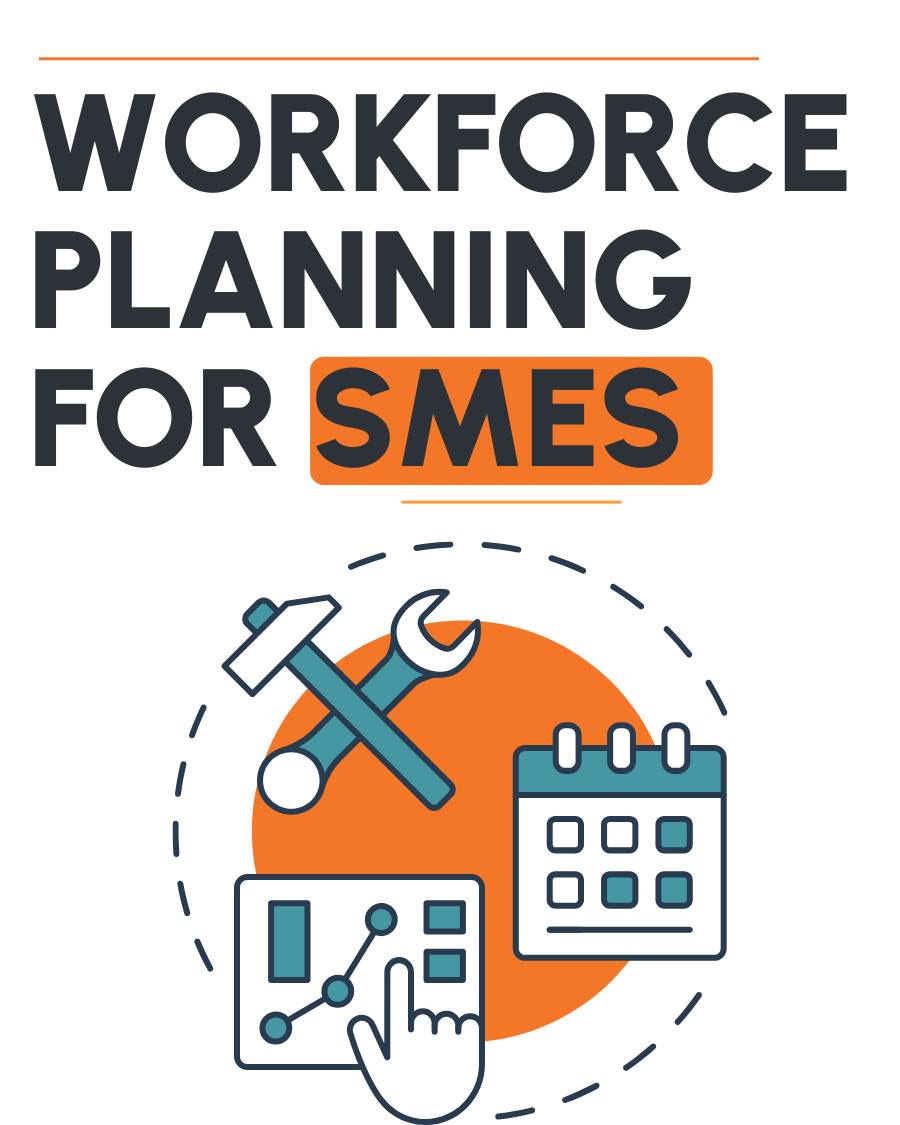
Workforce planning for SMEs is the process of aligning talent capability, cost, and structure to commercial outcomes — continuously, not annually.
It is not:
-
A headcount forecast exercise
-
A reactive response to hiring pain
-
An HR-only responsibility
-
A budgeting formality
Effective workforce planning for SMEs connects directly to:
-
Revenue protection
-
Growth sequencing
-
Operational bottlenecks
-
Risk management
When HR is excluded from strategic discussions, hiring becomes fragmented and reactive, a risk highlighted clearly in the webinar insights.
Where Does Workforce Planning Commonly Break Down?
Even with strong intent, execution is where most SMEs struggle.
Common failure points include:
-
Annual plans that are never revisited
-
Hiring for today’s pain rather than tomorrow’s constraint
-
Roles designed around headcount targets, not outcomes
-
Over-reliance on AI without human accountability
-
Slow decision-making losing top candidates
-
Adding people instead of fixing broken processes
These breakdowns compound quickly in SMEs, where leadership bandwidth and margin for error are limited.
If this sounds familiar, it may not be a talent shortage it may be a planning issue.
6 Strategic Shifts to Strengthen Workforce Planning for SMEs
1. Shift from Static to Adaptive Planning
Plan annually. Review quarterly. Challenge assumptions continuously.
Before opening any role, ask:
-
Does the need still exist?
-
Has the business context changed?
-
Is structure the real issue?
Quarterly review cycles anchored to long-term capability goals outperform rigid headcount plans.
2. Treat “Talent Shortages” as Clarity Problems First
Many shortages are misdiagnosed.
Overloaded job descriptions, unclear success metrics, and shifting expectations create artificial scarcity.
Define:
-
What success looks like at 6–12 months
-
The must-have capabilities
-
What can be trained
Clear roles shorten hiring cycles and improve retention.
3. Sequence Hiring Around Revenue Protection
Cost pressure is the dominant constraint for most SMEs.
Instead of freezing hiring entirely:
-
Prioritise revenue-generating roles
-
Protect delivery capacity
-
Delay leadership layering where possible
-
Focus on structural efficiency before adding headcount
Sequencing — not volume — determines resilience.
4. Use AI With Discipline
AI is reshaping recruitment, but it is not removing risk.
Candidate volumes are rising. Signal quality is declining.
To protect decision quality:
-
Introduce role-specific application questions
-
Keep human accountability in hiring decisions
-
Use AI to improve efficiency — not replace judgement
Automation accelerates both good and bad decisions.
5. Plan for Capability, Not Just Roles
Future bottlenecks are capability-based, not title-based.
High-performing SMEs are investing in:
-
AI literacy
-
Decision literacy
-
Adaptability
-
Change endurance
Hire for learning agility and judgement not just tool familiarity.
6. Align HR With Commercial Strategy
When HR operates as a support function instead of a business partner, workforce planning drifts away from commercial priorities.
Workforce planning for SMEs must be treated as:
-
A leadership responsibility
-
A commercial risk discipline
-
A board-level conversation
If HR is not in the room early, hiring becomes reactive.
A Practical Framework for Workforce Planning for SMEs
To turn strategy into execution:
Step 1: Identify 5–7 Critical Capabilities
Separate capability gaps from headcount gaps.
Step 2: Pressure-Test Every Hire
Ask:
-
What outcome does this unlock?
-
What breaks if we delay by three months?
-
Is this structural rather than talent-related?
Step 3: Simplify Roles Before Hiring
Reduce scope creep. Clarify outcomes. Separate essentials from nice-to-haves.
Step 4: Protect Revenue and Culture Simultaneously
Retention is often cheaper than replacement.
Invest in management quality to reduce regretted attrition.
Step 5: Review Quarterly
Challenge assumptions, not just numbers.
Re-sequence roles as conditions shift.
When Should SMEs Use a Talent Partner?
Workforce planning for SMEs often fails not because leaders lack clarity but because they lack capacity to execute consistently.
A talent partner becomes valuable when:
-
Hiring demand is uneven or unpredictable
-
Leadership time is consumed by recruitment
-
Roles evolve faster than internal teams can adapt
-
Hiring delays impact revenue or delivery
-
Candidate volume is high but quality inconsistent
This is a capacity and risk decision not just a cost one.
The Real Cost of Getting Workforce Planning Wrong
Poor workforce planning for SMEs leads to:
-
Revenue bottlenecks
-
Leadership distraction
-
Higher attrition
-
Costly hiring mistakes
-
Slower time-to-hire
-
Cultural misalignment
In uncertain markets, workforce planning is not a support activity — it is a growth strategy.
If speed and flexibility matter, our embedded recruitment model allows you to add specialist hiring capability in just 5 days aligned directly to your commercial goals.
Case Studies: Embedded Success In Action
Unique
Unique streamline its global hiring across Berlin, Zurich, New York, London, and Singapore. Within months, our embedded recruiter coordinated 291 interviews, delivered 17 offers, and achieved 10 successful hires.
MasterTech
Rent a Recruiter partnered with Mastertech for 27 months, embedding a dedicated Talent Partner directly into their business. €123,000 savings vs traditional agencies costing, 29 Placements
+3000 Passive candidates reached & 4:1 CV to interview ratio
These successes show how embedded recruitment transforms hiring from a reactive task into a strategic function that drives growth and resilience.
Need to scale quickly?
Our embedded recruiters can integrate within 5 days, giving you on-demand hiring capability without the overhead of traditional agency models.
Ready to Strengthen Your Workforce Planning Strategy?
If your hiring feels reactive, fragmented, or misaligned with growth it may be time to rethink your approach.
We help SMEs:
-
Reduce cost of talent acquisition
-
Improve time-to-hire
-
Protect leadership bandwidth
-
Build adaptive workforce planning capability
Our recruiters embed into your team within 5 days providing immediate capacity without long-term overhead.
Let’s discuss how to future-proof your workforce planning.
FAQs: Workforce Planning for SMEs
What is workforce planning for SMEs?
Workforce planning for SMEs is the continuous process of aligning talent capability, cost, and structure with commercial objectives in a volatile environment.
How often should SMEs review workforce plans?
At minimum, quarterly. Annual plans without review quickly become irrelevant.
Why do SMEs struggle with workforce planning?
Common reasons include reactive hiring, unclear role design, HR–leadership misalignment, and over-reliance on automation.
Is AI improving workforce planning?
AI improves efficiency but can reduce signal quality if not managed carefully. Human accountability remains essential.
When should an SME consider an embedded recruiter?
When hiring demand fluctuates, leadership time is stretched, or revenue is being impacted by slow or inconsistent hiring.

About the Author:
Mark Loughnane has over 15 years of experience in the recruitment industry, specialising in the development and delivery of scalable recruitment services. His career has spanned high-volume ramp-up projects and day-to-day hiring across the Life Sciences and Manufacturing sectors. Today, Mark leads our Rent a Recruiter service while also managing the wider recruitment team, ensuring clients receive both strategic guidance and hands-on delivery.
Ready to Scale Without the Bloat?
Let’s talk about how our short-term RPO solutions can help your business scale.