
A weak vendor can hit your business fast, missed contractor pay, hiring delays, and more time pulled into supplier issues.
If you rely on staffing firms, payroll partners, or recruitment suppliers, you need a simple way to check whether they can keep funding delivery. This is especially critical when hiring as you scale, where supplier stability underpins growth. The core test is plain: can they pay people and suppliers on time, without changing terms mid-engagement? If not, your cost, hiring speed, and internal workload can all worsen fast.
Here’s the short version:
- Tier vendors by risk, not just spend
- Check financial statements, credit files, and public records
- Watch cash flow and liquidity, not profit alone
- Score vendors the same way each time
- Set alerts early so you can cut exposure before service slips
For hiring leaders, CFOs, and CEOs, this is about more than finance hygiene. It is about protecting time-to-fill, contractor payroll, and delivery capacity. If one supplier sits too deep in your hiring model, you are carrying more risk than you think.
I’d treat vendor financial checks as a repeatable business process, not a one-off review.
Step 1: Segment Vendors by Criticality and Set Review Standards
Start with the vendors that would create the biggest financial and operational problem if they failed. The point is simple: the more damage a failure could cause, the deeper your finance review should be.
This keeps your team focused on risk that can hit hiring, payroll, and delivery, instead of treating every vendor the same.
Classify Vendors as Critical, Important, or Standard
Put vendors into three tiers based on two core questions: How badly would your hiring or operations break if this vendor failed? And how quickly could you replace them?
Critical vendors are the ones that would disrupt operations straight away. That could be an embedded recruitment partner managing most of your hiring, a payroll provider handling contractor payments, or a sole-source contract staffing supplier filling engineering or sales roles. These vendors sit inside your hiring or payroll workflow, so replacing them may take months, not days.
Important vendors still matter, but they are not as hard to replace. A secondary staffing agency, a background-check provider, or a niche recruitment marketing platform fits this group. If one drops out, hiring slows down and extra admin lands on your team, but the business keeps moving.
Standard vendors cover low-risk services that are easy to swap out. Think generic job boards, training content tools, or small recruiting utilities that can be replaced within days with little disruption.
A short internal questionnaire helps here. Use it to record:
- dependency on the vendor
- replacement speed
- who owns the process internally
Log the answers in a vendor risk register, then use that record to assign the tier. That gives you a clear audit trail and makes it much easier to defend decisions later if finance, procurement, or leadership asks why one vendor got a deeper review than another.
Set Financial Review Criteria for Each Vendor Tier
Once vendors are tiered, the depth of review should match the tier. Match the review to the cost of failure, not just the amount you spend.
That matters because a low-cost vendor can still create a major problem if they are sole-source or tied to a core workflow.
Use the table below to keep review timing and document checks consistent across teams.
| Vendor Tier | Documents | Review Frequency | Alert Triggers |
|---|---|---|---|
| Critical | Audited or reviewed financials (2-3 years), cash flow statement, business credit report, ownership structure | Annual review + quarterly monitoring | Credit score drop, new liens or judgments, leadership changes, payroll/hiring service failures |
| Important | Income statement, balance sheet (1-2 years), business credit report | Every 12-18 months or at renewal | Rating downgrade, new regulatory actions, noticeable service degradation |
| Standard | Credit check and short vendor questionnaire, W-9 verification | At onboarding; every 2-3 years or renewal | Missed deliveries, payment disputes, legal notices |
Use annual spend as a starting point, but do not stop there. If a lower-spend vendor is sole-source, move them into a higher tier. Cheap does not always mean low risk.
That one call can save you from a nasty surprise later, especially when the vendor supports hiring delivery, contractor payroll, or a hard-to-replace part of your funnel.
sbb-itb-a23bd6a
Step 2: Collect Financial Statements, Credit Reports, and Public Records
Once your vendors are tiered, the next move is simple: gather the facts before you form a view.
You’re not trying to judge a vendor from one snapshot. You’re trying to see the full picture, and whether that picture is getting better or worse over time.
Use the tier to set the depth of review. Critical vendors need the deepest review. Standard vendors usually need basic checks only. That keeps your process tight and avoids wasting time where the risk is low.
Request the Right Financial Documents
For public vendors, review the latest 10-K and 10-Q in EDGAR for cash flow, debt, and going-concern risk. [15][17]
For private vendors, request 2 to 3 years of balance sheets, income statements, and cash flow statements. [13][14][18] That gives you enough history to spot a pattern, not just react to one good year or one bad one.
For critical or high-spend vendors, ask for audited statements. An independent CPA review gives you added comfort that the numbers have been checked properly. If a vendor can only provide management-prepared financials, take that as a red flag. In that case, put more weight on credit reports and reference checks.
Financial statements tell you where the business has been. Credit files and public records help you see whether pressure is building right now.
Run Credit and Public-Record Checks
Financial statements show the past. Credit and public records show current strain.
Pull commercial credit reports from Dun & Bradstreet, Experian Business, or Equifax Business. These are the three main U.S. business credit bureaus, and each keeps its own file. [9][10][11][12] Their reports can show payment history, risk scores, and public records linked to the vendor.
Watch for late payment patterns. If a vendor is paying 30 to 60+ days past terms, that can point to cash flow trouble.
You should also run:
- UCC lien searches
- Tax lien checks
- Civil judgment searches
- Bankruptcy record checks
Use state-level filings and specialist lien-search providers for this work.
For staffing and recruitment vendors, this matters even more. They often pay workers weekly or biweekly, while waiting to collect from clients on net-30 or net-45 terms. That gap can put pressure on cash. A current ratio below 1.2 is a warning sign for tight liquidity. [16] UCC liens or tax authority claims against a vendor’s assets can also point to trouble meeting obligations.
Finally, check corporate status with the right Secretary of State. Overdue annual reports or a delinquent status can point to weak internal control or plain administrative mess.
Spot Qualitative Warning Signs the Numbers Miss
Numbers matter, but they rarely tell you first.
By the time financial stress appears in an income statement, it has often been building for months. A sudden CEO exit or ownership change can point to instability. If one client makes up more than 25% of revenue, the vendor is exposed, even if margins still look fine. [3][4]
Other warning signs are easy to miss if your review is too narrow. Flag:
- Large upfront retainers
- Shorter payment terms
- New payee instructions
- Tighter contract terms
- Slower responses
- Rising staff turnover
- Falling delivery quality [5][6][8]
For staffing and payroll vendors, these signs often show up before missed contractor pay or service delays. That’s why this step matters commercially, not just from a compliance angle. Spotting strain early can save you from service disruption, finance headaches, and a costly supplier switch later.
Step 3: Analyze the Numbers and Score Vendor Risk
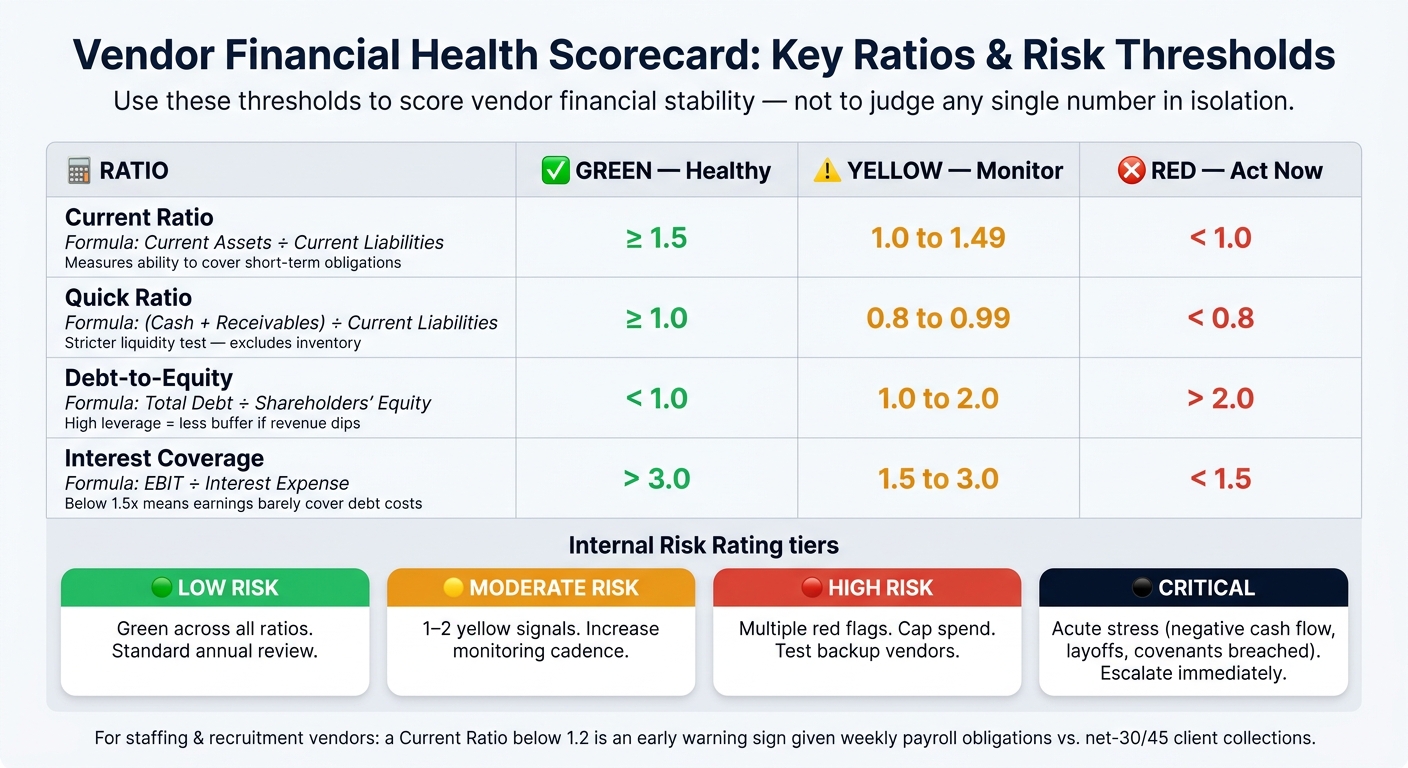
Vendor Financial Health Scorecard: Key Ratios & Risk Thresholds
Once you have the documents, turn them into a simple internal risk score. The goal is plain enough: can this vendor meet its obligations, turn work into cash, and avoid over-reliance on a small number of clients?
Check Liquidity, Profitability, and Debt Levels
Start with the balance sheet, income statement, and statement of cash flows for the last 2 to 3 years.[20][21][24] That time view matters. A single strong quarter can hide pressure that shows up across a longer stretch.
On the balance sheet, focus on:
- cash and cash equivalents
- accounts receivable
- current liabilities
- total debt
On the income statement, look first at gross margin, operating margin, and net margin. On the cash flow statement, check operating cash flow to see whether reported profit is turning into actual cash.
The current ratio tells you whether the vendor can cover short-term obligations:
current assets ÷ current liabilities
The quick ratio is stricter. It uses cash, marketable securities, and accounts receivable against current liabilities.
For debt, calculate:
- debt-to-equity: total debt ÷ shareholders’ equity
- interest coverage: EBIT ÷ interest expense
High leverage can put a service business under pressure fast. If revenue slips or collections slow down, there may be very little room to fund payroll or keep delivery stable if a major client walks away.
Use the table below as a quick reference. These thresholds are a practical starting point for service businesses, including recruitment and staffing firms.[21][2][23][24]
| Ratio | Green ✅ | Yellow ⚠️ | Red 🔴 |
|---|---|---|---|
| Current Ratio | ≥ 1.5 | 1.0 to 1.49 | < 1.0 |
| Quick Ratio | ≥ 1.0 | 0.8 to 0.99 | < 0.8 |
| Debt-to-Equity | < 1.0 | 1.0 to 2.0 | > 2.0 |
| Interest Coverage | > 3.0 | 1.5 to 3.0 | < 1.5 |
Use these ranges to score the vendor, not to judge one number on its own.
Profitability needs the same approach. Track gross margin, operating margin, and net margin across at least three years. A vendor may show a healthy gross margin, but if interest coverage is only 1.3, the business is more fragile than that margin suggests.[20][21][22][24] And if operating cash flow is falling behind accounting profit, that should get your attention fast.
Review Revenue Trends and Client Concentration
Revenue direction matters just as much as revenue size. Flat revenue, declining revenue, or margin compression can all point to weakening service capacity.[20][21][19][2]
Client concentration needs its own close look. If one customer accounts for 30% to 40% of revenue, treat that as concentration risk. For recruitment vendors, losing one anchor client can lead to layoffs, slower sourcing, and less stable account teams. If the top three customers make up more than 60% to 70% of revenue, that should move into yellow or red depending on the vendor tier.[20][21][19][2]
This is where commercial impact becomes clear. A vendor with thin liquidity and heavy client concentration is more likely to cut delivery staff, delay hiring support, or struggle to keep service levels steady when pressure hits.
Assign an Internal Risk Rating
After reviewing the ratios and trends, roll the findings into one internal rating. A four-tier model works well for most small and mid-sized businesses:
- Low Risk: Green across liquidity and leverage ratios, with stable or growing revenue. Standard sign-off and annual review.
- Moderate Risk: One or two yellow signals, such as slightly compressed margins or moderate debt, but no acute red flags.
- High Risk: Multiple red-zone ratios, such as a quick ratio below 0.8 or interest coverage below 1.5, declining revenue, or one client representing 40% to 50% or more of sales.
- Critical: Acute stress signals, such as negative operating cash flow across multiple periods, recent layoffs tied to lost accounts, or breached loan covenants. Put vendors in this tier to the top of the list if they affect payroll or core hiring delivery.
Score each factor in a simple worksheet and map the total to one tier. The value is not in false precision. It’s in consistency, so your team can compare vendors in the same way every time.
Use the rating to set monitoring cadence in Step 4.
Step 4: Monitor Ongoing Risk and Reduce Exposure
Use the Step 3 risk rating to set review cadence. Vendors can weaken between formal reviews, and early shifts in cash flow, payment behaviour, or credit can hit hiring timelines fast.
Set a Monitoring Schedule and Define Alert Triggers
Use the risk rating from Step 3 to set review frequency and trigger thresholds. Standard vendors need an annual check: updated financials, a quick credit score scan, and a review of any new legal or regulatory filings. Important vendors need a review every six months, with payment behaviour trends and service performance metrics added in. Critical vendors should be reviewed monthly, with automated credit alerts running between reviews. [7][25]
The table below links common warning signs to a clear response:
| Warning Sign | Owner | Response Action |
|---|---|---|
| Credit score drops sharply | Finance | Request updated financials; review exposure limits |
| Vendor requests shorter payment terms or deposits | Finance / Procurement | Treat as a liquidity signal; update the risk rating |
| Repeated missed hiring milestones | Talent Acquisition | Escalation meeting; activate backup sourcing plan |
| New lien, UCC filing, or tax action | Finance / Legal | Assess contract rights; cap exposure |
| Auditor going-concern note in financials | Finance | Escalate to senior leadership; prepare contingency |
| Visible staff departures or delivery quality drop | Hiring Manager / TA | Move roles; test backup vendors |
Assign one owner to each critical vendor. That person keeps the risk file current, reviews alerts, and works with Talent Acquisition or Finance when a trigger fires. Without clear ownership, these checks get missed during busy hiring periods, right when exposure is highest.
Take Mitigation Steps Before Problems Escalate
When a vendor moves into a higher-risk category, act while they still have enough capacity to support a handover. Don’t wait until they miss payroll or cut staffing.
Start by capping new spend commitments with that vendor. Avoid signing new retained search agreements or extending contract terms until you have a clearer view. Move critical roles to a more stable vendor first. Tie fees to milestones, part on shortlist delivery and the rest on the hire’s start date.
Also review open purchase orders and any retained agreements so you know your total exposure. If one vendor holds a large share of active requisitions, start shifting work out in stages. Testing a backup vendor on a few lower-stakes roles now gives you cover if your main vendor slips further.
Build a More Resilient Recruitment Model
Single-vendor dependence is a structural risk, not just a vendor problem. If one vendor still carries too much of your hiring load, reduce that concentration now.
Centralise requisitions, standardise workflows, and keep backup capacity ready. That gives you more control over cost, less delivery risk, and fewer hiring delays if one provider starts to struggle.
If you want tighter control without agency fee spikes, Rent a Recruiter places recruiters inside your team to manage hiring end-to-end with clearer process control and fixed monthly pricing.
Conclusion: Turn Vendor Financial Checks Into a Repeatable Process
Vendor issues rarely arrive with a big warning sign. More often, they show up in small ways first: tighter payment terms, requests for money upfront, credit downgrades, legal notices, or a drop in service. By that point, hiring delays may already be hitting the business.
The five-step process covered in this guide, tier your vendors, collect objective data, analyse key indicators, score risk, and review it on a set schedule, helps you spot trouble early. After that, it comes down to clear ownership.
Give each critical vendor relationship one named owner. Keep scorecards, risk ratings, and review logs in one shared place. Then document the workflow in a simple SOP or checklist, so the process is clear and repeatable. Add calendar reminders for each vendor tier’s review cycle, so nothing gets missed and no one is relying on memory or scattered follow-up.
This matters most with recruitment vendors. If a staffing partner or recruitment vendor fails in the middle of a search, you can lose time-to-fill and see vacancy costs climb. Cut single-partner risk now. Rent a Recruiter places experienced recruiters directly into your team, giving you end-to-end hiring control with a flat monthly fee you can plan around, while freeing up more than 80 hours per month in internal hiring and admin time.[1]
FAQs
What if a vendor refuses to share financial statements?
Treat it as a transparency red flag and pause onboarding or renewal until you can verify financial stability through other documented evidence, such as audited financial statements, credit ratings, or bank references.
At a minimum, document the refusal, clarify any risk indicators, and bring in Procurement or Legal to tighten contract protections and payment terms before you move forward.
Which warning signs usually appear before service failure?
Common early warning signs show up first in day-to-day communication and uneven delivery. In plain terms, if your hiring partner feels hard to reach or hard to pin down, that usually points to a bigger issue behind the scenes.
That often looks like:
- no dedicated account manager
- frequent contact changes
- delayed responses
- vague progress updates or limited transparency
Those issues don’t just create friction. They slow decisions, waste internal time, and make hiring harder to manage.
Other warning signs tend to show up in the hiring data and the way the search is being run. If sourcing feels rigid and not shaped around your roles, that’s a problem. If candidate drop-off is high, you’re likely losing people before offer stage. And if metrics such as time-to-fill, candidate quality, or hiring manager satisfaction start to stall or slip, the cost lands on your business fast.
For CEOs, CFOs, and talent leaders, this matters because poor recruitment delivery rarely stays contained inside the hiring team. It spills into lost time, missed growth targets, and more pressure on managers who should be focused on running the business.
How often should we reassess a critical vendor?
For a critical vendor, review performance on a set schedule more often than you would for a transactional supplier.
A good rule is simple:
- Run an annual high-level review
- Hold more frequent detailed check-ins for high-spend, strategic vendors
That gives you a steady view of cost, delivery, and hiring results, without waiting for problems to pile up.
You should also reassess straight away if warning signs show up. That includes drops in time-to-fill, candidate quality, or hiring manager satisfaction. It also includes costs going up without better results, poor transparency, or weak communication.
And if there’s a major change that could affect risk, review the vendor again at that point, not months later.
For hiring leaders, this matters because vendor drift is expensive. A supplier that looked fine six months ago can start slowing hiring, pushing up spend, and creating friction for your team long before it becomes obvious in a quarterly report.