
If you are making more than 20 to 30 hires a year, manual hiring often costs more than it looks, even before agency fees spike.
I’d sum it up like this: manual hiring gives you low tool spend but high labour and vacancy cost, while AI-powered recruitment tools cut admin time and can bring cost-per-hire down from about $5,475 to roughly $2,900 to $3,400 in reported cases. For scaling teams in SaaS, Technology, IT, Fintech, Engineering, Security, Insurance, and Professional Services, the best cost model is often AI plus human ownership, not AI alone.
Here’s the short version:
- Manual hiring often means more recruiter hours, more hiring manager time, and more open-seat cost.
- AI hiring can cut time-to-fill by 40% to 70% and reduce admin-heavy work like screening and scheduling.
- Agency use can push costs up fast, often 15% to 25% of salary per hire.
- Low-volume hiring may not justify a full AI stack.
- High-growth hiring usually rewards process, fixed cost control, and repeatable workflows.
- A hybrid model with an embedded recruiter can help you cut internal workload without handing control to traditional recruitment agencies.
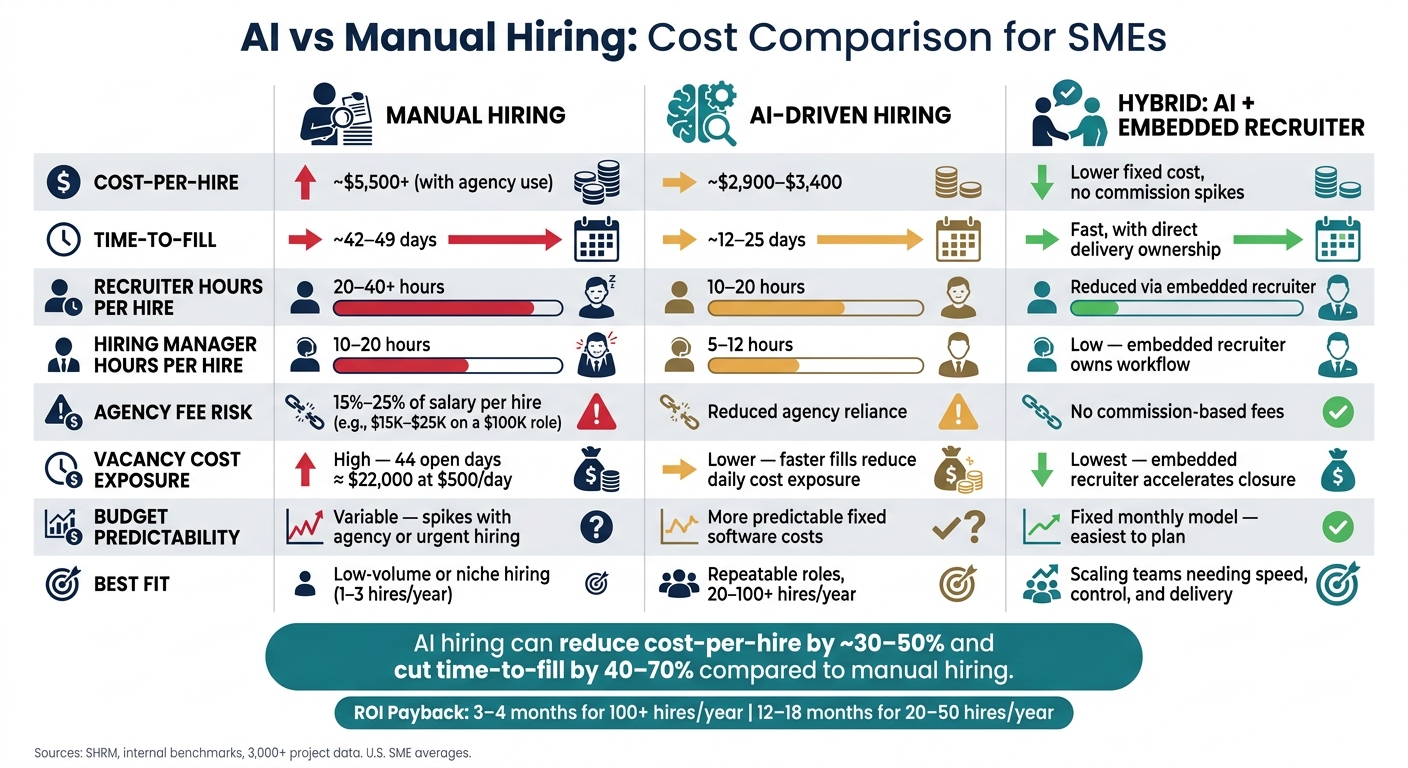
AI vs Manual Hiring Cost Comparison for SMEs
Quick Comparison
| Area | Manual Hiring | AI-Driven Hiring | Hybrid: AI + Embedded Recruiter |
|---|---|---|---|
| Cost-per-hire | Often higher once labour and vacancy cost are counted | Lower at the right hiring volume | Lower cost control with human ownership |
| Time-to-fill | Often around 42 days | Often 12 to 25 days in reported cases | Fast, with direct ownership of delivery |
| Internal time | High | Lower admin load | Lower leadership and team involvement |
| Budget control | Can swing with agency use | More fixed-cost led | Fixed monthly model is easier to plan |
| Best fit | Low-volume or niche hiring | Repeat hiring with internal process discipline | Scaling teams that need speed, control, and delivery |
If you are weighing cost, speed, and team capacity, the point is simple: look at total hiring cost, not just software or recruiter spend on its own.
sbb-itb-a23bd6a
Manual Hiring Costs: Where SME Budgets Get Used Up
Manual hiring often looks cheap on paper. In practice, the bill is bigger than most teams expect.
Direct costs: recruiter time, job ads, and agency fees
Manual hiring costs usually sit in three places.
First, you have internal recruiter and HR salaries. If a recruiter earns $80,000 a year and spends half their time on active hiring, that works out at roughly $2,000 to $4,000 per hire for a business making 10 to 20 hires a year.[7]
Then there’s hiring manager time. Defining the role, reviewing resumes, running interviews, and joining debriefs all add up. Managers usually spend 14 to 26 hours per hire. At a blended hourly rate of $60, that is $840 to $1,560 per role in leadership time. That’s time not spent on revenue, product, or customers.[10]
Job board spend adds another $600 to $1,500 per role.
Then come agency fees, and this is where costs can jump fast. Commission-based agencies often charge 15% to 25% of first-year base salary.[4][5] On a $100,000 role, that means a fee of $15,000 to $25,000 for a single hire. If an SME fills 10 similar roles in a year, it could spend $150,000 to $250,000 on agency commissions alone, before you even count internal time or job ad spend.[6]
That mix of labour, ad spend, and vacancy cost is the baseline when you compare manual hiring with AI-led hiring.
Hidden costs: slow hiring, admin work, and lost output
The biggest costs are often the ones that never hit an invoice.
Research shows that 42% of respondents say unfilled roles cost more than $500 per day. Leave a role open for 30 days, and that can mean more than $15,000 in missed value.[11]
Admin work makes it worse. In manual hiring setups, recruiters spend 40% to 70% of their time on tasks like scheduling, data entry, and reporting.[8][9] Resume screening on its own can take 23 hours per opening.[10]
That’s the drag. Your team is busy, but not always busy with work that moves hiring forward.
When manual hiring still makes financial sense
Manual hiring is not always the wrong call.
If your business only makes 1 to 3 hires a year, it may not make sense to put money into new systems or tooling. The same goes for occasional specialist roles, like senior technical hires or niche leadership posts, where a hands-on, network-led approach can still do the job better than a standard process.
The honest test is simple:
- Volume
- Urgency
- Internal capability
If you already have skilled recruiters, a clear process, and low hiring volume, manual hiring can work without too much cost leakage. But once hiring volume starts to climb, those costs stack up fast, and the manual model gets harder to defend.
That cost profile is what AI-driven hiring changes next.
AI Hiring Costs: Lower Cost-Per-Hire at the Right Scale
What SMEs pay for: software, setup, and oversight
AI only earns its place in hiring if the savings beat the cost of putting it in place and managing it. For most U.S. SMEs, spend usually falls into five buckets: platform subscriptions, setup and configuration, ATS integrations, recruiter training, and ongoing oversight.[19]
Subscriptions for AI-enabled ATS platforms, sourcing tools, screening tools, and chatbot software can range from a few hundred dollars a month for smaller teams to several thousand dollars a month for more advanced suites. That part is easy to spot.
The hidden spend tends to show up during setup.
Even if a vendor includes setup at no extra charge, your HR team, IT team, and hiring managers may still spend 20 to 60 hours configuring workflows, connecting systems, and testing everything. That time is not free. It carries a direct cost in salaries and a knock-on cost in delayed hiring work.
The better way to judge AI spend is to treat it as part of total hiring cost. Measure it against recruiter time saved and the cost of roles sitting open for longer than they should.
Where AI cuts spend: sourcing, screening, and scheduling
The biggest savings come from taking repetitive admin off your team’s plate. AI can handle sourcing, screening, and scheduling, cutting time-to-schedule from 2.3 days to 4.2 hours.[13]
That kind of change adds up fast. Across the most time-heavy parts of recruitment, automation can give back 20 to 26 hours per recruiter per week.[15]
That drop in labor time feeds straight into lower cost-per-hire. This is the point where AI starts to beat manual hiring on total cost-per-hire, not just speed.
Companies using AI screening tools have reported cost-per-hire of $2,900 to $3,400, compared with the SHRM average of about $4,700. That is roughly a 30% reduction.[17][14] Data from more than 3,000 projects shows an even broader range, with 30% to 50% lower cost-per-hire, bringing hiring costs down to as low as $2,300 per hire in some cases.[18]
AI-driven hiring has also been shown to cut time-to-fill by 40% to 70%, moving average fill times from about 42 days to 12 to 25 days.[18][16]
For a scaling business, that is not just an efficiency story. It affects output, team capacity, and revenue timing. If your recruiters spend less time chasing interview slots and reviewing first-pass applications, they can spend more time on the hires that move the business forward.
When AI becomes cost-effective for SMEs
ROI comes down to three things: hiring volume, role consistency, and growth stage.
AI works best when the same workflow repeats often enough for setup costs to be spread across a larger number of hires. If you are hiring steadily, for example several roles each month or a batch of similar positions, the maths starts to work in your favor.
Across 150 companies using AI recruiting, median payback was 5.2 months. For businesses making 100 or more hires per year, that dropped to 3 to 4 months.[12] For companies making 20 to 50 hires a year, payback stretched to 12 to 18 months.[12]
If you only hire a small number of people each year, and those roles vary a lot, a full AI stack may be more than you need. In that case, selective automation can make more sense. Using AI just for resume parsing or scheduling can still save time without the cost and oversight that comes with a full rollout.
For growth-stage SMEs, especially after funding or market expansion, AI can give a lean hiring team more reach. You can manage more hiring volume without adding recruiter headcount at the same pace or leaning as hard on different recruitment models like traditional agencies.
The break-even point depends on how often you hire and how repeatable those roles are.
| Hiring Volume | AI ROI Profile | Recommended Approach |
|---|---|---|
| Very low volume | Low; setup costs may be hard to recoup | Selective automation only |
| 20 to 50 hires/year | Moderate; payback around 12 to 18 months[12] | AI-enhanced ATS with human oversight |
| 100+ hires/year | Strong; payback around 3 to 4 months[12] | AI-enhanced ATS with human oversight |
Role repeatability matters just as much as volume. If you are hiring the same types of roles, such as sales reps, engineers, or customer success managers, AI screening rules can be set once and reused across each search. That is when the savings start to stack up. See how these efficiencies work in practice through our embedded recruitment case studies.
Side-by-Side Comparison: AI vs. Manual Hiring for Scaling Companies
If you want a fair comparison, look at the same commercial metrics in both models: cost-per-hire, time-to-fill, and internal effort.
The main difference is not the impact of AI on recruitment software costs alone. It’s the labour cost inside your team, and the vacancy cost that builds up while roles stay open.
Cost comparison table: total hiring cost, time-to-fill, and internal effort
The figures below use U.S. SME benchmarks. Your numbers will shift based on role type, location, and how much you lean on agencies today.
| Metric | Manual Hiring | AI-Driven Hiring |
|---|---|---|
| Average cost-per-hire | About $5,500+ with agency use [24][27] | About $2,900 to $3,400 in documented examples [2][27] |
| Time-to-fill | About 42 to 49 days [20][21][22] | About 27 to 36 days [25][26][28][29] |
| Recruiter hours per hire | 20 to 40+ hours | 10 to 20 hours |
| Hiring manager hours per hire | 10 to 20 hours | 5 to 12 hours |
| Vacancy cost exposure | High, 44 vacancy days can cost about $22,000 at $500 per day [3][23] | Lower, faster fills cut vacancy days and daily cost exposure |
| Spend predictability | Variable; costs jump when agency use or urgent hiring goes up | More predictable; fixed software costs can offset variable agency spend |
| Scalability | Costs rise with each extra hire, often through more recruiter time or more agency fees | Marginal cost per hire tends to fall as volume rises because software and process setup are reused |
This is where many hiring teams miss the point. A manual model can look cheaper at first glance if you only look at tools. But once you factor in recruiter hours, manager time, and open-seat cost, the picture changes fast.
Scenario comparison table: low-volume vs. high-growth SME hiring
That gap gets bigger or smaller depending on hiring volume and how often the same role comes up.
| Factor | Low-Volume SME (10 to 15 hires/year) | High-Growth SME (50 to 100+ hires/year) |
|---|---|---|
| Manual cost-per-hire | $4,000 to $6,000 with some agency use | $5,000 to $10,000+ due to heavier agency reliance [24] |
| Fixed cost reuse | Limited, fewer hires to spread setup costs across | Fixed cost spreads across more hires as volume rises |
| Effective AI cost-per-hire | Around $3,000 to $4,500 if adoption is strong | Around $2,500 to $5,000 when agency reduction and lower labour costs are factored in |
| Time-to-fill improvement | Moderate, about 20% to 40% faster | Strong, about 20% to 40% faster, with vacancy savings building as volume grows [25][26] |
| Cost-effective threshold | Best fit: repeatable roles and 20 to 30+ annual hires [1] | Often becomes cost-effective once annual hiring volume crosses 20 to 30 hires; savings build with scale |
| Role repeatability benefit | Low, mixed roles reduce reuse of screening rules | High, repeat roles like SDRs, engineers, and customer success allow one-time setup to be reused |
For a low-volume SME, AI can still cut cost-per-hire. But the margin is tighter, and a lot depends on whether the team uses the tools properly.
For a high-growth company, the maths gets much clearer. Once hiring volume moves past 20 to 30 hires per year and role patterns start repeating, AI usually starts to win on both cost and speed.
Risks and trade-offs to include in the cost model
No cost model works if it ignores what can go wrong. Both approaches come with risk, but the cost shows up in different places.
| Risk / Trade-off | In Manual Hiring | In AI-Driven Hiring | Cost Impact |
|---|---|---|---|
| Upfront setup and workflow discipline | Low tech setup, but informal processes often create inconsistency | Requires upfront configuration, integrations, training, and steady workflow adherence | Delayed ROI and added internal labour during rollout; without discipline, savings do not show up |
| Hiring manager adoption | Managers may fall back on familiar methods, creating extra cycles | New portals or structured scorecards may be underused | Higher effective cost-per-hire and wasted software spend |
| Buying more software than the team can use | Not applicable in the same way; the main risk is overreliance on agencies | SMEs may buy platforms built for higher volumes than they actually have | High fixed cost with poor use |
| Bias and compliance risk | Subjective resume screening and unstructured interviews can create bias | Poorly configured models can screen out qualified candidates or amplify bias | Potential litigation, reputational damage, or lost talent |
| Budget volatility | Agency fees and ad-hoc job board spend can spike under pressure | Fixed subscription costs are more predictable, but savings depend on actual tool use | Manual: budget overruns; AI: fixed cost without matching savings if volume drops |
The biggest mistake is simple: buying more software than your team can use, or rolling it out without tight workflow discipline.
That matters because software alone does not cut hiring cost. Usage does. Process does. Manager adoption does.
For scaling companies, especially in SaaS, Technology, IT, Fintech, Engineering, Security, Insurance, and Professional Services, that often points toward a hybrid setup. You keep control of hiring, reduce agency dependence, and bring down cost without piling more admin onto your internal team.
A Practical Hybrid Model for SMEs: Embedded Recruiters Plus AI
When AI saves time but still needs human ownership, the most practical answer is a hybrid model.
AI takes care of repetitive work: sourcing, screening, scheduling, updates, and pipeline tracking. An embedded recruiter handles intake, alignment, interviews, closing, and offers. Put the two together, and you cut admin without giving up control.
That matters because it hits the main cost drivers: recruiter hours, vacancy cost, and admin load.
How Rent a Recruiter Helps Reduce Hiring Cost Without Losing Control
Rent a Recruiter places experienced recruiters into your team within days and manages hiring end-to-end. The fixed monthly pricing model makes spend far easier to plan. Clients typically cut hiring costs by up to 70% and save more than 80 hours per month in internal hiring and admin time, roughly two working weeks back for recruiters and hiring managers.
That setup keeps control in your hands while cutting the internal time cost of each hire.
What a Lower-Cost Hiring Model Looks Like for Scaling Teams
The real trade-off is not software versus people. It is about how you split repetitive work from decision-making.
The table below compares three common setups across the metrics that matter most to growth-stage SMEs.
| Factor | In-House Manual Hiring | AI-Supported Hiring | Embedded Hybrid Model |
|---|---|---|---|
| Ownership | Internal team owns all coordination | Internal team still manages the process | Embedded recruiter owns day-to-day workflow |
| Leadership time per hire | High, founders and managers own coordination | Moderate, internal team still manages the process | Lower, embedded recruiter owns day-to-day workflow |
| Budget predictability | Variable; agency fees and ad hoc spend can spike | More predictable fixed software costs, but savings depend on usage | Fixed monthly cost with no commission-based spikes |
| Scalability under demand | Costs rise with each new hire | Costs drop as volume rises, but internal ownership is still required | Fixed-cost support scales without new headcount |
| Best fit | Sporadic, low-volume hiring | Repeatable hiring with internal process ownership | Post-funding growth, product launches, or hiring surges |
For a company hiring 10 to 15 people in 60 days after funding, neither a fully manual process nor a standalone AI tool fits the moment.
A manual process pulls founders and managers into daily recruiting work. An AI-only setup still needs someone to own decisions, manage stakeholders, and close candidates. A hybrid model is built for that kind of pressure.
Conclusion: Choose the Model That Lowers Cost and Improves Hiring Speed
The right model is the one with the lowest total cost of ownership and the fastest path to filled roles. For most high-growth U.S. SMEs, that means combining AI efficiency with the accountability of an embedded recruiter.
If your team is scaling after funding, launching a new product, or dealing with a sudden rise in hiring demand, a hybrid model gives you full hiring visibility without building an internal recruiting function from scratch.
Book a Call to talk through your hiring situation and see what a lower-cost model could look like for your team.
FAQs
How do I know if AI hiring will pay off for my team?
Start by setting a baseline for your current cost-per-hire, time-to-fill, and recruiter admin hours. If you skip that step, you won’t know whether AI is cutting spend or just adding noise.
Track those metrics on a regular basis. That gives you a clear view of whether AI is lowering costs, saving time, or improving hiring output in a way that matters to the business.
Use this formula to measure ROI:
ROI = (Total Benefits − Total Costs) ÷ Total Costs
A 90-day pilot focused on hard-to-fill roles is a sensible way to test it. Keep human approval in place for AI actions so your team stays in control while you check the numbers.
One note of caution: if your data is inconsistent, your forecasts will be less reliable.
What hiring volume makes AI more cost-effective than manual hiring?
AI tends to make more financial sense when your hiring volume is high enough that manual screening and admin start slowing the team down. In most cases, that happens at more than 10 hires per year, especially when you’re hiring across several roles on a recurring basis.
At that stage, automation can take care of repetitive work like resume screening and interview scheduling. That helps lower cost-per-hire, saves team time, and stops hiring costs from climbing too fast as application volume grows.
Why is a hybrid hiring model often better than AI alone?
A hybrid hiring model is often a better bet than AI on its own.
Here’s why: AI does its best work on repeatable, low-judgment tasks like screening and scheduling. Those steps can eat up hours. Automating them helps you move faster and cuts admin load.
But final hiring decisions are different. They need human judgment, business context, and stakeholder input. A tool can rank profiles. It can’t judge team dynamics, read the room with a hiring manager, or weigh trade-offs in the way a recruiter or leader can.
There’s also a data issue that gets overlooked. If your ATS or HRIS data is messy or inconsistent, AI can scale that mess at speed. And once that happens, small process problems turn into bigger hiring problems.
Used well, AI helps you save time and move candidates through the process faster. Your recruiters still handle the parts that drive outcomes: relationships, stakeholder alignment, culture-fit decisions, and offer negotiation.
That balance matters. You get the pace of automation without losing control of hiring quality.