
Bad interviews cost money. If your panel asks different questions, scores in different ways, and hires on instinct, you get slower decisions, more rework, and a higher risk of the wrong hire.
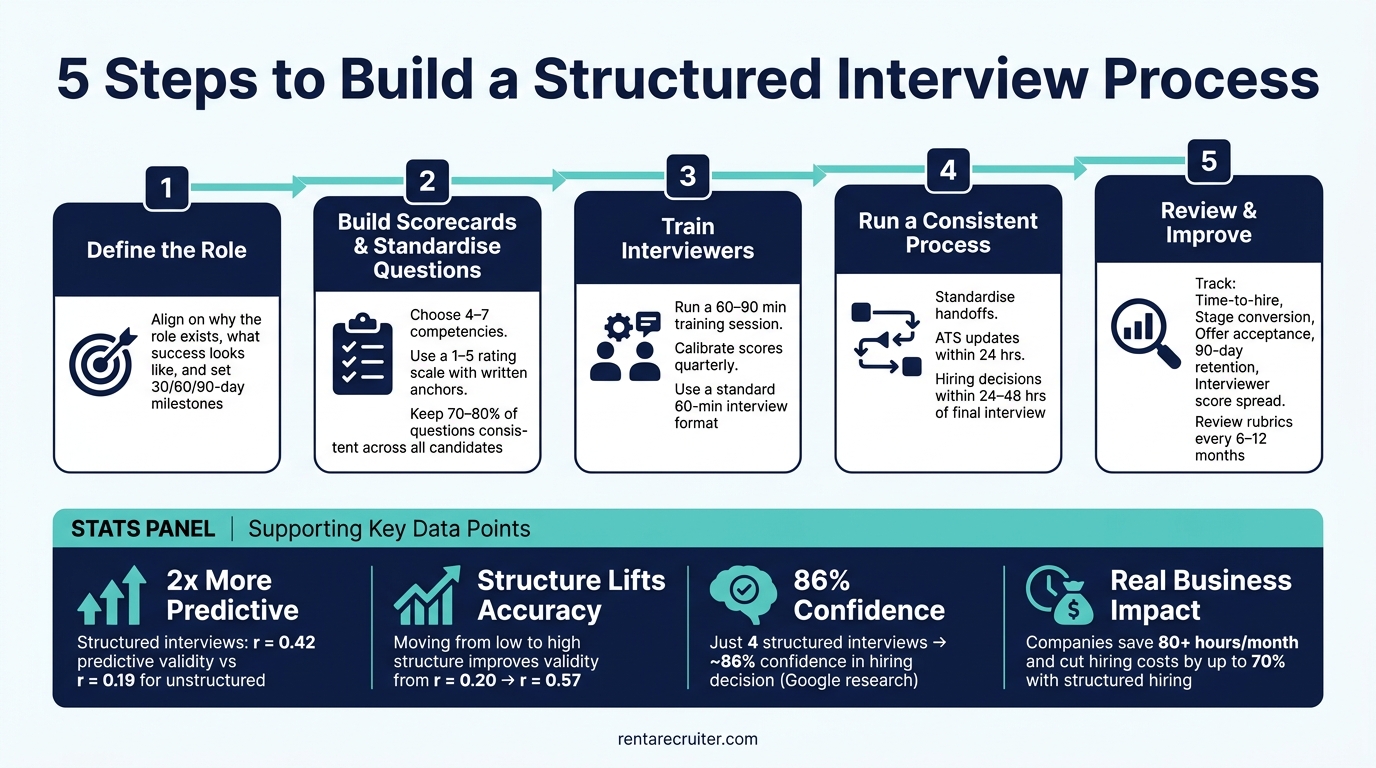
I’d fix that with a simple five-step system: define the role, choose 4 to 7 job-related skills, build scorecards, standardise questions, train interviewers, then review the data. The payoff is clear. Structured interviews are about twice as predictive of job performance as unstructured ones, with research cited in the article showing r = 0.42 versus r = 0.19. For scaling teams, that means better hiring calls, less wasted time, and lower cost from hiring mistakes.
Here’s the short version:
- Set the role clearly so every interviewer tests for the same outcomes
- Limit scoring to 4 to 7 skills linked to success in the job
- Use one scorecard and one core question set for each stage
- Train and calibrate interviewers so scores mean the same thing across the panel
- Track results like time-to-hire, stage conversion, offer acceptance, 90-day retention, and score spread
If you need extra hiring capacity while you put that in place, Rent a Recruiter can support your team with a structured hiring process built for scale.
5-Step Structured Interview Process for Better Hiring
What is Structured Interviewing?
sbb-itb-a23bd6a
Step 1: Define the Role and the 4 to 7 Competencies That Predict Success
Before you book interviews, run a role intake. The goal is simple: get clear agreement on why the role exists, what success looks like, and which competencies matter most. If that alignment is missing, interviews drift, feedback gets messy, and hiring decisions get weaker.
Turn business needs into a clear role profile
Start with the business goal, then work down into the role.
If your SaaS company needs to add $3,000,000 in ARR over the next 12 months, the role should tie straight back to that target. An Account Executive, for example, might own a $750,000 quota and run full-cycle deals.
A strong role profile should set out:
- Core responsibilities
- First-year outcomes
- Team context
- Must-have skills and behaviours
Many teams also include 30/60/90-day milestones so ramp expectations are clear from day one. That level of detail gives interviewers something concrete to test for, and it makes scoring far more consistent because answers are judged against actual ramp expectations.[3]
Once the profile is written, store it in your ATS or internal hiring wiki so the whole hiring team works from the same source of truth.[4] Then use that profile to build the scorecard in the next step.
Choose competencies that match your growth stage
Pick 4 to 7 competencies that predict success in the role.[5] Go past that, and focus starts to slip. Interviewers end up covering too much, scoring becomes fuzzy, and comparison across candidates gets harder.
The U.S. Office of Personnel Management recommends identifying which competencies are best assessed by interview after completing job analysis.[4]
A useful way to structure this is across five dimensions:
- Technical skill
- Behavioral skill
- Stakeholder management
- Execution
- Adaptability
The mix should change with your growth stage.
Early-stage startups, like Seed and Series A companies, often put more weight on adaptability and broad problem solving. Roles move fast, scope changes, and processes are still being built. Series B to D companies often lean more toward stakeholder management and scalable execution. At that stage, you usually need people who can build structure and work across teams, not just figure things out on the fly.[5][6]
Each competency should be observable, scoreable, and tied to a business outcome. It should also be distinct and non-overlapping. If two competencies sound almost the same, your interview team will struggle to score them cleanly. And each one should map to a question you can ask every candidate. That gives you a scorecard that is tighter, fairer, and much easier to use at scale.
Step 2: Build Scorecards and Standardize Questions for Each Interview Stage
Now turn those competencies into a scorecard and a standard set of questions. Each competency should have a written scoring measure and one or two core questions.
Create a scorecard with clear rating anchors
A good scorecard should include the role, interview stage, interviewer, competencies, a 1 to 5 scale, and space for evidence notes. Write out what each rating means. For example, a 3 might mean the person meets the bar with some guidance, while a 5 shows strong independent performance backed by clear, measurable examples. When every interviewer scores against the same written standard, debriefs move faster and feedback gets more useful.
Use one scorecard for each stage, tied to the competencies that stage is meant to test. A recruiter screen may focus on motivation, communication, and logistics. A hiring manager interview may look at execution, ownership, and stakeholder management. A technical panel should test role-specific hard skills. Clear boundaries cut overlap and make it easier for you to compare candidates across the full process.
Notes should record facts, examples, metrics, decisions, and outcomes, not gut feel. Strong notes show the problem, the action, and the result. For example:
Reduced onboarding time from 14 days to 9 days by redesigning the checklist and aligning sales, customer success, and ops on handoff steps.
That kind of evidence gives your team something concrete to discuss. It also lowers the risk of vague feedback slowing down decisions.
Use the same core questions for every candidate
Once your scorecard is in place, map two to four questions to each competency. Ask only questions that give you job-related evidence.
Keep 70% to 80% of each interview the same across candidates. Use the rest for role-specific follow-up. This makes comparison cleaner, cuts the effect of interviewer style, and helps make sure no candidate gets an easier or harder interview just because of who was in the room.[7][8]
The mix of question types matters as well. Behavioral questions are usually best for checking past experience. Situational questions help when someone has less direct background, or when you want to test judgment. Technical questions only make sense when the role calls for them. Structured interviews built this way show predictive validity of about r = 0.42 to 0.51 for job performance, compared with r = 0.19 to 0.38 for unstructured interviews. That gap matters when the cost of a bad hire is high.[9][2][1]
Interview question types by use case: comparison table
Match the question type to the evidence you need.
| Question Type | Best Used For | Strengths | Trade-offs |
|---|---|---|---|
| Behavioral | Validating past performance and real experience | Produces concrete examples; high predictive validity | Can disadvantage candidates with nontraditional backgrounds if probing is weak |
| Situational | Assessing judgment and decision-making under realistic conditions | Applies consistently; useful when direct experience is limited | Measures hypothetical thinking, not proven behavior |
| Technical | Roles requiring specific hard skills, such as coding, financial modeling, or system design | Tests job-critical capability directly | Can become too narrow if focused on trivia rather than practical performance |
For most roles, use behavioral questions for core competencies, situational questions for judgment, and technical tasks only where the role calls for them.
With the scorecard and question set in place, the next step is training interviewers to use them the same way every time.
Step 3: Train Interviewers, Run a Consistent Process, and Calibrate Scores
Once your scorecard and question set are in place, the next risk is simple: people use them differently. Even a strong interview design can fall apart in practice. That’s where most structured interview systems fail, not at setup, but in day-to-day use.
Train hiring managers to score based on evidence
Train interviewers in 60 to 90 minutes. That short session does a lot of heavy lifting. It gets everyone scoring from the same standard instead of personal instinct.
Walk interviewers through the scorecard line by line. Show what meets, exceeds, and below expectations look like for each competency. Use two or three clear behavioral examples for each level. Then run a short role-play. One person plays the candidate, another the interviewer, and the group scores the same answer on their own before comparing results. That’s where calibration starts to do its job, it closes the scoring gaps.
Teach a simple probing model:
- What was the situation?
- What did the candidate do?
- What was the result?
Managers should also practise turning vague answers into specific ones. If a candidate speaks in general terms, the interviewer needs to dig for facts. Notes should be short and factual. Vague notes don’t support scoring. Only job-related evidence should be recorded. Exclude comments about protected characteristics or any other non-job-related traits.[12][16]
Training helps, but it won’t hold if the interview flow changes from one interviewer to the next.
Set a standard interview flow and handoff process
Use the same 60-minute interview format for every candidate. A common structure is:
- 5 minutes for introductions and a short role overview
- 40 to 45 minutes for the core structured questions
- 5 to 10 minutes for candidate questions
- 2 to 5 minutes to close and confirm next steps
Tell candidates up front that the format is standardised. That makes comparisons cleaner and debriefs easier.[17][18]
Handoffs between recruiters and hiring managers need the same level of clarity. Recruiters should handle scheduling, ATS updates within 24 hours, and scorecard sharing before debriefs. Hiring managers should confirm the panel before the role opens and make a decision within 24 to 48 hours after the final interview. A plain rule like feedback submitted by 5:00 p.m. local time on the next business day removes grey areas and keeps hiring moving, especially across teams working in different U.S. time zones.[17][18][19]
One-time training vs. quarterly calibration: comparison table
Training gets the process started. Calibration keeps it on track as hiring volume grows. Research shows that moving interview structure from very low to very high can improve predictive validity from about r = 0.20 to r = 0.57. But that lift only holds when teams apply the process the same way every time.[15]
Without calibration, managers slowly start using their own version of meets expectations. Once that happens, the scorecard stops giving you a clean read.
| Initial Interviewer Training | Quarterly Calibration Sessions | |
|---|---|---|
| Time investment | 60 to 120 minutes per interviewer, up front | 45 to 60 minutes per session, recurring |
| Consistency impact | Moves teams from highly subjective to moderately consistent | Keeps ratings aligned as team size and hiring volume grow |
| Best for | New interviewers joining a panel | Active panels with 3+ interviewers scoring often |
| Risk if skipped | Interviewers fall back on gut feel from day one | Score drift, rating standards drift by interviewer |
| Fast-scaling teams | Needed, but not enough on its own | High impact, especially when scheduled by function, such as sales and engineering |
For new interviewers, calibrate after every three evaluations in the first 30 days. For experienced interviewers, quarterly recalibration is the standard.[10] A typical calibration session reviews three to five recent candidates across a mix of outcomes. Each participant scores on their own before the group meets. Then the team works through rating gaps of two or more points per competency, always tying the discussion back to the written rubric. End each session with scorecard changes and clear owners for follow-through.[11][13][14]
Use calibration data to spot score drift early, before it starts shaping hiring decisions in the wrong way.
Steps 4 and 5: Review Results, Improve the Process, and Scale What Works
Track a small set of hiring metrics that show business impact
Use the scorecard and calibration data from Step 3 to check whether your interview process is holding up in live hiring.
Focus on a small set of metrics that link hiring activity to business results:
- Time-to-hire
- Stage conversion
- Offer acceptance
- 90-day retention
- Interviewer score spread
Report these monthly in one scorecard view. That gives you a clean read on what’s working, where friction is building, and whether the process is staying consistent. You keep hiring visible without turning recruitment into a reporting exercise.
When those numbers start moving the wrong way, the root cause is often simple. A weak interview question. A loose rubric. Scorer drift between interviewers.
Fix weak questions, unclear rubrics, and uneven interviewer behavior
After a few months of live hiring, the patterns start to show up in debrief notes and score data.
Questions that keep producing clustered mid-range scores usually aren’t doing their job. They’re not separating strong candidates from weak ones, so they should be removed.
Interviewer scoring patterns matter too. If one interviewer scores far higher or lower than the rest, that needs attention fast. A calibration session or one-to-one coaching can stop that gap from shaping hiring decisions.
Rubric wording is another common issue. If a rating level can’t be scored the same way by different interviewers, tighten it. Define observable behaviours, what the candidate actually said or did, so scores are based on evidence rather than gut feel.
Review rubric wording every six to 12 months. If some rating levels are barely used, or used inconsistently, update them before the inconsistency spreads into later hiring rounds.
Once the process is producing steady results, use the same structure across each new role. That’s where you start saving time, cutting rework, and getting more consistency across the business.
Conclusion: Build a repeatable system and take the next step
A structured interview process only works when all five parts work together: a clear role profile, a well-built scorecard, standardised questions, trained interviewers, and a regular review cycle.
Miss one, and the rest start to drift.
Google’s internal research found that four structured interviews are enough to predict hiring decisions with roughly 86% confidence[20]. That only holds when the process is applied the same way every time. The review cycle is what keeps that standard in place.
If your team needs support running this process, Rent a Recruiter can embed recruiters directly into your hiring team. Companies typically cut hiring costs by up to 70% compared with commission-based recruitment models and save over 80 hours per month in internal hiring and admin time.
If you want this built into your hiring process, Rent a Recruiter can help.
FAQs
How do I choose the right competencies?
Start with a job analysis built around what the role needs to deliver in the first six months. That keeps the brief tied to business output, not guesswork. Work with hiring managers and top performers to pin down the skills and behaviours that show up in strong performance.
Then choose four to six observable, role-specific competencies. Skip vague ideas like culture fit, they don’t give you a clear hiring standard and they make decisions harder to defend. Instead, focus on what you can actually assess.
Force-rank those competencies and assign weights to each one, so the skills that matter most have the biggest impact on the final decision. This gives you a clearer scoring model, saves time in interview debriefs, and helps your team stay aligned when hiring volume starts to grow.
What if interviewers score candidates differently?
Different scores usually mean your team needs better calibration and clearer behavioral anchors.
Ask each interviewer to submit their scorecard on their own, before any group discussion starts. That scorecard should include both the score and specific observable evidence. Not gut feel. Not vague comments. Just what the interviewer saw or heard.
In the debrief, focus first on the competencies with the largest scoring gaps. That’s usually where inconsistency is costing you time and slowing decisions.
If the gaps keep showing up, run calibration sessions with a mock interview. It’s a simple way to line people up on the rating scale and the performance criteria, so you get cleaner hiring decisions and less back-and-forth in panel reviews.
How long does it take to build a structured process?
Building a structured interview process doesn’t mean ripping everything up and starting again. In most cases, it’s a manageable investment.
You can expect to spend 4 to 6 hours per role to define competencies and build reusable scorecards. That’s a small input if it helps you cut wasted interview time, improve hiring decisions, and give managers a clearer way to assess talent.
A 6-week pilot across one or two job families is often enough to collect data, prove the case, and get internal buy-in. It gives you a low-risk way to test the process before rolling it out more broadly.
If you need support, Rent a Recruiter can help with implementation, training, and end-to-end process management.